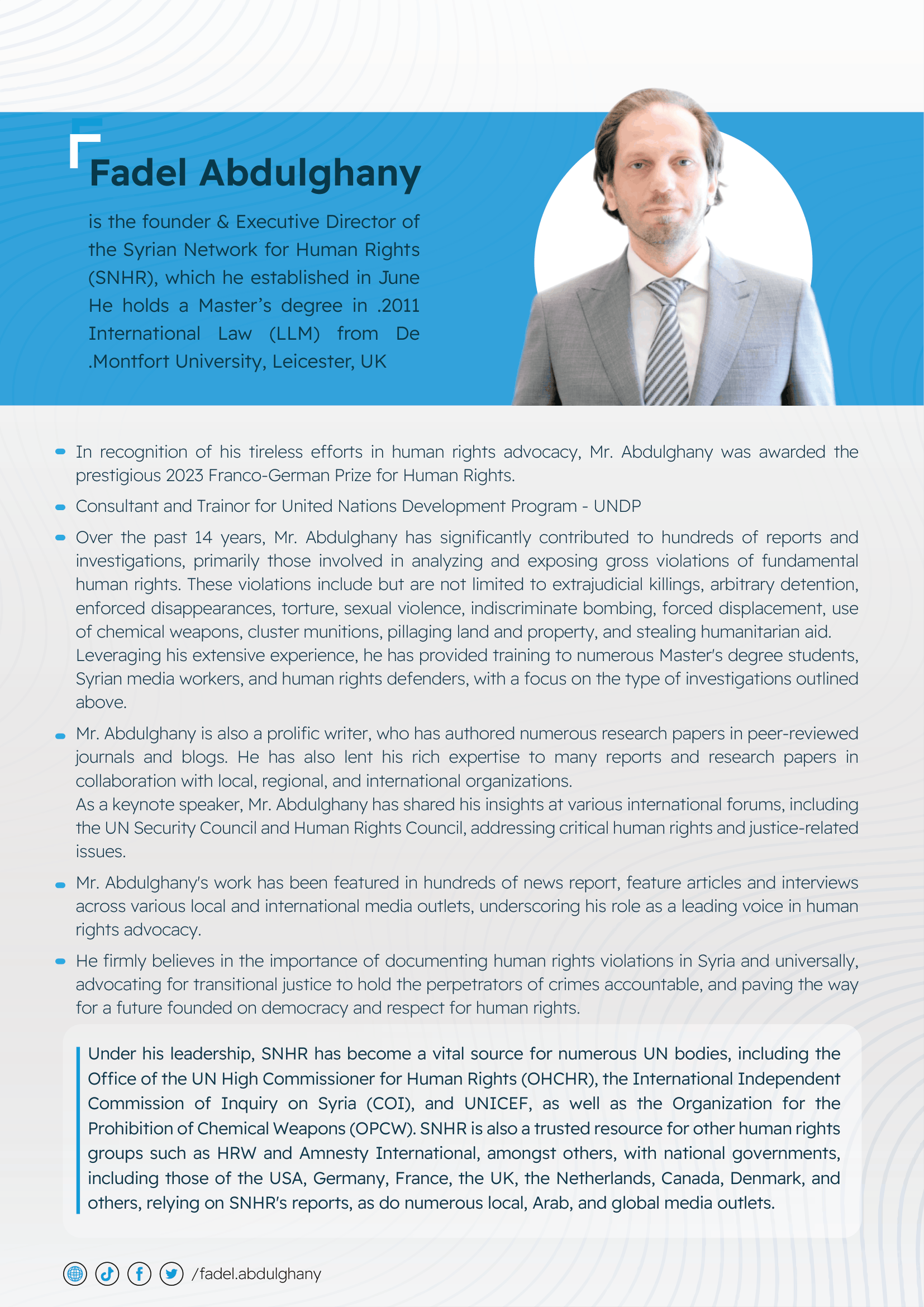
Fadel Abdulghany is the Executive Director of the Syrian Network for Human Rights (SNHR), which he founded in June 2011. He holds a master’s degree in international law from De Montfort University in Leicester, UK. He is a doctoral researcher in the United Kingdom specializing in International Criminal Law and Transitional Justice.
Abdulghany serves as a consultant and trainer for the United Nations Development Programme (UNDP), providing expertise in international law, governance, documentation standards, human rights reporting, and advocacy strategies. In 2023, he was awarded the Franco-German Prize for Human Rights and the Rule of Law in recognition of his continued contributions to human rights advocacy.
Over the past fifteen years, Abdulghany has contributed to hundreds of reports and investigations documenting and analyzing gross human rights violations. These include extrajudicial killings, arbitrary detention, enforced disappearance, torture, sexual violence, indiscriminate attacks, forced displacement, the use of chemical weapons and cluster munitions, looting, violations of housing and property rights, and the diversion of humanitarian aid. He has also trained graduate students, Syrian media professionals, and human rights defenders on rigorous investigation methodologies and evidence-based reporting.
Abdulghany has authored two books: The Assad Regime’s Use of Chemical Weapons and the Failure of the International Community and Undermining Judicial Independence and Paths to Reform. Additionally, he has co-authored chapters in collective academic works, most notably Transition Pathways: Insights into Justice and Reconciliation.
Abdulghany has published numerous peer-reviewed materials and writes regularly for leading Arabic platforms. He has also co-authored joint reports with local, regional, and international organizations. Abdulghany has delivered statements at international forums, including the United Nations Security Council and the United Nations Human Rights Council, and his work is extensively cited by international media. Under his leadership, the Syrian Network for Human Rights has become a primary reference for several UN entities, including the Office of the United Nations High Commissioner for Human Rights (OHCHR), the UN Independent International Commission of Inquiry on the Syrian Arab Republic (UNCoI), UNICEF, and the Organisation for the Prohibition of Chemical Weapons (OPCW), as well as for leading human rights organizations and various governments.


