


Available in:
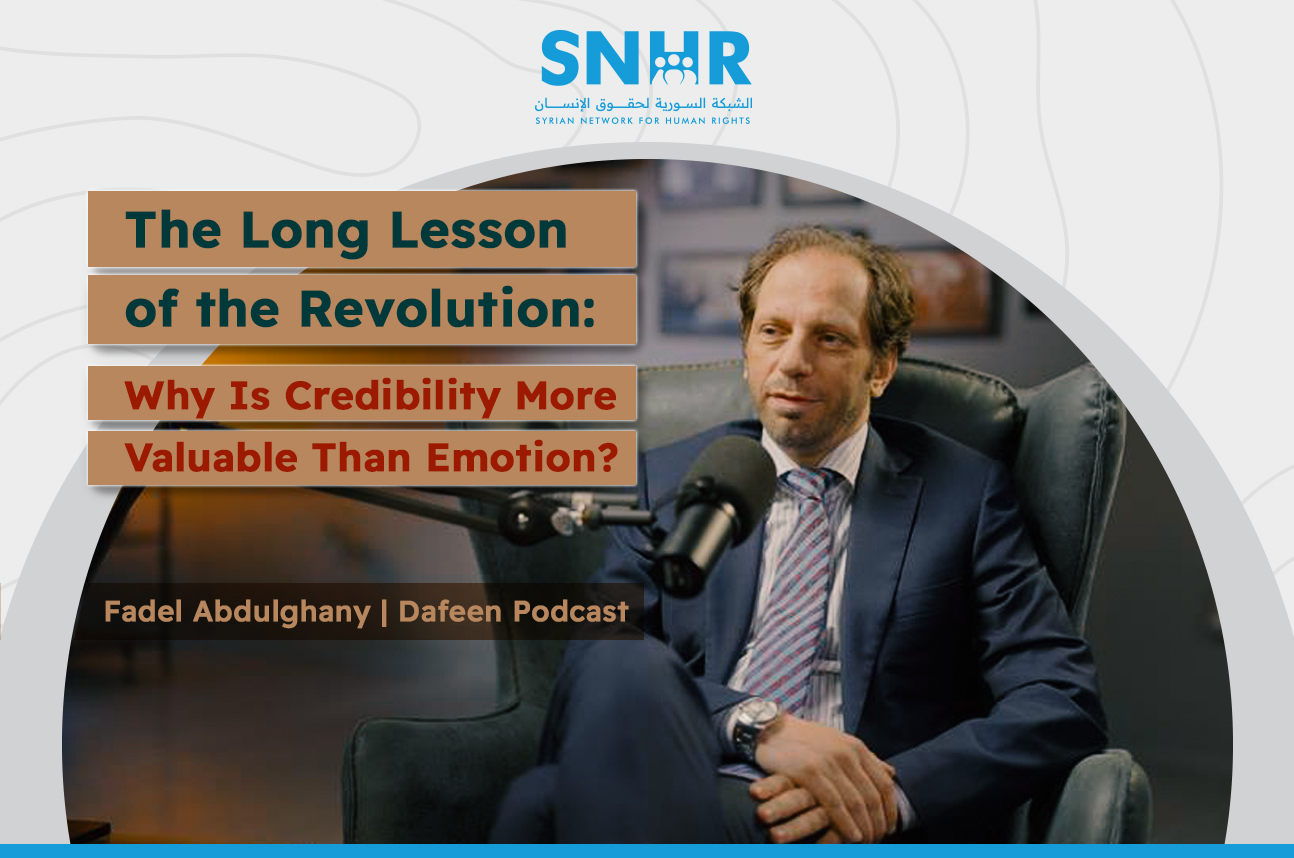
Damascus, Syria – In an extensive interview on Syria TV’s “Dafeen” podcast, Fadel Abdulghany, director and founder of the Syrian Network for Human Rights, outlined the personal and professional path that led him to establish one of the most prominent and internationally recognized Syrian human rights organizations.
During the interview, Abdulghany explained that the Syrian revolution of 2011 was the “watershed moment” that changed the course of his life. He left Syria in 2006, carrying with him the “Syrian concern,” shaped by his experience as a son of Hama, a city that inherited a deep wound from the 1982 massacre, in addition to his undisclosed intellectual and political activity with his friends before the revolution.
The Network Was Born Out of Necessity
Abdulghany revealed that the idea of establishing the Syrian Network for Human Rights was not a goal in itself, but rather a result of a “glaring vacuum” in human rights documentation at the beginning of the revolution. He noted that in the first months, most opposition figures were preoccupied with political activity, anticipating the regime’s rapid fall.
After repeated attempts to provide existing organizations with data on detainees, to no avail, Abdulghany decided to establish an organization to fill this gap, relying on an organizational structure and working methodology from the outset.
Methodology and Credibility: The Secret to International Recognition
Mr. Abdulghany emphasized that the secret to the widespread acceptance of the Syrian Network for Human Rights’ reports by the United Nations, the International Commission of Inquiry, and the foreign ministries of major countries such as the United States, Britain, and Germany lies in its adherence to international standards, objectivity, and legal methodology.
He said, “I decided to separate revolutionary and human rights work to avoid a conflict of interest. Our work is legal, which requires accuracy and avoiding exaggerations that have often harmed the credibility of the revolution.” He added that the network has modeled its work on established international organizations such as Human Rights Watch, which has earned it the trust of international bodies that rely on it as a primary and reliable source of information on violations in Syria.
The Motto “No Justice Without Accountability”
Abdulghany concluded his remarks by emphasizing that the network’s motto, “No Justice Without Accountability,” is its working principle and vision for the future. He explained that all the network’s meticulous documentation efforts ultimately aim to build paths for accountability and transitional justice, which go beyond trials but also include acknowledging the suffering of victims and redressing their harm, thus laying the foundation for lasting stability in Syria.
