


Available in:
Damascus – The Syrian Network for Human Rights
On the International Day in Support of Victims of Torture, which falls on June 26, the Syrian Network for Human Rights renews its call for the adoption of a comprehensive approach to addressing the legacy of torture in Syria, an approach built on truth-seeking, accountability, reparation, institutional reform, and guarantees of non-recurrence, and on activating the tools of transitional justice in a systematic manner that ensures violations don’t remain without effective redress, and that puts an end to the state of impunity that accompanied the years of the conflict. This call rests on continuous documentation and analytical work ongoing since March 2011. The Network’s database and its analysis of detention patterns indicate that torture, enforced disappearance, and death in detention constituted a systematic, wide-scale pattern tied to the structure of the detention apparatus throughout the years of the conflict, and were not isolated individual violations.
The Context of Torture within the Detention System
Years of documentation have revealed that torture in Syria was tied to an institutional pattern whose effects extended across the branches of the security agencies and their affiliated centers, and reached official and unofficial detention sites alike. The documented patterns included severe beating, electric shocks, suspension in painful positions, the deprivation of sleep, food, and medical care, prolonged isolation, sexual violence, and humiliation, in addition to harsh detention conditions that in themselves lead to death. This pattern extended, to varying degrees, to detention centers belonging to other parties to the conflict, in accordance with what is documented in the Network’s database.
In most of the documented cases, torture was tied to the phenomenon of enforced disappearance, as the detainee is denied communication with their relatives, access to a lawyer, and any form of judicial oversight for extended periods, which opens the way for the continuation of the violation and the obstruction of avenues of redress. This connected chain (arbitrary arrest, enforced disappearance, torture, death in detention) constitutes an integrated pattern that requires an integrated, rather than fragmented, legal response.
The Documented Toll
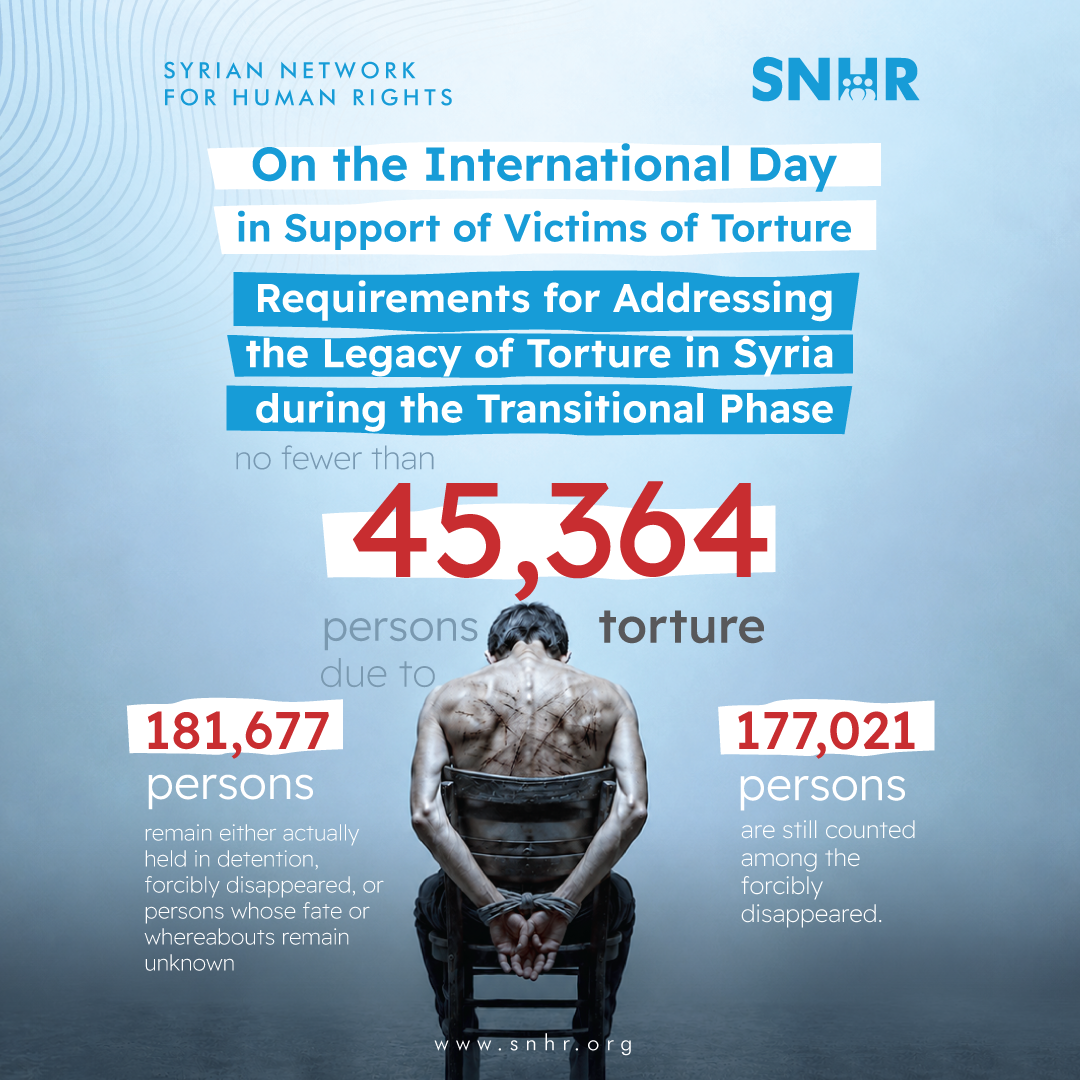
According to the database of the Syrian Network for Human Rights, no fewer than 181,677 persons, among them 5,352 children and 9,213 women, remain either actually held in detention, forcibly disappeared, or persons whose fate or whereabouts are still unknown at the hands of the parties to the conflict in Syria from March 2011 through June 2026. Among these, no fewer than 177,021 persons, among them 4,536 children and 8,984 women, are still counted among the forcibly disappeared.
The Network has documented the killing of no fewer than 45,364 persons due to torture or harsh or inhuman detention conditions during the same period, among them 231 children and 116 women. The data indicate that 45,038 victims perished inside the detention centers of the former Syrian regime, a proportion reaching nearly 99%, while 326 cases were distributed among the remaining parties to the conflict according to the classification adopted in the Network’s database.
The tolls set out in this statement rest on the database of the Syrian Network for Human Rights, and include the cases for which sufficient identifying data were available and which were verified through multiple sources or supporting evidence. These tolls don’t include the cases that are still under verification, and therefore they represent a documented minimum, not the full actual number. In gathering and analyzing information, the Network adheres to the principles of do no harm, free and informed consent, the protection of the identity of witnesses, survivors, and victims’ relatives, and the confidentiality of sensitive data. The developments subsequent to December 8, 2024, and the fall of the Assad regime, have made it possible to access official documents and detention centers that had been beyond reach, which contributed to updating an essential portion of the data and to reclassifying cases that had been recorded as enforced disappearance into deaths in detention.
The Legal Framework
Acts of torture, cruel, inhuman, or degrading treatment, death in detention, and enforced disappearance constitute grave violations of the Syrian State’s obligations under international human rights law, in particular the Convention against Torture, which Syria acceded to on August 19, 2004, and which entered into force for it on September 18, 2004, and the International Covenant on Civil and Political Rights, which Syria acceded to on April 21, 1969, and which entered into force for it on March 23, 1976.
Although Syria is not a party to the International Convention for the Protection of All Persons from Enforced Disappearance, the acts constituting enforced disappearance touch upon rights protected under existing treaty obligations, in particular the right to life, the right to liberty and personal security, the prohibition of torture and ill-treatment, the right to recognition as a person before the law, and the right to an effective remedy.
The documented patterns, where the elements of a widespread or systematic attack directed against a civilian population and knowledge thereof are present, point to the possible applicability of the characterization of crimes against humanity, including torture and enforced disappearance, without prejudice to the necessity of establishing the individual criminal responsibility of each suspect separately. Some acts may, depending on the specific facts of each case, constitute war crimes whenever a sufficient nexus to the armed conflict is present.
The international obligations of the Syrian State, including the duty to investigate allegations of torture whenever there are reasonable grounds to believe that an act of torture has been committed, pursuant to Article 12 of the Convention against Torture, remain in place and continuing, in accordance with the principle of the continuity of the international legal personality of the State, regardless of the change in government.
The National Institutional Framework
On May 17, 2025, two decrees were issued providing for the formation of the Transitional Justice Commission and the National Commission for the Missing, with the aim of addressing grave human rights violations and uncovering the fate of the missing and the forcibly disappeared. The formation of the two commissions represents an institutional development in the approach to the files of arbitrary detention, enforced disappearance, and the violations associated with them.
However, the Network draws attention to the importance of ensuring that the scope of mandate of any national body does not lead to the exclusion of the victims of violations committed by parties other than the Assad regime, even though it is the largest perpetrator of violations in Syria. Transitional justice, as a victim-centered approach, does not hold up if its application is confined to one category of those responsible to the exclusion of another, nor if the suffering of a segment of victims is overlooked because of the party responsible for the violation.
In May 2026, the Syrian government launched the process of preparing the comprehensive National Strategy to Combat and Prevent Torture, through a series of workshops held by the Ministry of Foreign Affairs and Expatriates, with the aim of building a national framework consistent with Syria’s obligations under the Convention against Torture. The Network is taking part in this process by attending the consultation sessions and providing technical and legal observations grounded in its accumulated expertise in documenting patterns of torture. The Network is of the view that the value of this strategy depends on transforming it from a policy document into a binding, enforceable framework that includes independent oversight mechanisms, clear performance indicators, a defined timetable, an allocation of resources, and an effective complaints mechanism within reach of victims and survivors.
The Track Before the International Court of Justice
On June 8, 2023, both Canada and the Netherlands submitted a joint application against the Syrian Arab Republic before the International Court of Justice on the basis of the Convention against Torture. On November 16, 2023, the Court issued an order of binding provisional measures, by which it requested Syria to take effective measures to prevent acts of torture and other forms of cruel, inhuman, or degrading treatment or punishment, to ensure that such acts are not committed by any of its officials or by the entities subject to its control, and to preserve the evidence relating to the allegations covered by the Convention.
This track remains under consideration before the Court, which renders the obligations of the Syrian State under the Convention, and the obligations arising from the order of provisional measures, in place and continuing. The Network affirms that the State’s handling of this track and its compliance with the Court’s orders are part of its international legal responsibilities, and that this track does not replace national transitional justice but rather complements it.
Recommendations
To the Syrian Government:
- Full compliance with the order of provisional measures issued by the International Court of Justice, including the prevention of torture and ill-treatment, ensuring that such acts are not committed by any of its officials or by the entities subject to its control, and preserving the evidence connected to the allegations.
- Enabling the national bodies to access official documents, the records of detention centers, and current and former places of detention, both official and unofficial, and ensuring the preservation of these sites and the chain of custody of evidence within them.
- Reviewing and repealing the legislations that facilitated arbitrary detention and unfair trials, or provided an environment for escaping effective judicial oversight, foremost among them the Counterterrorism Law and the decree establishing the Counterterrorism Court, and harmonizing the Penal Code with the definition of torture set out in Article 1 of the Convention against Torture.
- Ensuring that grave international crimes (torture, enforced disappearance, crimes against humanity, war crimes) are not covered by any general amnesty measures or settlement arrangements, in accordance with what is settled in international law and the United Nations principles relating to combating impunity.
- Considering accession to the International Convention for the Protection of All Persons from Enforced Disappearance and to the Optional Protocol to the Convention against Torture, and working to establish an independent national preventive mechanism upon acceding to the Optional Protocol.
- Ensuring that the National Strategy to Combat Torture is a binding, enforceable framework, with implementation and independent oversight mechanisms, clear performance indicators, an effective complaints mechanism, and the institutional integration of civil society organizations and victims’ associations in the stages of its preparation, implementation, and evaluation.
- Subjecting all places of detention to effective judicial and independent oversight, and ensuring respect for the fundamental safeguards against torture from the moment of deprivation of liberty, including the detainee’s right to inform their relatives, access to a lawyer, an independent medical examination, and prompt appearance before a judge.
To the United Nations and Member States:
- Continuing to support the Independent International Commission of Inquiry on Syria, the International, Impartial and Independent Mechanism, and the Independent Institution on Missing Persons in the Syrian Arab Republic, and providing them with sufficient human and financial resources to ensure the continuity of their work.
- Providing technical support to the new Syrian institutional frameworks, in a manner that ensures their consistency with the relevant United Nations principles concerning truth commissions and national bodies on missing persons, while respecting the national ownership of the process.
- Encouraging the Syrian State to accept the visits of the special procedures of the Human Rights Council, in particular the Special Rapporteur on Torture, the Working Group on Enforced or Involuntary Disappearances, and the Working Group on Arbitrary Detention.
To Civil Society Organizations and Victims’ Associations:
- Ensuring the integration of the perspective of victims and survivors at all stages of transitional justice, in a manner that ensures the pathways are built on actual representation and substantive participation, not on formal consultation.
- Developing documentation capacities consistent with international standards, in a manner that subsequently serves the pathways of national and international judicial accountability, taking into account the requirements of the chain of custody of evidence and its admissibility before the judicial bodies.
