


A Number of Violations, Including Torture and Violations of Human Dignity and Religious Symbols, Took Place in a Security Crackdown in Homs Governorate
Available In
The Hague – The Syrian Network for Human Rights (SNHR) today released a statement urging the transitional government to bolster its measures for protecting civilians during security operations in light of the complex challenges confronted by Syria. The group added that a number of violations were documented in the course of a security crackdown in Homs governorate, including torture and violations of human dignity and religious symbols.
The statement explains that, on January 21, 2025, the General Security Forces, in coordination with the Syrian transitional government’s Military Operations Command, carried out a security campaign targeting individuals formerly affiliated with Assad regime forces and pro-Assad militias, who were accused of committing human rights violations. The campaign, which took place in several towns in Homs governorate, was part of the government’s efforts to pursue individuals who refused to participate in the reconciliation processes announced by the transitional authorities following the fall of Bashar al-Assad’s regime on December 8, 2024, which included surrendering weapons.
The security campaign extended to several towns in northern rural Homs, such as Kafrnan, Jabbourin, Tasnin, Raf’in, al-Hisa, and al-Ghor al-Gharbi, in addition to other areas in northwestern rural Homs, including Balqasa, Tarin, Kherbat al-Hamam, Al-Za’frana, al-Sindiyana, Maryamin, Fahel, and a number of other villages. During the operations, most of these areas witnessed clashes between wanted armed individuals and the ‘General Security Forces’, resulting in the killing and detention of several armed individuals, as well as injuries among security forces.
The statement adds that SNHR has been able, through its teams on the ground, to document several violations in the course of this security crackdown that took place in some towns in rural Homs. These included acts of property destruction, torture, physical and verbal abuse, and threats and intimidation against civilians. Additionally, there were assaults on religious artefacts belonging to members of the Murshidi and Alawite sects.
In the course of its documentation efforts, the statement notes, SNHR is still investigating numerous reports received regarding these violations; however, our teams face significant challenges in documentation due to the complex security situation that hinders access to certain areas. Furthermore, organized widespread media misinformation campaigns on social media platforms, ranging from outright denial of violations to extreme exaggeration, further fuel sectarian tensions and complicate documentation efforts. This ultimately has a negative impact on the rights of victims and the accountability of those responsible for these violations.
As the statement further reveals, these developments are taking place within the broader campaign by the transitional authorities to enhance security and disarm non-state actors in rural Homs. While this campaign is crucial for restoring order and stability, its implementation must align with international legal standards on human rights. These standards require the issuance of judicial warrants through the public prosecution service, and the absolute prohibition of torture and of any humiliation of human dignity and religious beliefs, and must adhere to international treaties and conventions, including the Universal Declaration of Human Rights (1948), the International Covenant on Civil and Political Rights, the UN Basic Principles on the Use of Force and Detention (1990), and the Convention Against Torture and Other Cruel, Inhuman or Degrading Treatment or Punishment (1984). Adhering to these principles is essential to ensuring the success and legitimacy of the security campaign and fostering trust between the transitional authorities and local communities.
According to the statement the most prominent areas that saw violations in the course of this security crackdown in rural Homs are:
Maryamin town
On Thursday, January 23, 2025, the ‘General Security Administration, in coordination with the Military Operations Command, expanded its security and military campaign into Maryamin town in northwestern rural Homs. The operation involved storming the town, followed by carrying out raids on dozens of homes in search of wanted individuals.
SNHR documented multiple violations during the campaign, including property destruction and the beating and torture of civilians, including elderly individuals, using electric cables. SNHR has obtained photographs documenting these violations. Additionally, SNHR recorded heavy gunfire inside the town, which caused panic among local residents, and the tearing down of posters depicting certain Murshidi religious figures inside homes.
SNHR also documented the detention of at least 31 individuals from Maryamin town during the security campaign, all of whom were released in a gradual fashion by January 30, 2025.
According to information obtained by SNHR from local activists and eyewitnesses, a military group affiliated with Syrian National Army (SNA) factions, currently operating under the Military Operations Command, entered the town after the official security operation had ended. This group, carrying lists of wanted individuals, committed additional violations. Later, reports indicated that the General Security detained several members involved in perpetrating these violations after the operation had concluded.
The statement further reveals that these violations led to protests in several surrounding villages, including al-Suwairi, Aouj, Kafr Kamra, and Qasraya, with residents demonstrating also in Maryamin town. In response, an official delegation from the transitional authorities visited the town. The delegation included the governor of Homs, the police chief, and the provincial relations officer, along with representatives of the Military Operations Command. Subsequently, the media office in Homs governorate issued a statement via the Syrian Arab News Agency (SANA), asserting that the group responsible for the violations in Maryamin was “a criminal group impersonating security personnel.”
Fahel town
On Thursday, January 23, 2025, The General Security Forces, in cooperation with units from the Military Operations Directorate, carried out a large-scale security campaign in the town of Fahel and its surroundings in the western Homs suburbs. The campaign aimed to pursue militants believed to be former members of Bashar al-Assad’s regime forces and the National Defense Militia who failed to participate in the settlement agreements or surrender their weapons.
After encircling the town and closing its entrances, the campaign forces began firing heavy gunfire into the air minutes after entering the village. This was followed by extensive raids and searches across various neighborhoods, accompanied by verbal and physical abuse, sectarian rhetoric, and looting and theft of homes belonging to citizens who had fled since the fall of the former regime in December 2024.
The Syrian Network for Human Rights obtained information indicating that forces had arrested a number of residents of the town, including civilians and former military personnel who had previously been subjected to settlement agreements. Local testimonies confirmed that some of the detainees were informed that their interrogations would be routine, but their families were later surprised to discover that a number of them had been killed.
The next day, Friday, January 24, the bodies of three detainees were found in a nearby village, while the bodies of 12 others were handed over to village elders after mediation with authorities in Homs. This brought the total number of victims to 15, including former and retired officers from the Assad regime’s forces, most of whom were among the detainees taken during the campaign. The Military Operations Directorate retrieved the bodies of the dead from the mountainous areas, and after verifying their identities, some were handed over to the Civil Defense and village elders for burial.
SNHR obtained photographs, medical reports, and testimonies from medical sources in Homs, confirming that 12 of the 15 documented bodies had been shot in the head at close range, with several also bearing stab wounds. This suggests that the victims were subjected to extrajudicial executions after being detained, a grave violation of international human rights law.
In addition, SNHR documented the detention of seven residents of the village by the General Security Forces during the security campaign, who were released on January 30, 2025.
Majidel village
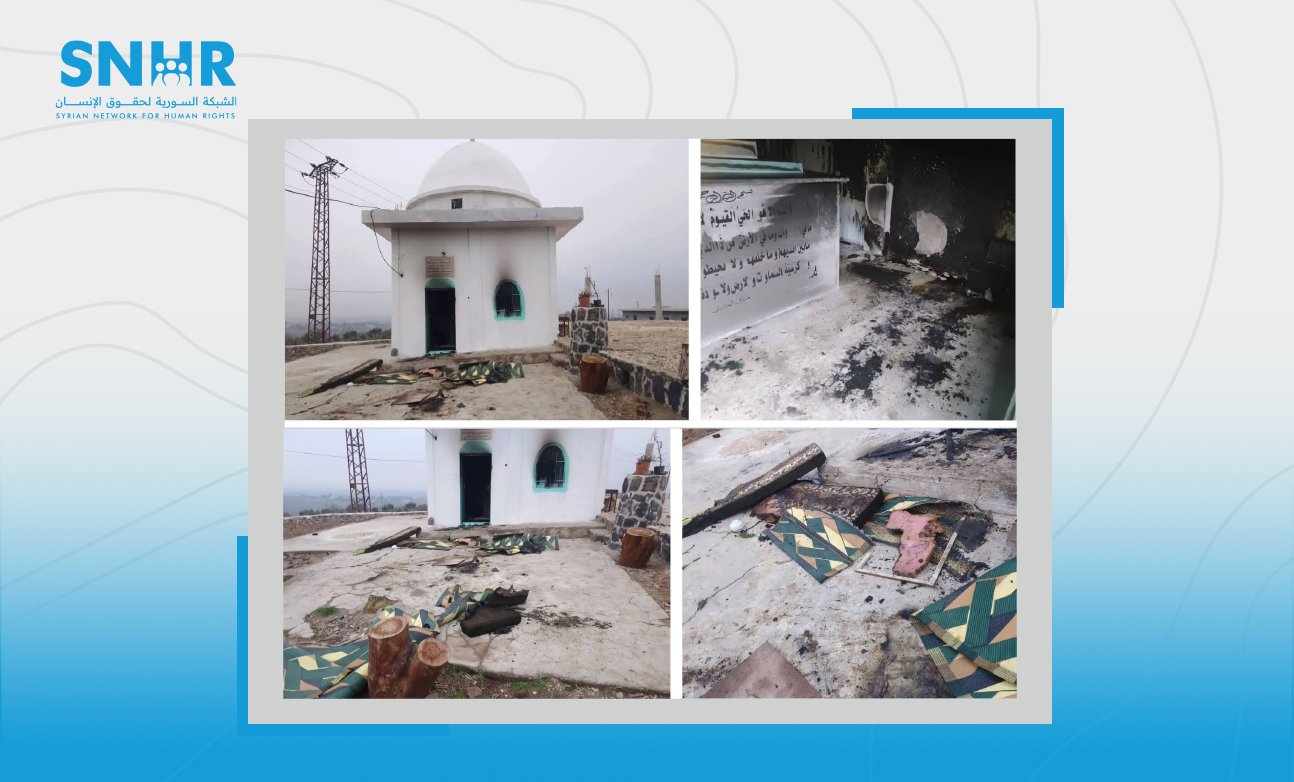
On Thursday, January 23, 2025, a religious shrine for an Alawite spiritual figure in Majidel village in western rural Homs, known locally as ‘Tashrifat Sheikh Salman al-Rawas’, was set on fire by unidentified individuals. The incident resulted in moderate material damage to the shrine and its contents. SNHR obtained photographs documenting the damage caused by the fire.
This attack occurred following a security campaign conducted by the General Security Forces and the Military Operations Command to pursue armed individuals from Bashar al-Assad’s former forces who had rejected reconciliation and refused to surrender their weapons. According to preliminary information obtained by SNHR, evidence suggests that unidentified groups may have been involved in carrying out the attack, with the aim of inciting sectarian tensions in the area.
When SNHR asked about the incident, the General Security Forces’ media relations officer denied any involvement by the General Security Forces in this incident.
The statement also outlines a number of recommendations to ensure the success of the security campaign and strengthen community trust. To this end, SNHR underlined that the transitional government must adhere to international legal rules in all of its security operations to ensure justice and consolidate stability in Syria.
In this context, SNHR submits the following recommendations:
- Strengthen oversight and accountability within security agencies
- Establish independent monitoring committees to oversee the performance of security personnel during operations and prevent violations against civilians or property.
- Hold accountable any personnel proven to be involved in human rights violations to prevent any recurrence of such behavior and build trust between security forces and local populations.
- Improve communication with residents and enhance transparency
- Conduct regular meetings with village elders and community representatives to explain the objectives of the security campaign and reassure residents that it is aimed at enhancing security and stability, and does not target specific groups.
- Publish periodic reports detailing the progress and results of security operations to increase transparency.
- Counter media misinformation
- Establish official social media platforms to disseminate accurate information and swiftly refute misinformation.
- Strengthen cooperation with independent media and local activists to ensure professional and objective coverage of events.
- Ensure human rights compliance during security operations
- Train security personnel on humane treatment of civilians during raids and prohibit any physical or verbal abuse.
- Ensure that arrests are based on credible evidence and promptly release those proven to have no involvement in violations.
- Guarantee detainees’ rights and protect them from mistreatment or degrading treatment.
- Allow independent media and civil society organizations to cover these campaigns to ensure transparency.
- Promote reconstruction and community reconciliation
- Launch initiatives for reconciliation and civil peace in communities that experienced tensions under the previous regime.
- Support reconstruction projects in affected areas, such as repairing schools and infrastructure, to encourage cooperation with transitional authorities.
- Regulate the handling of religious symbols
- Direct security personnel to respect religious symbols of all sects during operations.
- Investigate incidents of religious desecration whenever they occur, such as tearing down sacred images or symbols, and hold perpetrators accountable to prevent any recurrence of such behavior.
- Expedite the settlement process for wanted individuals
- Facilitate and expedite settlement procedures for wanted individuals who pose no security threat and have not been involved in any violations, encouraging them to surrender their weapons and reintegrate into society.
- Ensure transparency and justice in settlement processes to prevent exploitation of any shortcomings in a retaliatory or unjust manner.
- Focus on preventive security
- Strengthen intelligence efforts to gather information on former regime elements and armed militias before conducting security operations to avoid unnecessary clashes and minimize human losses.
- Provide peaceful options for wanted individuals, such as issuing prior warnings, to give them an opportunity to surrender and avoid armed confrontations.
- Enhance community representation in decision-making
- Involve representatives from various sects and social groups in decision-making mechanisms at the local level to ensure comprehensive representation and defuse sectarian tensions.
- Launch community awareness campaigns
- Organize awareness campaigns for local populations on the importance of cooperating with transitional authorities to ensure the success of the transitional phase and build a more stable future.
- Highlight the dangers of the proliferation of illegal weapons and their negative impact on community security.
In conclusion, the statement stresses that that the success of the transitional phase requires a firm commitment to human rights, enhanced transparency, and ensuring fair accountability. These measures are essential for establishing stability and building trust between the public and the transitional authorities.
