


Just Security – Published: June 3, 2026 | By: Fadel Abdulghany and Kenneth Roth
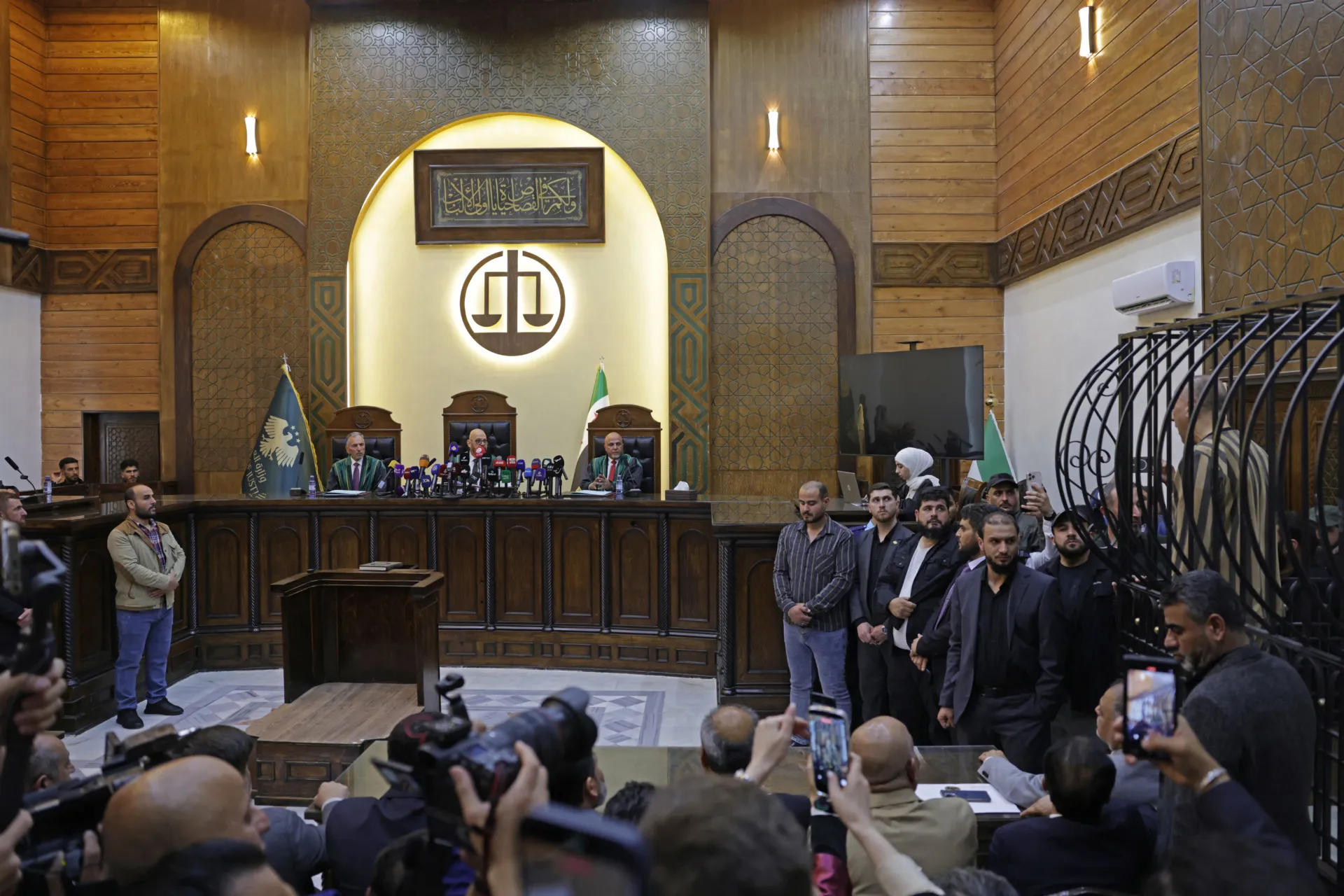
Just Security has published “Syria’s Accountability Gap: The Najib Trial and the Case for the ICC,” a new analysis by Fadel Abdulghany and Kenneth Roth, as part of the publication’s ongoing series on Syria in Transition. The article examines the first criminal trial against a senior official of former President Bashar al-Assad’s regime, which opened in Damascus in April 2026 and where at least ten charges were read out the following month, and argues that while the proceedings mark a welcome step toward justice, flaws in the trial expose a deeper contradiction in the transitional government’s approach to accountability. The authors contend that the domestic and international tracks of justice are complementary, and that the government’s refusal to pursue both undermines each.
The article centers on the trial of Brigadier General Atef Najib, a cousin of Assad and the head of political security in Daraa until March 2011, who faces at least ten charges including murder, torture resulting in death, responsibility for massacres, and the torture of minors, tied to the early-2011 crackdown on protests. Najib has pleaded not guilty. The authors note that prosecutors are pursuing the case under domestic law while also characterizing the offenses as crimes against humanity under Syria’s new Constitutional Declaration, even though those provisions have yet to be incorporated into the penal code. They highlight critical gaps. Syrian law has no command-responsibility doctrine comparable to Article 28 of the Rome Statute, effectively shielding the chain of command. The availability of the death penalty also risks foreclosing the European cooperation that prosecutors will need, since EU states and the UK will not extradite or assist where execution is a realistic outcome.
Abdulghany and Roth then turn to the international track, arguing that the surest route to ICC jurisdiction would be for the new government to join the court and grant retroactive jurisdiction under Article 12(3) of the Rome Statute, as Ukraine did. The ICC prosecutor, U.N. officials, and the head of the IIIM have all urged Syria to ratify. Yet the new authorities have hesitated, the authors write, largely to avoid exposing themselves and their allies to prosecution for crimes committed during their earlier rule as rebel leaders in Idlib, a reluctance reflected in the narrow mandate of the new National Commission for Transitional Justice, which is confined to violations by the defunct regime. The hostility of the Trump administration to the ICC, the prospect of U.S. sanctions relief, and the reconstruction funding Syria needs from Gulf states are all cited as further deterrents to action.
The authors conclude that the European Union holds perhaps the greatest leverage to encourage a more productive path. They recommend that the deepening EU-Syria partnership tie further sanctions relief and reconstruction support to clear benchmarks. These would include enacting legislation on crimes against humanity and war crimes, submitting an instrument of accession to the Rome Statute, and expanding the NCTJ’s mandate to cover all perpetrators. The trial of Najib, they argue, could be a watershed moment in the history of Syrian accountability, but its transformation into a genuine basis for justice depends on the willingness of the transitional government to build the necessary legal and institutional framework, not merely to conduct judicial proceedings of limited scope and impact.
