


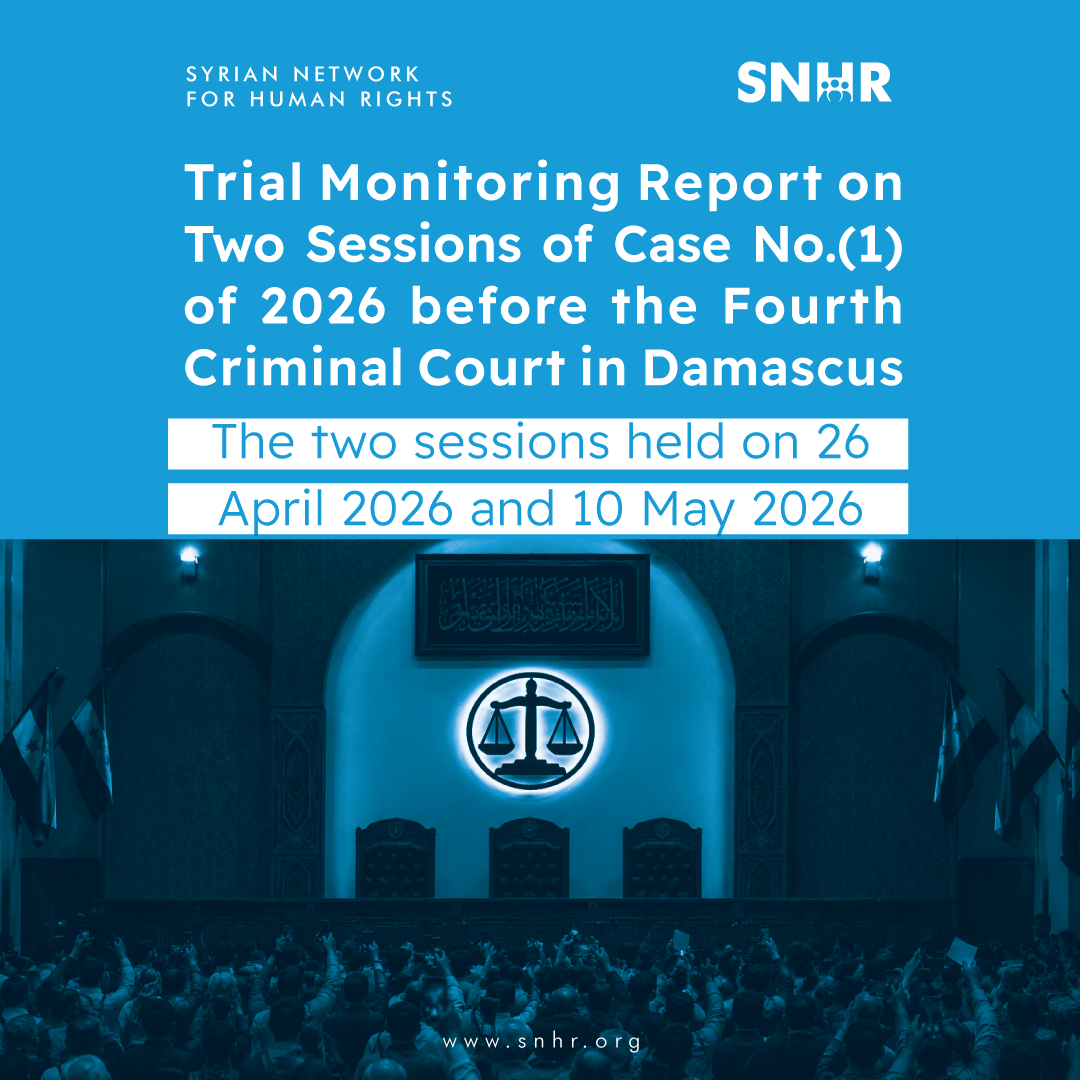
The two sessions held on 26 April 2026 and 10 May 2026
Available in:
Damascus, 19 July 2026:
The Syrian Network for Human Rights (SNHR) said, in its report issued on the monitoring of two sessions of the trial of Case No. (1) of 2026 before the Fourth Criminal Court in Damascus, that the two sessions held on April 26, 2026, and May 10, 2026, showed a clear degree of publicity and organization, with substantive procedural and legal issues remaining in need of follow-up in the subsequent stages. The report concerns a criminal case connected to accusations directed at a number of former civilian, security, and military officials, against the background of the events of Daraa governorate during 2011.
SNHR affirmed that the report is a judicial monitoring report, and not an accusatory report or a judgment on the correctness of the facts, the sufficiency of the evidence, or the individual criminal responsibility of any of the defendants. Its scope is limited to monitoring what took place in the public parts of the two sessions, and what the court, the Public Prosecution, and the parties to the case announced inside the courtroom; it doesn’t include an independent assessment of the case file or of the evidence that wasn’t presented publicly.
During the first session, held on April 26, 2026, the presiding judge opened the consideration of Case No. (1) of 2026, and announced that the session was dedicated to the administrative and legal procedures related to notification and preparation. The defendant Atef Najib Najib appeared before the court in person and in the presence of his lawyer, while the court recorded the absence of the rest of the defendants whose names were called out, and it decided to issue grace-period decisions against the absent defendants and to notify them duly in accordance with the provisions of Article 322 of the Code of Criminal Procedure. The judge also announced that the number of plaintiffs, according to the list that was read inside the courtroom, is fifty plaintiffs, among them ten women, and that most of them attended while five of them were absent; the court then adjourned the consideration of the case to May 10, 2026.
SNHR said that the first session was of a preparatory and procedural character, and it didn’t include the interrogation of the present defendant, a discussion of the merits of the case, or a presentation of the evidence. The monitoring team observed that the session was held publicly, in the presence of representatives of local and international media outlets, human rights organizations, lawyers for the plaintiffs, and the defense lawyer of the present defendant, without observing any apparent restrictions on the entry of the attendees or on their following of the session.
As for the second session, held on May 10, 2026, it witnessed the transition of the case from the preliminary procedural stage to the stage of presenting the summary of the indictment and the grounds of the prosecution. After the calling of the defendants, the court announced that the absent defendants hadn’t attended the previous session, and that the summonses and the grace-period decisions related to them had been duly notified according to what was announced inside the session. Based on that, the court decided to confirm their absence, to proceed with the case against them in absentia, to consider them fugitives from justice, to try them according to the procedures specific to the trial of fugitive defendants, and to order the legal effects it announced based on Article 322 of the Code of Criminal Procedure.
The presiding judge then read a summary of the indictment decision directed at the present defendant, which included a presentation of attributed facts related to the events of Daraa governorate in early 2011, among them the arrest of children and school students, allegations of the occurrence of torture and cruel treatment, the use of force against protests and sit-ins, the shooting of protesters and mourners, the prevention of the rescue of wounded persons, and the occurrence of deaths and injuries, in addition to accusations connected to command responsibility and to participation in issuing orders or directing security operations.
The report also recorded that the court and the Public Prosecution referred to provisions of the Syrian law and to rules and principles of international law, including the right to life, the prohibition of torture and ill-treatment, the right to liberty, and the rights of children, in addition to international legal characterizations such as crimes against humanity and war crimes. SNHR stressed that recording these characterizations doesn’t mean adopting them or settling the extent of their applicability, particularly since the characterization of the facts as war crimes requires the fulfillment of specific legal and contextual elements, among them the existence of an armed conflict and a sufficient nexus between the attributed acts and the conflict.
In the pleading of the Public Prosecution, the representative of the prosecution presented the prosecution’s narrative concerning the events of Daraa governorate in 2011, and considered that the facts began with the arrest of children against the background of writings on walls, followed, according to the prosecution, by torture, cruel treatment, and the suppression of the peaceful protests. He also attributed to a number of the defendants command, security, and political responsibilities, linked that to a military and security chain of command, and considered that the facts constitute, according to the position of the prosecution, a systematic pattern of violations that rises to crimes against humanity and war crimes, in addition to crimes punishable under the Syrian law.
The monitoring team observed that some of the phrases contained in the presentation of the indictment and in the pleading of the Public Prosecution were, on their face, of a declarative or conclusive character. SNHR considers that the soundness of the proceedings requires that these phrases be understood exclusively as a presentation of the indictment, not as a final judicial conclusion preceding the discussion of the evidence and the hearing of the arguments of the defense. The team also observed that the court announced the right of the defense lawyer to obtain a copy of the summary of the indictment and to review it, which is an important step; however, the sufficiency of this guarantee will remain tied to what will later be made available to the defense in terms of time, materials, and the possibility of discussing the evidence and the witnesses and responding to the facts attributed to the defendant.
Before moving to the stage of the interrogation of the present defendant, the court announced that some of the questions may include documents and names of witnesses covered by protection measures, and it requested stopping the live broadcast and the departure of the representatives of the media outlets, while keeping a number of the attendees inside the courtroom according to what the court permitted. The court clarified that the recordings will be published later, after the deletion of the names of the witnesses and the sensitive documents or data. SNHR considered that witness protection measures may be legitimate if they remain specific, necessary, and proportionate, and provided that they don’t prejudice, in an unjustified manner, the rights of the defense or the principle of the publicity of the trial.
The relevant legal framework, as presented in the sessions and the report, is built on the Syrian law, and on rules of international human rights law, particularly the right to life, the prohibition of torture and ill-treatment, the guarantees of liberty and fair trial, and the rights of the child. Also raised inside the session were the Convention against Torture, the Convention on the Rights of the Child, the International Covenant on Civil and Political Rights, and rules of international humanitarian law and the Geneva Conventions, in addition to international criminal characterizations such as crimes against humanity and war crimes. SNHR stresses the necessity of not conflating human rights violations, the crimes stipulated in the national law, and the international crimes that require independent legal and contextual elements.
SNHR called on the Fourth Criminal Court in Damascus to maintain a clear separation between the presentation of the indictment and any phrases that may be understood as a prior settling of criminal responsibility, and to guarantee respect for the presumption of innocence throughout the stages of the trial. It also called on the court and the Public Prosecution to use attributed and precise formulations when presenting the facts and the legal characterizations, especially when referring to the international crimes, and to enable the defense to have effective access to the summary of the indictment and to the relevant evidence and documents, and to grant it sufficient time to prepare, to respond, and to discuss the witnesses and the evidence.
SNHR also recommended limiting any restriction of the publicity of the trial, the broadcast, or the attendance of the media outlets to the extent necessary to protect the witnesses or the sensitive data, and guaranteeing that no unjustified prejudice is done to the rights of the defense or to the principle of public oversight of the trial. It called on the court and the competent judicial authorities to clarify the guarantees available to the absent defendants, particularly with respect to effective notification, the right to appeal, and the possibility of a retrial or a review of the proceedings in accordance with the law if they appear at a later stage or if it becomes possible to notify them in an effective manner. It also called on the bodies concerned with witness protection to continue withholding the identifying data that isn’t necessary, and to refrain from publishing names, documents, or details that may expose the witnesses, the plaintiffs, or their families to danger.
SNHR concluded that the two sessions showed positive elements related to publicity, organization, and procedural sequencing, alongside fundamental issues that require follow-up, particularly the presumption of innocence, the rights of the defense, the trial in absentia, witness protection measures, and the precision of the use of the legal characterizations. It affirmed that any final assessment of the extent of the trial’s compatibility with the standards of fair trial remains contingent on the follow-up of the subsequent stages, particularly the interrogation of the defendant, the hearing of the witnesses, the presentation and discussion of the evidence, and enabling the defense to exercise its rights in an effective manner.
