

Documentation of the killing of 428 civilians in the first half of 2026, including 160 civilians in the second quarter of the same year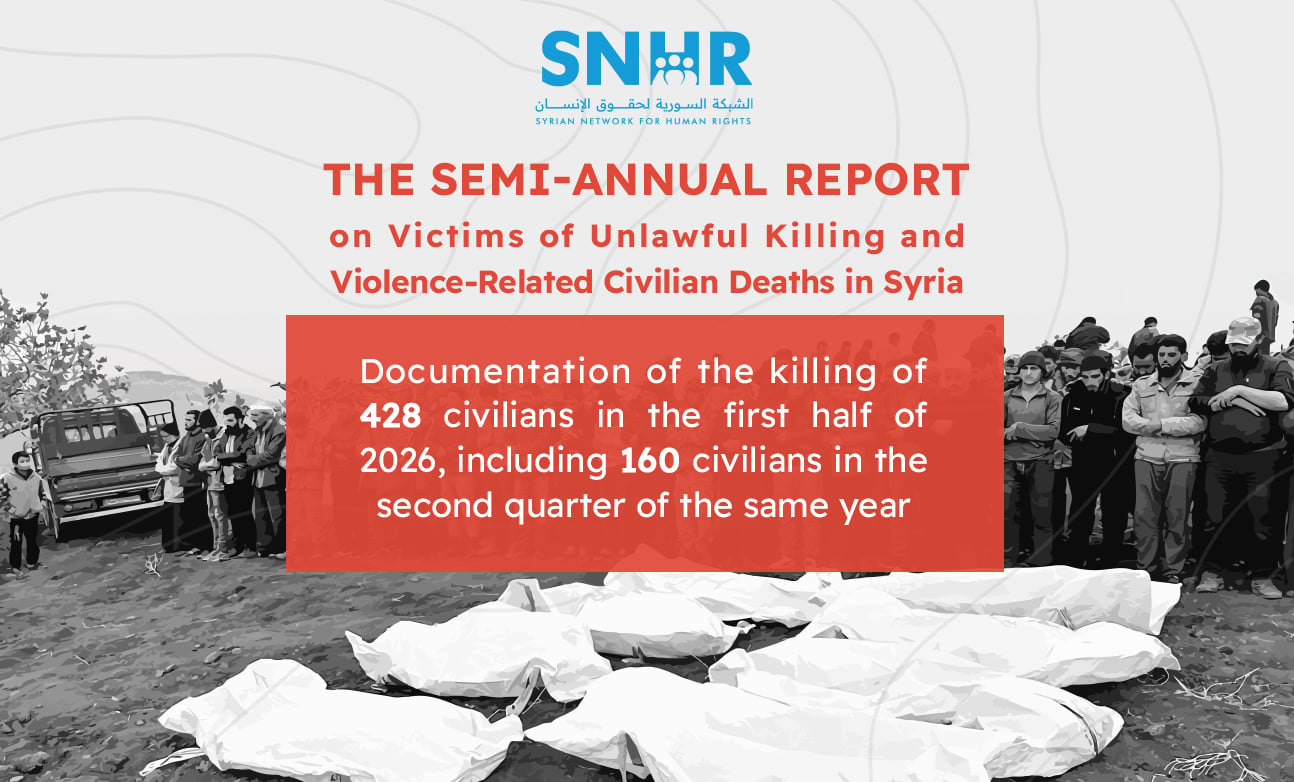
Available in:
Damascus, July 1, 2026: The Syrian Network for Human Rights said in its semi-annual report on the victims of unlawful killing and violence-related civilian deaths in Syria, issued today, Wednesday, that it documented the killing of no fewer than 428 civilians in the first half of 2026, among them 80 children and 33 women, in addition to 8 medical personnel and 2 media workers. The Network also documented the killing of one person due to torture during the same period.
The report presents the toll of the first half of 2026 as the overall statistical framework, with a separate analytical section devoted to the second quarter of the same year. Within this toll, the Network documented the killing of no fewer than 160 civilians during the second quarter, among them 37 children and 6 women, in addition to one media worker.
The Network confirmed that this toll represents the minimum of the cases it was able to document and verify in accordance with its methodology, and doesn’t necessarily reflect the full magnitude of all incidents of unlawful killing or violence-related civilian deaths during the period covered. The toll is also presented as a toll of the cases whose documentation was achieved during the reference period, with a distinction, whenever possible, between the date of documentation and the estimated date of death.
According to the responsible party or the party most likely responsible, or according to the pattern of the incident when attribution is difficult, the Network documented, within the toll of the first half of the year, the killing of 202 civilians, among them 14 children and 19 women, by gunfire whose source it couldn’t identify; 59 civilians, among them 24 children and 2 women, due to landmines of unidentified source; 50 civilians, among them 21 children and 1 woman, in explosions whose perpetrators remained undetermined; and 35 civilians, among them 8 children and 4 women, at the hands of individuals it couldn’t identify. It also documented the killing of 57 civilians, among them 5 children and 2 women, at the hands of the Syrian Democratic Forces, including one person due to torture; 12 civilians, among them 3 children and 3 women, at the hands of the Syrian Government forces; 9 civilians, among them 5 children and 2 women, within the “remnants of the Assad regime”; 3 civilians at the hands of ISIS; and one civilian at the hands of the Israeli occupation forces.
The report uses the phrase “remnants of the Assad regime” as a general documentary classification for facts connected to the former regime or to the effects of its previous operations, not as a unified legal basis for responsibility in all cases.
The toll of the documented civilian victims in the first half of 2026 was distributed across the months as follows: 111 victims in January, 96 in February, 61 in March, 75 in April, 44 in May, and 41 in June. January thus constituted the highest monthly toll, followed by February, then April.
Children and women together made up 113 victims out of 428 documented civilian victims, that is, roughly 26% of the total. According to the distribution across the provinces, the province of Aleppo topped the toll with 81 victims, that is, nearly 19% of the total victims, followed by Hama with 67 victims, then Homs with 63, Idlib with 53, and Raqqa with 51. The report points out that most of the victims in Aleppo were recorded in incidents attributed to the Syrian Democratic Forces or to sources of violence whose affiliation the Network couldn’t determine, whereas the overwhelming majority of the victims in Hama were attributed to sources of violence the Network couldn’t identify.
As for the toll of the second quarter of 2026, the Network documented the killing of 76 civilians, among them 4 children and 4 women, by gunfire whose source it couldn’t identify; 34 civilians, among them 18 children, due to landmines of unidentified source; 27 civilians, among them 10 children and 1 woman, in explosions whose perpetrators remained undetermined; and 15 civilians, among them 1 child and 1 woman, at the hands of individuals it couldn’t identify. These four categories made up nearly 95% of the total documented civilian victims during the second quarter. The report also recorded the killing of 5 civilians, among them 3 children, within the category of “remnants of the Assad regime”; the killing of one child at the hands of the Syrian Government forces; one civilian at the hands of ISIS; and one civilian at the hands of the Israeli occupation forces. Children made up roughly 23% of the victims of the second quarter.
In addition, the report documented no fewer than 24 incidents of attack on vital civilian centers in the first half of 2026, among them 3 incidents that targeted educational facilities, 4 incidents that targeted medical facilities, and one incident that targeted a place of worship. These incidents were distributed as follows: 10 incidents attributed to the Syrian Democratic Forces, 7 to the Israeli occupation forces, 4 to shells whose source the Network couldn’t identify, 2 to attacks whose perpetrators the Network couldn’t identify, and one incident to the Syrian Government forces. The province of Aleppo recorded the highest number of these incidents, with no fewer than 9 incidents, followed by the province of Daraa with no fewer than 6 incidents. In the second quarter alone, the Network documented no fewer than 7 incidents of attack on vital civilian centers, all of which were attributed to the Israeli occupation forces, and were concentrated in the two provinces of Daraa and Quneitra.
The report concludes that the incidents of unlawful killing and violence-related civilian deaths touch upon the right to life, which is protected under international human rights law, in particular Article 6 of the International Covenant on Civil and Political Rights. The existing authorities and the forces in effective control bear obligations to protect this right, to prevent the arbitrary deprivation of life, to investigate the cases of death that are likely to be unlawful, and to hold those responsible for them accountable.
Some of the documented incidents also raise concerns under international humanitarian law, in particular the rules of protecting civilians and civilian objects, the principles of distinction, precaution, and proportionality, and the prohibition of indiscriminate attacks. Some of these facts may rise to the level of serious violations of international humanitarian law or war crimes, if an independent investigation establishes the availability of the necessary legal elements, including the act, the intent, the context, and the connection to the armed conflict where appropriate.
The Syrian Network for Human Rights called on the Syrian government in the report to establish an independent and effective national mechanism to register all incidents of civilian death and to investigate them, to give priority to clearing landmines and remnants of war in inhabited areas, to protect the crime sites and the material evidence, including the mass graves and the former detention centers, to investigate the deaths connected to torture or ill-treatment or enforced disappearance, to control the spread of unregulated weapons, and to adopt national policies for transitional justice that include the uncovering of the truth, accountability, the reparation of harm, and the guarantees of non-repetition.
The Network also condemned the Israeli occupation forces and called on them to halt the military operations in the southern Syrian territories and to respect the sovereignty of Syria, and to take the necessary measures to hold their elements accountable and to protect civilians and civilian objects. It also called on the humanitarian organizations and the donor bodies to expand the awareness programs on the dangers of landmines and remnants of war, to support the medical response, and to integrate the activities of clearing landmines and remnants of war into the humanitarian response.
In addition, the Network called on the Office of the High Commissioner for Human Rights to support the building of the capacities of the Syrian authorities in investigating cases of the arbitrary deprivation of life in accordance with international standards, in particular the Minnesota Protocol. It also called on the Independent International Commission of Inquiry and the International, Impartial and Independent Mechanism to give special priority to the patterns of killing connected to the transitional phase, including killing at the hands of unidentified parties and the attacks on civilian objects, and to work on preserving and analyzing the evidence in a way that supports future accountability. The Network also appealed to the international community to increase the funding allocated to clearing landmines and to support the independent investigations.
