


Since December 8, 2024 and up to the end of the first quarter of 2026, more than three million Syrians, between refugees and internally displaced persons, have returned, while millions of others still live in conditions of asylum and displacement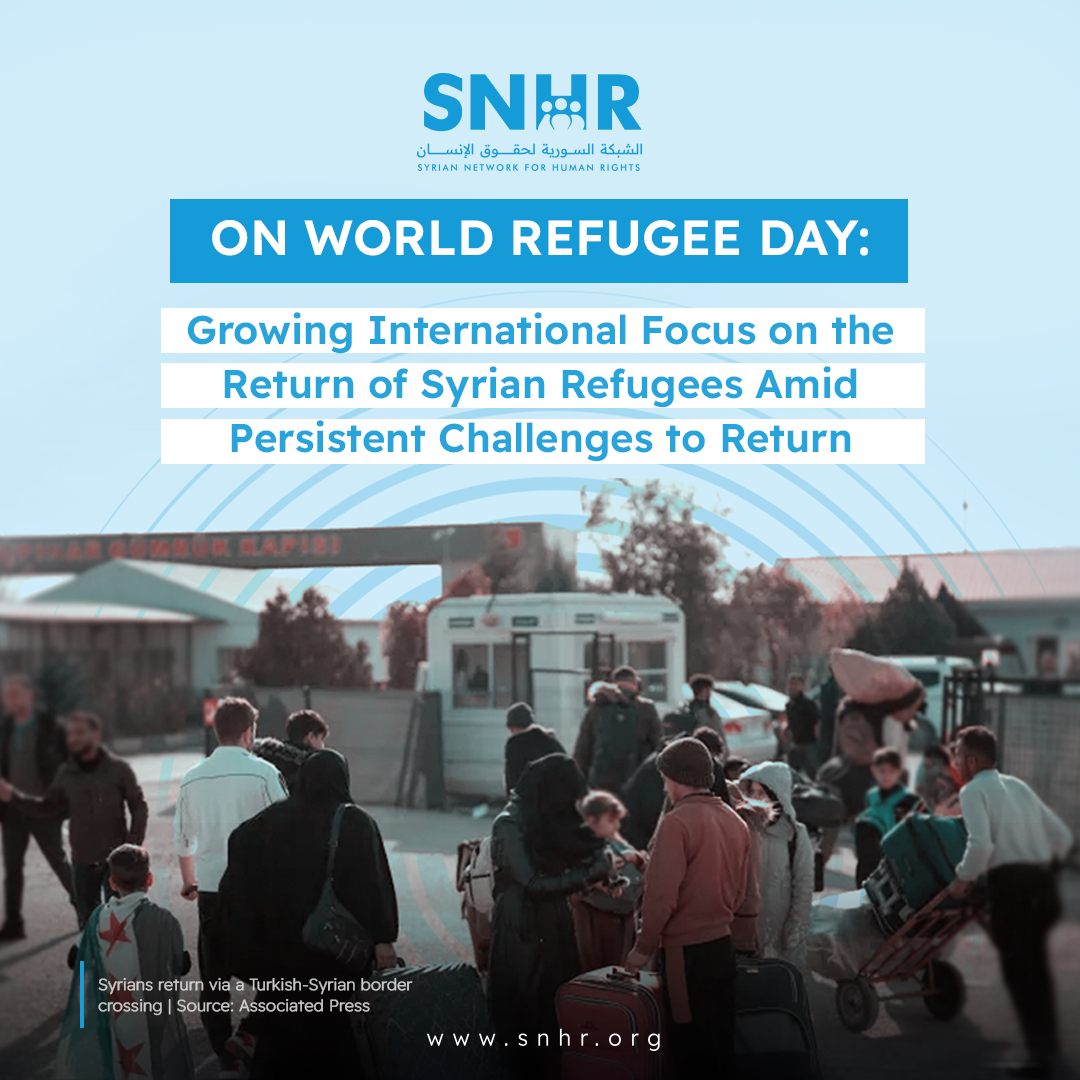
Available in:
Damascus, June 20, 2026: The Syrian Network for Human Rights said in its report issued on the occasion of World Refugee Day that the growing international focus on the return of Syrian refugees comes at a time where substantive challenges persist that prevent the achievement of a voluntary, safe, dignified, and sustainable return for all those wishing to return. The report noted that, since December 8, 2024 and up to the end of the first quarter of 2026, more than three million Syrians, between refugees and internally displaced persons, have returned, while millions of others still live in conditions of asylum and displacement.
The report indicated that the fall of the Bashar al-Assad regime on December 8, 2024 removed one of the most prominent political and security obstacles that had been preventing the return of broad segments of Syrians to their areas of origin, however it did not lead to the disappearance of the rest of the security, legal, economic, and service-related obstacles. It said that the period extending from June 2025 to mid-2026 witnessed a clear shift in the international discourse, from an almost exclusive focus on the conditions of asylum and displacement to the examination of the issues of return, reintegration, and recovery, with a continued warning of the challenges facing returnees.
According to the report, more than 6.8 million Syrian refugees had left the country since March 2011 and up to the end of 2024, while the number of internally displaced persons exceeded 6.9 million people. As for the period since December 8, 2024 and up to the end of the first quarter of 2026, more than 1.5 million Syrian refugees have returned from the host states to Syria, and more than 1.8 million internally displaced persons have returned to their areas of origin. Nevertheless, more than 9 million Syrians remain in a state of asylum or internal displacement up to the end of the first quarter of 2026, and nearly 15.6 million people inside Syria need some form of humanitarian assistance.
Fadel Abdulghany, the Executive Director of the Syrian Network for Human Rights, says: “The growing numbers of returnees are not, in themselves, sufficient to judge that the conditions of return have been completed. The human rights standard is reflected in the decision of return being free and informed, and in returnees finding a legal and safe environment, basic services, and livelihoods that allow them to settle without fear or deprivation.”
The report affirmed that the return of refugees must be based on the principle of full voluntariness, and must take place amid the availability of safety, stability, basic services, and dignified livelihoods. It also stressed the obligation of the host states to respect the right of the refugee to take the decision of return or to continue seeking protection, and to refrain from adopting policies or measures, whether direct or indirect, that may push refugees to return forcibly or under the weight of legal or living pressures.
The report monitored policies and measures in some host states that contributed to increasing the pressures placed on Syrian refugees. It noted that the Arab Republic of Egypt witnessed, following the fall of the Bashar al-Assad regime, a change in its treatment of Syrians; as the Network documented, in a statement issued in April 2026, a noticeable deterioration in the legal and humanitarian conditions of the Syrians residing in Egypt during the period extending between January and April 2026, which included cases of detention that affected refugees registered with the Office of the United Nations High Commissioner for Refugees, as well as indirect legal and living pressures. The file of the Syrian refugees in Lebanon also remained at the heart of the political and administrative discussions related to return, amid the continuation of official calls to accelerate the return to Syria.
As for internal displacement, the report said that the displacement crisis has not ended, despite the return of more than 1.8 million internally displaced persons to their areas of origin, and the closure of a number of displacement camps between June 2025 and June 2026. It noted that the acts of violence in Suwayda governorate in July 2025, and the battles between the Syrian government forces and the Syrian Democratic Forces in the north and east of Syria in January 2026, led to new waves of internal displacement of tens of thousands of people, some of which were temporary and some of which are still ongoing, in addition to the recording of cases of asylum outside Syria.
The report indicated that nearly 1,126 camps still exist in northern Syria, among them approximately 786 camps in Idlib governorate and nearly 340 camps in the Aleppo countryside, and these camps shelter nearly 700,000 displaced persons. It also showed that the floods and torrents that struck a number of Syrian areas on February 7 and 8, 2026 revealed the continued fragility of the conditions of the camps, particularly in the western Idlib countryside, and affected the conditions of thousands of displaced families.
The report recorded a localized improvement in some basic services, particularly the supply of electricity, and a relative stability in the availability of water, however it pointed to the rise in the costs of electricity, fuel, and basic materials since the beginning of 2026. It also observed a clear disparity between the regions in the level of services and recovery, and the continued weakness of the infrastructure in areas that the Syrian government recently took control of by the end of January 2026, such as parts of Raqqa and Deir Ez-Zour.
The report showed that the security situation witnessed a significant decline in the levels of direct violence associated with the conflict compared to the previous years, however it remains uneven between the regions, amid the continuation of factors of fragility that include the presence of unregulated weapons and the persistence of local security risks in some areas of return. It also affirmed that the humanitarian and living situation remains extremely severe, as more than 90% of the population live below the poverty line, and millions of Syrians suffer from food insecurity.
The Syrian Network for Human Rights documented, since the fall of the Bashar al-Assad regime and up to June 2026, the killing of no fewer than 341 civilians, among them 88 children and 21 women, as a result of the explosion of landmines and the remnants of cluster munitions among the remnants of the conflict, without that meaning, in all cases, the identification of the party that planted or used them. Among these victims are 66 civilians, among them 27 children and 4 women, who were killed since the beginning of 2026.
The report also pointed to the continued existence of unresolved legal conditions and protection risks, and to the fact that the announced steps to limit the impact of some arrest warrants of a political nature and to ease some travel restrictions are still in need of clear implementation mechanisms and independent judicial oversight. It noted that a large number of returnees, and of Syrians in general, still face difficulties in proving ownership or in recovering confiscated or damaged homes and properties, despite the Syrian government having taken initial steps, among them the cancellation of the precautionary seizure decisions under a presidential decree issued in May 2025.
The framework of international human rights law applies to the violations and challenges contained in the report, particularly the right to life, the right to liberty and security, the prohibition of forced return, the guarantees of due process of law, the right to freedom of movement, and the protection of housing and property. International humanitarian law also remains relevant to the effects of the armed conflict, including the dangers of mines, unexploded ordnance, and the remnants of cluster munitions, while international criminal law remains a necessary framework for the assessment of, and accountability for, the grave violations associated with the conflict and forced displacement.
The Syrian Network for Human Rights called on the Syrian government to adopt a national policy for return based on the international principles of human rights, to issue just legislation to address the issues of housing, land, and property, to reduce the fees of official documents, to launch immediate support programs for returnees, to strengthen local security, and to guarantee the representation of women and of survivors, both male and female, in decision-making processes. It also called on the United Nations and its agencies to strengthen the independent monitoring of the conditions of return, to support the Syrian Transitional Justice Authority and the National Commission for the Missing, and to fund reintegration programs. It urged the host states to commit to the principle of non-refoulement, to provide a safe legal environment for refugees, and to adopt alternatives to detention, while it called on the donor states and the international community to support the programs of return, early recovery, and reconstruction through transparent and monitored mechanisms, and to link funding to the principles of human rights, justice, accountability, and non-discrimination.
