


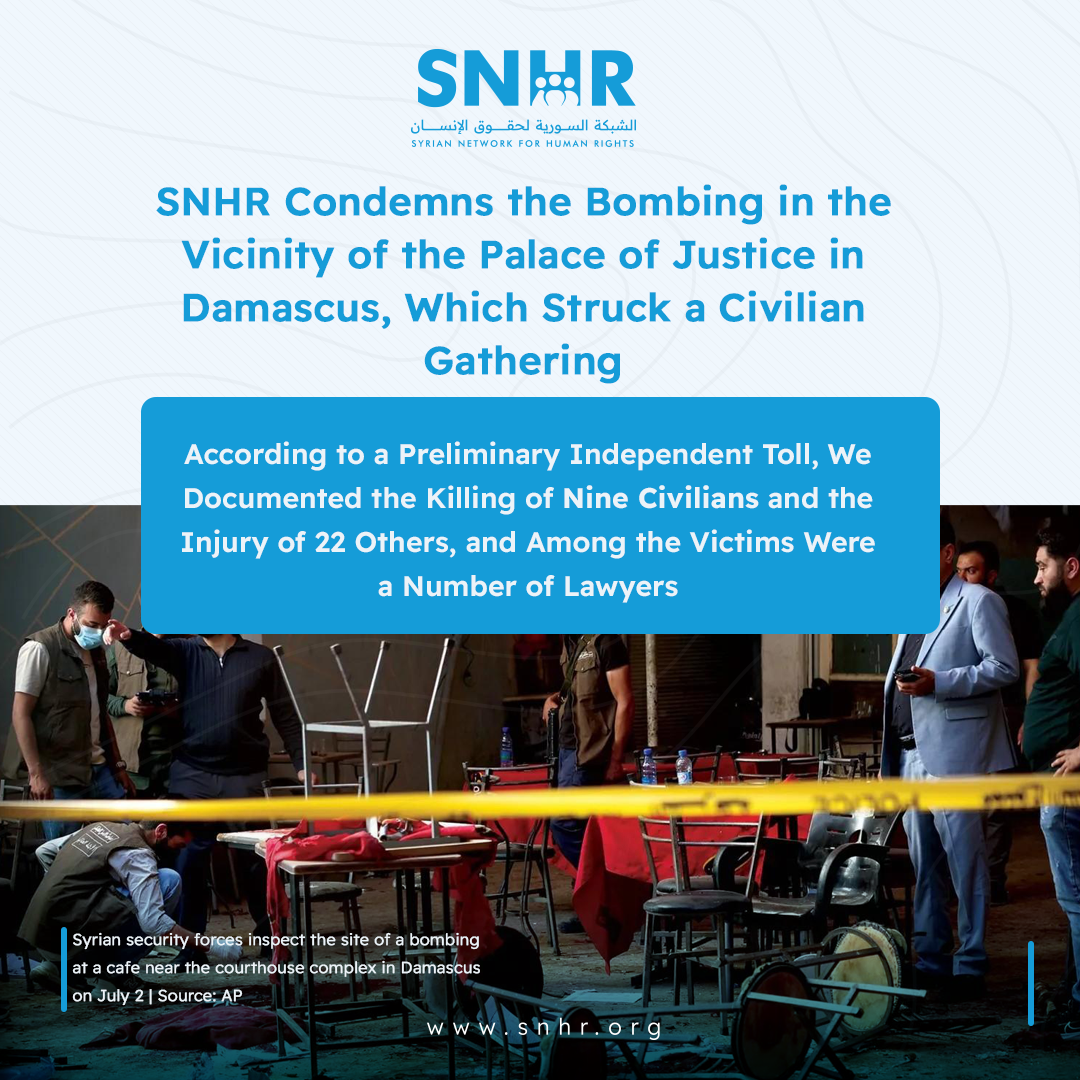
According to a Preliminary Independent Toll, We Documented the Killing of Nine Civilians and the Injury of 22 Others, and Among the Victims Were a Number of Lawyers
Available in:
Damascus – The Syrian Network for Human Rights
On Thursday, July 2, 2026, the city of Damascus witnessed a bombing that occurred in one of the cafés adjacent to the Palace of Justice, in an area frequented daily by judges, lawyers, employees, and visitors. The bombing resulted, according to the preliminary independent toll documented by the Syrian Network for Human Rights up until the time of the release of this statement, in the killing of no fewer than nine civilians and the injury of 22 others with wounds of varying severity, in addition to material damage at the site of the bombing.
The preliminary information we obtained indicates that among the victims were a number of lawyers, as well as persons who were present in the vicinity of the Palace of Justice while practicing their work or conducting their daily visits. Preliminary information also indicates that the bombing resulted from an explosive device (IED), which the Network continues to verify as part of the ongoing documentation process. The Network is still working on verifying the names of the victims and the injured, the final toll, the sequence of events, the means used, and any reliable indicators regarding the party responsible for the bombing.
The ongoing documentation process is built on the cross-referencing of preliminary testimonies and information from local and medical sources, alongside a review of government statements and declarations, and of open-source materials in a complementary manner and under verification. The Network treats this information according to varying degrees of verification, and will update it successively whenever additional reliable information becomes available. The Network is also committed to withholding any identifying information that may expose witnesses, survivors, or the families of the victims to danger, and to refraining from publishing names, sensitive details, or individual testimonies until verification is completed, safety and privacy considerations are taken into account, and the appropriate consent is obtained wherever necessary.
The bombing occurred in the vicinity of a civilian judicial facility and a café frequented by civilians, both of which fall, in principle, within the category of civilian objects that may not be targeted. The occurrence of the bombing in this location highlights the gravity of the assault on civilians, on safe access to justice, and on the safety of the workers and visitors in a public judicial facility.
The Syrian Network for Human Rights condemns this bombing in the strongest terms, extends its sincere condolences to the families of the victims and their loved ones, and wishes a speedy recovery for the injured. It stresses that the occurrence of a bombing in a crowded civilian gathering constitutes a serious assault on the right to life and physical integrity, and necessitates a prompt, effective, independent, impartial, and transparent investigation that reveals the circumstances of the incident, identifies those responsible for it, and paves the way for their accountability in accordance with judicial proceedings that are consistent with the international standards of fair trial.
Given that the preliminary information doesn’t yet allow for a conclusive determination of the responsible party or of the incident’s legal connection to a context of armed conflict, the Network stresses the necessity of avoiding any premature conclusions regarding the perpetrator, the motive, or the final legal characterization. If it is proven that the bombing was connected to an armed conflict and was carried out by one of its parties against civilians or a civilian site, it may constitute a serious violation of international humanitarian law, and may amount to a war crime. (Syria is still in a state of non-international armed conflict with ISIS and with the non-State armed groups in Suwayda.) Regardless of this characterization, the Syrian authorities remain under a duty to protect the right to life, to conduct an effective investigation into the potentially unlawful deaths and the related injuries and criminal incidents, and to hold those responsible for them accountable.
Recommendations
To the Syrian Government
- Conduct a prompt, effective, independent, and transparent investigation into the bombing, and announce its non-confidential results to the public, in a manner that doesn’t harm the course of the investigation or the safety of witnesses and victims.
- Secure the crime scene and prevent any tampering with the evidence, and preserve the relevant material and digital evidence, including camera recordings and the available filmed materials, in accordance with the law, and in a manner that respects the principles of necessity, proportionality, and privacy.
- Identify those responsible for the planning, execution, incitement, financing, and contribution to the bombing, and guarantee their accountability before a competent and independent judiciary, and in accordance with fair trial guarantees.
- Strengthen proportionate and non-discriminatory safety measures in the vicinity of courts and all other public facilities that witness dense civilian gatherings, in a manner that doesn’t restrict the civilians’ right to access justice and public services.
- Guarantee that counter-terrorism procedures or the security measures taken in the aftermath of the bombing don’t lead to arbitrary arrests, collective punishment, the violation of due process guarantees, or the targeting of any group on the basis of general suspicion, affiliation, profession, or region.
- Provide urgent medical and psychological care for the injured, facilitate social and legal support for the families of the victims, and guarantee clear pathways for compensation, rehabilitation, and reparation.
To the United Nations and the International Community
- Support the efforts aiming to protect civilians and civilian facilities in Syria, particularly the judicial and service facilities, markets, and densely populated areas.
- Provide the necessary logistical and technical support in the fields of criminal investigations, forensic medicine, and the preservation of digital evidence, in a manner that strengthens the capacity to conduct professional investigations into the attacks that affect civilians.
- Support the medical, psychological, and legal care programs for the victims and their families, and strengthen the capacities of the national institutions and civil society in responding to the needs of the victims and protecting witnesses and survivors.
