


Patterns of Expropriation and Their Impact on Women in the Context of Conflict and The Transitional Phase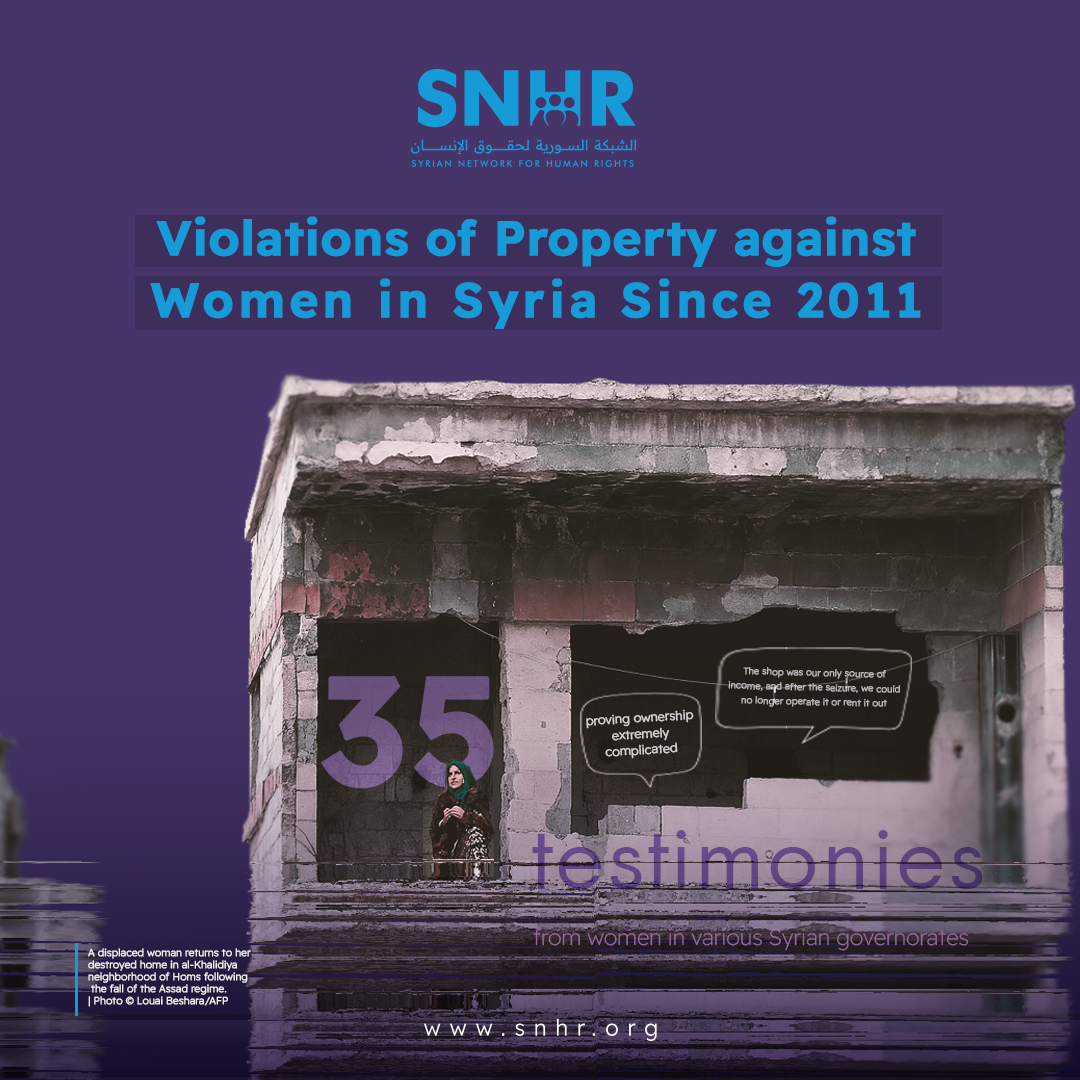
Available in:
Damascus, July 23, 2026: The Syrian Network for Human Rights issued a report titled: Violations of Property against Women in Syria Since 2011: Patterns of Expropriation and Their Impact on Women in the Context of Conflict and The Transitional Phase. The report included 35 accounts of women from different Syrian governorates out of tens of witness and victims interviews. These witness interviews, conducted between January 2025 and March 2026, concludes that the former Assad Regime used property rights as a tool for punishment, political subjugation, and demographic engineering, and that the fall of the regime on December 8, 2024, did not automatically lead to the restoration of stolen rights, but rather created new challenges related to the complexity and high cost of procedures and the absence of clear mechanisms for redress and compensation.
Documented Violation Patterns
The report categorized violations into three main overlapping categories: direct property violations, arbitrary legal or administrative measures, and discriminatory socioeconomic factors. Documented patterns include the loss of property rights due to forced displacement; loss resulting from bombing and widespread or deliberate destruction of property; use of civilian property for military purposes; arbitrary precautionary and executive seizure and confiscation; confiscation related to the detention and actual or perceived political affiliation of family members; expropriation through exceptional legislation and coercive urban planning; loss of legal documents; falsification and deliberate manipulation of property records; restrictions on access to justice and effective remedies; loss of inheritance rights in the context of family disputes; and financial extortion in exchange for maintaining or disposing of property.
The report indicates that these patterns interacted with a pre-existing discriminatory structure, where property registration was often in the names of husbands, fathers, or male relatives who were arrested, forcibly disappeared, killed, or displaced, placing women in a weaker legal position in the absence of the registered owner. This was compounded by the structurally low rate of women officially registered as property owners before the conflict, a consequence of social norms, economic dependency, and limited legal awareness, further exacerbating their vulnerability to property loss.
The report documents how the former Assad regime resorted to seizure and confiscation through exceptional courts, particularly the Terrorism Court established by Legislative Decree No. 63 of 2012, based on Counterterrorism Law No. 19 of 2012, without respecting fair trial guarantees. It also relied on expropriation legislation, including Law No. 10 of 2018 and Legislative Decree No. 66 of 2012, which imposed unrealistic deadlines for proving ownership and led to the administrative seizure of properties belonging to displaced persons and refugees. The report notes that women who reclaimed their properties after the regime’s fall often found them destroyed or in need of costly repairs beyond their financial means.
Fadel Abdulghany, Executive Director of the Syrian Network for Human Rights, said: “The denial of property rights to Syrian women during the armed conflict was part of a systematic policy targeting opponents of the former regime and their families, and was linked to a legislative and administrative framework designed to enshrine the seizure and give it formal legitimacy. The compounded effect of this policy on women stems from its intersection with previous structural discrimination in real estate registration, inheritance, and guardianship of property.” Abdulghany added: “The transitional phase places an obligation on the Syrian authorities to establish an independent property restitution body that adopts streamlined and low-cost procedures, and is based on a legal framework that enables the families of the forcibly disappeared, especially the wives, to manage the property of the missing.”
The International Legal Framework
The report bases its legal analysis on Syria’s obligations under international human rights law, in particular the International Covenant on Civil and Political Rights, which Syria ratified in 1969, the International Covenant on Economic, Social and Cultural Rights, in particular Article 11(1) relating to the right to an adequate standard of living, including housing, and the Convention on the Elimination of All Forms of Discrimination against Women (CEDAW), which Syria acceded to in 2003 with reservations, along with General Comments No. 4 of 1991 and No. 7 of 1997 of the Committee on Economic, Social and Cultural Rights, and General Recommendation No. 29 of 2013 of the CEDAW Committee.
With regard to international humanitarian law, the report is based on Rule 50 of customary international humanitarian law, which prohibits the destruction or seizure of an adversary’s property except in cases of imperative military necessity, and Rule 52, which prohibits pillage, as well as the principles of distinction and proportionality. The report indicates that the documented patterns, if their legal elements are met, may amount to war crimes under Article 8(2)(e)(12) of the Rome Statute concerning the destruction of property, and to crimes against humanity under Article 7(1)(d) concerning the forcible transfer of populations, and Article 7(1)(h) concerning persecution. The report also draws on the 2005 Pinheiro Principles on the Return of Housing and Property to Refugees and Internally Displaced Persons, and on Principle 21 of the 1998 Guiding Principles on Internal Displacement.
Calls and Recommendations
SNHR calls on the Syrian authorities to establish an independent national body for property restitution and real estate dispute resolution, with judicial and administrative powers, and to adopt alternative mechanisms for proving ownership, including statements, witness testimonies, satellite imagery, and tax and municipal records, drawing on the experiences of the Real Estate Claims Commission in Bosnia and Herzegovina (CRPC), the Real Estate Claims Commission in Kosovo (KPCC), and the Iraqi Real Estate Claims Commission (IPCC). It also calls for expanding the scope of the decree abolishing precautionary seizures issued in May 2025 to include executive seizure orders issued by exceptional courts, repealing Law No. 10 of 2018, reviewing Legislative Decree No. 66 of 2012, repealing the Law on the Management and Investment of Confiscated Funds issued in 2023, and withdrawing Syria’s reservations to the Convention on the Elimination of All Forms of Discrimination against Women (CEDAW), particularly the reservation to Article 16.
SNHR calls on the Office of the High Commissioner for Human Rights and treaty bodies to ensure that the CEDAW Committee issues specific concluding observations on women’s property rights in Syria, and that the Independent International Commission of Inquiry on the Syrian Arab Republic (COI) includes violations of women’s property rights in its reports. It also calls on UN agencies, including UNHCR, UNDP, and UN Women, to provide technical assistance to the Syrian authorities and to fund free legal aid programs for affected women.
SNHR also calls on states exercising universal jurisdiction to include property rights violations, including systematic confiscation, deliberate destruction, and organized falsification of property records, in open criminal cases as elements of war crimes and crimes against humanity, and to facilitate the cooperation of witnesses and refugee victims on their territories with accountability mechanisms, including the International, Impartial and Independent Mechanism (IIIM). It further calls on donor states to allocate direct funding for the establishment of a property restitution body and to link reconstruction aid to effective guarantees for respect for property rights.
