


An Analytical Study on the Legal Structure of Criminalization, Modes of Responsibility, and Trial Guarantees in Syrian Judicial Proceedings
Available in:
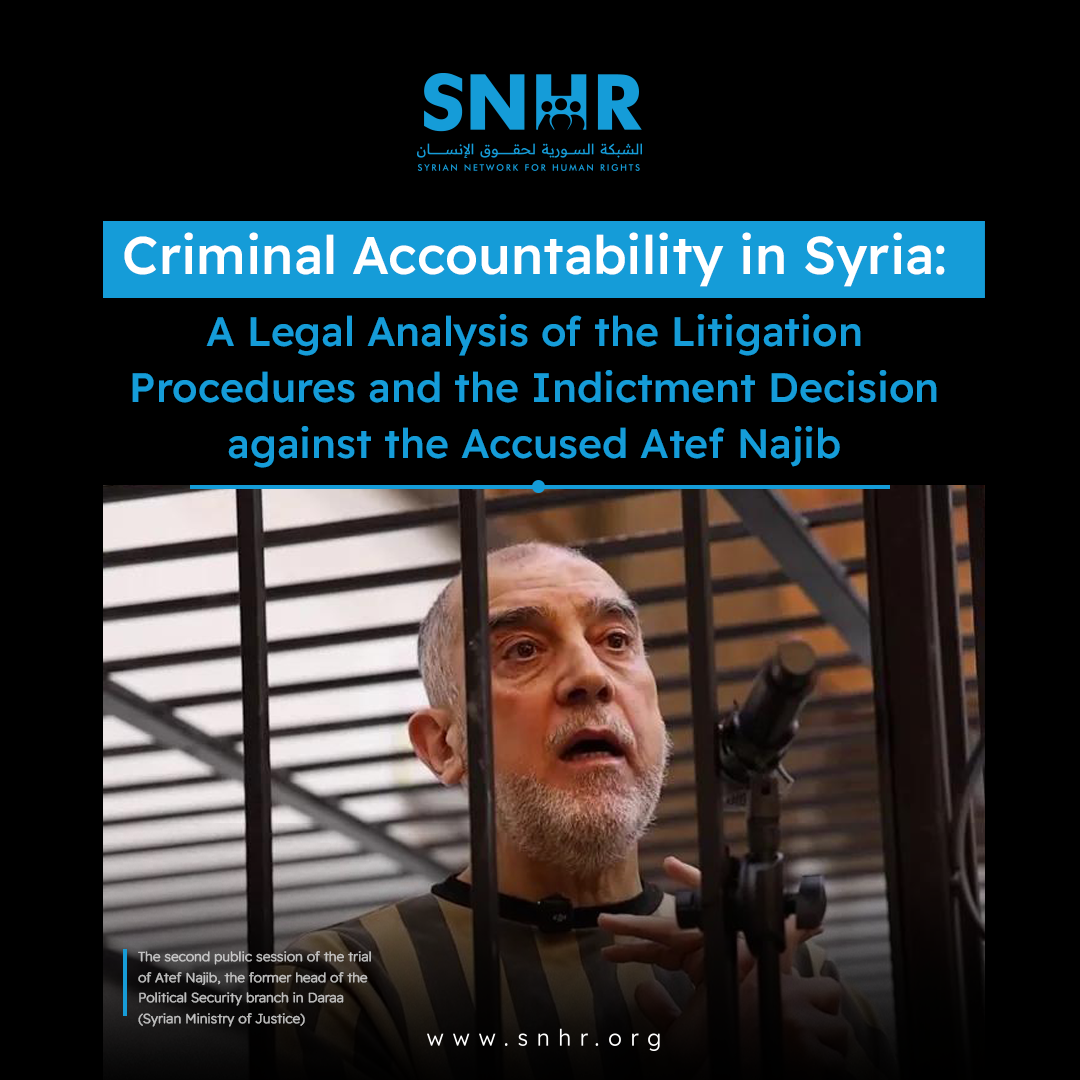
Damascus, 21 May 2026: The Syrian Network for Human Rights issued an analytical legal report examining the litigation procedures and the indictment decision against Brigadier General Atef Najib, the former head of the Political Security Branch in Daraa.
The Fourth Criminal Court in Damascus took up the case, which constitutes a judicial proceeding undertaken by the Syrian authorities against a prominent figure in the security apparatus of the former regime.
The report concluded that the trial of Najib reveals loopholes in the legislative framework, the characterization of the crimes, the theoretical basis of individual responsibility, the temporal application of the war-crimes framework, and the procedural guarantees of the in-absentia trial.
The first session was held on 26 April 2026, presided over by Judge Fakhr al-Din al-Aryan. Najib appeared in person before the court, while proceedings were directed in absentia against eight other defendants, namely Bashar al-Assad and his brother Maher al-Assad, Fahd Jassem al-Freij, Mohammad Ayman Mahmoud Ayoush, Louay Ali al-Ali, Qusay Ibrahim Mihoub, Wafiq Saleh Nasser, and Talal Fares al-Aseimi. In the second session, held on 10 May 2026, the court established the defendants’ absence, declared them fugitives from justice, and placed their assets under state administration pursuant to Article 322 of the Code of Criminal Procedure. Fifty plaintiffs were registered as civil parties, with the court confirming that the list of plaintiffs isn’t final.
The indictment, as read in the session of 10 May, included facts that comprised arrests and enforced disappearance in February 2011 against the backdrop of political opposition, the subjection of detainees to physical and psychological methods of torture, including electric shocks and severe beatings, and the death of detainees under torture, among them children. Najib was also charged with participating in meetings of the security committee that approved the use of live ammunition against peaceful protesters, with participating in the storming of the Omari Mosque, with opening fire from several axes, with preventing the evacuation of the wounded and detaining ambulances, with targeting protesters with snipers positioned on government buildings, including the Political Security building in Deir Ez-Zour, with torture leading to death inside detention centers, and with the use of arrest as a tool of extortion and to compel the families of detainees to hand over other persons.
Fadel Abdulghany, the Executive Director of the Syrian Network for Human Rights, says: “This trial is the first test of the Syrian judiciary’s capacity to build a legal record that withstands scrutiny in the face of crimes of the magnitude of what was committed in Syria. The loopholes identified by the report are practical points of weakness that can lead to the overturning of the rulings at the appeal stage. Remediation is possible within the proceedings underway, however it requires judicial will and explicit legal reasoning in every one of the five dimensions identified by the report.”
The report identified five structural loopholes. The first is that the Syrian Penal Code doesn’t include definitions for crimes against humanity, war crimes, genocide, enforced disappearance, or command responsibility. Likewise, Law No. 16 of 2022 defines torture by a standard lower than the one set forth in Article 1 of the Convention against Torture, in that it omits the element of purpose and the connection with a public official.
The second is that the indictment relied on the rules of peremptory international law (jus cogens) and Article 53 of the Vienna Convention on the Law of Treaties as a basis for characterizing crimes against humanity, even though Article 53 concerns the validity of treaties, doesn’t define the elements of the crime, and doesn’t establish a mode of individual criminal responsibility. The indictment also relied on the 1968 Convention on the Non-Applicability of Statutory Limitations to War Crimes and Crimes against Humanity, though Syria isn’t a party to it.
As for the third, it consists in that Article 49 of the Constitutional Declaration excludes the international crimes attributed to the “former regime” from the protection of non-retroactivity, while it preserves this protection for other categories of defendants, which raises a problem in light of Articles 15 and 26 of the International Covenant on Civil and Political Rights.
The fourth consists in that the events of Deir Ez-Zour in February 2011 preceded the threshold of non-international armed conflict according to the available international assessments. The Independent International Commission of Inquiry on Syria identified February 2012 as the date of the emergence of the non-international armed conflict, and the International Committee of the Red Cross described the situation as having reached this threshold in July 2012. Thus, the application of the war-crimes framework to acts that preceded that threshold produces a legal error subject to challenge.
As for the fifth, it consists in that the public record of the in-absentia proceedings doesn’t include a comprehensive notification log documenting the attempts at service and the reasons for their failure, nor does it confirm the appointment of counsel to represent the procedural interests of the absent defendants.
The report concluded that the most consistent path, from the legal standpoint, is the grounding of the characterization of crimes against humanity on the definitions of customary international law, as codified in Article 7 of the Rome Statute and confirmed in the 2019 draft articles of the International Law Commission, and their national application through Article 12 of the Transitional Constitutional Declaration. It also concluded that the commission of the crime through another person and the issuance of direct orders represent the strongest modes of legal responsibility attributable to Najib, and that the court must analytically separate the track of his responsibility from the track of Assad’s responsibility.
The report directed specific recommendations to four parties. It called on the Fourth Criminal Court to address the self-executing nature of Article 12 of the Constitutional Declaration explicitly in the ruling, to ground the non-retroactivity analysis on customary international law rather than on the selective exception alone, and to appoint counsel to represent the procedural interests of the absent defendants. It called on the Public Prosecution to abandon reliance on Article 53 of the Vienna Convention as a basis for the characterization of crimes against humanity, and to document all attempts to notify the absent defendants comprehensively in the record. It also called on the Syrian government to enact specialized transitional criminal legislation that defines crimes against humanity, war crimes, genocide, enforced disappearance, and command responsibility in national law. It called on the International, Impartial and Independent Mechanism to formalize cooperation with the Syrian Public Prosecution, in a manner that enables access to the case files ready for litigation.
