

Available in:
Damascus – The Syrian Network for Human Rights:
The Dutch Ministry of Foreign Affairs released a report on the situation in Syria, in the context of assessing asylum applications submitted by Syrians and making decisions on the return of those whose applications were rejected. The report addressed several key issues, focusing in particular on the human rights situation, political developments, and security conditions during the period from November 27, 2024, to April 2025.
The report relied on several human rights sources, the most prominent of which, in order of frequency of citation in the report, are:
- United Nations High Commissioner for Refugees: 174 citations.
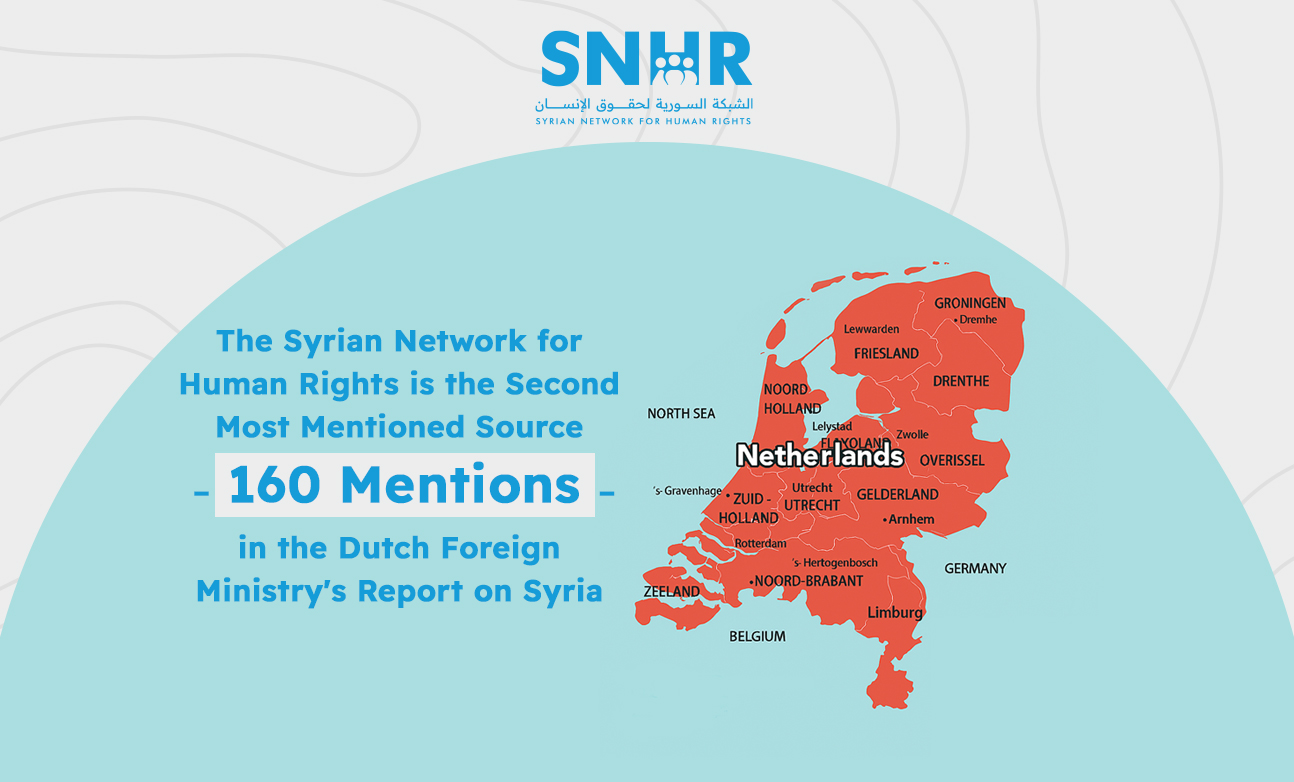
- Syrian Network for Human Rights (SNHR): 160 citations.
- United Nations Office for the Coordination of Humanitarian Affairs: 51 citations.
- Human Rights Watch: 27 citations.
It also relied on other sources, including UNICEF, the International Red Cross, a number of local and international organizations, and some media outlets and newspapers.
SNHR reviewed the 164-page report, which was published last May. The following is a summary of its main points:
The report addressed political developments, noting the collapse of the Assad regime after a surprise attack by opposition factions led by Hayat Tahrir al-Sham, which led to Bashar al-Assad fleeing to Russia and the complete disintegration of the state security apparatus.
It also refers to the complex military control landscape, where the transitional government failed to impose its authority over the entire Syrian territory, leaving the country in a state of division. The Syrian Democratic Forces (SDF) retained control of areas in the northeast, while the Turkish-backed Syrian National Army extended its influence over northern areas. The United States and Russia continued their military presence in a number of locations, alongside Israeli expansion in the south. The report noted that local armed factions continued to control areas such as Suwayda and Daraa, despite announcing their integration into the new state institutions.
On the security front, the report noted a state of instability and ongoing tensions, despite the absence of major military confrontations. It cited incidents of sectarian violence, particularly in the provinces of Homs and Latakia, as well as reprisals against members of the former regime. It concluded that the security changes did not lead to real stability, but rather created security vacuums that were exploited by local factions and surrounding geopolitical factors.
Regarding the situation of displaced persons and refugees, the report confirmed the continuation of internal displacement as a result of clashes, fear of arrest, and the absence of basic services. It also noted that conditions remain unfavorable for the return of refugees from abroad, given the lack of security and legal guarantees, the presence of mines and war remnants, and widespread destruction of infrastructure.
The report focused on the sharp deterioration in living conditions across the country, noting the collapse of basic services and the spread of poverty and unemployment. It also noted that the reconstruction projects launched by the transitional government continue to have limited impact due to weak institutions and a lack of coordination between the responsible parties.
The report also addressed the human rights situation in Syria, focusing on the documentation of SNHR, which documented the killing of at least 1,562 civilians in March alone, including 102 children, 99 women, and 33 medical personnel. It also monitored at least 880 cases of arbitrary detention since the beginning of 2025, as well as deaths under torture. The network expressed concern about the continuation of arbitrary detention practices and violations in areas under self-administration, calling for compliance with international human rights standards during the transition period.
The report addressed freedom of movement within Syria, emphasizing that movement between different areas of control remains fraught with danger due to the proliferation of checkpoints, lack of security coordination, and mistreatment of civilians, especially by armed factions. Women and activists face additional restrictions on their movement, and those coming from abroad are exposed to security risks when entering the country.
Regarding the reality of the judiciary and the rule of law, the report pointed to the fragility of existing judicial systems and the continued operation of field or exceptional courts. It also explained that judicial institutions in Damascus lack independence and are subject to the executive branch, while areas under self-administration are accused of imposing a non-transparent partisan justice system. Cases of torture and ill-treatment in detention centers remain common, without oversight or accountability.
The report concluded by addressing the issue of refugee return, noting that official calls for return are not being implemented in practice, given the continuing violations and the absence of legal frameworks to ensure safe, voluntary, and dignified return. Difficulties in recovering property and the lack of housing, education, and health services are additional obstacles that hinder return and further complicate the future of refugees.
The Syrian Network for Human Rights affirms that it has been and continues to be one of the most prominent human rights sources relied upon by the Dutch Ministry of Foreign Affairs in assessing the human rights situation in Syria, thanks to its daily work in documenting violations and recording them in an integrated database, which produces accurate statistics based on cumulative data and provides a comprehensive picture of the scale and continuity of violations.
The network renews its commitment to continue cooperating with UN and international bodies by providing them with information and data that contribute to supporting the rights of victims and exposing those responsible for violations.
To view the full report of the Dutch Ministry of Foreign Affairs, please download it via this link (The report is available in Dutch).
