


Available in:
Damascus – Syrian Network for Human Rights:
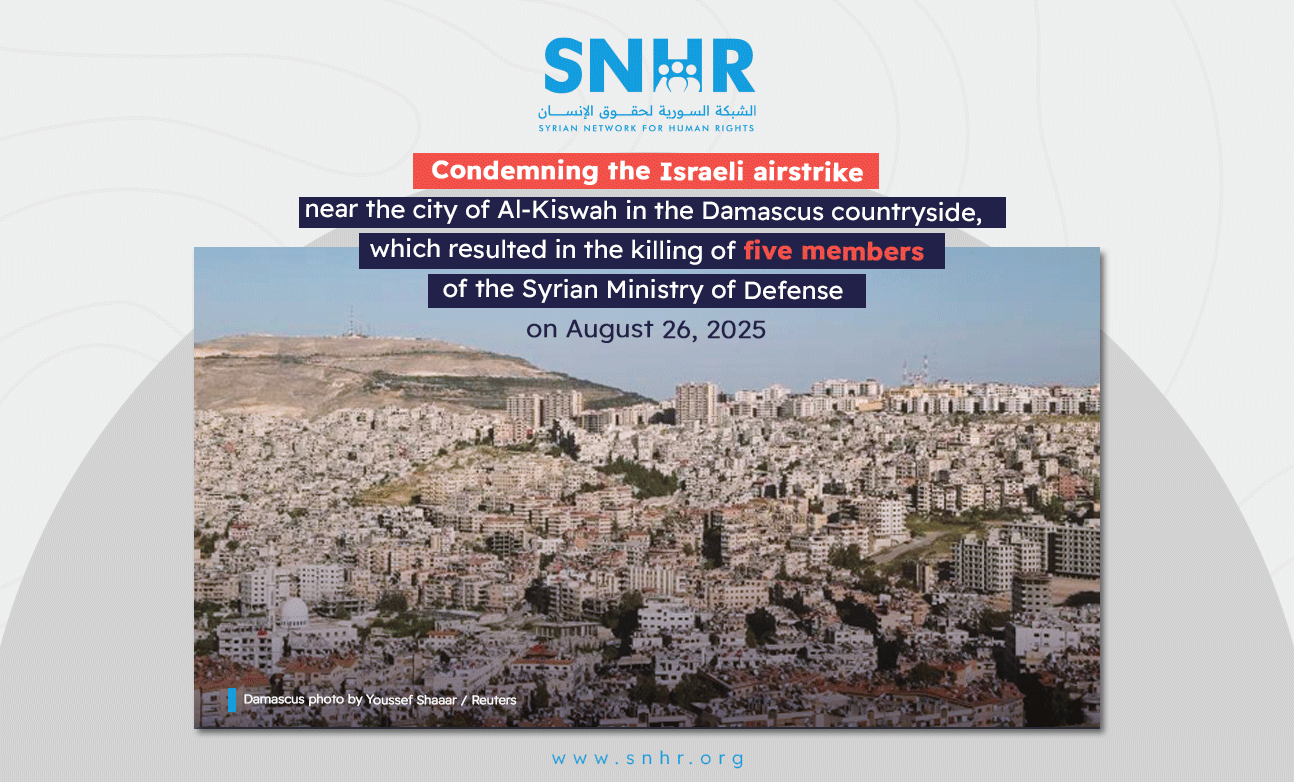
On Tuesday, August 26, 2025, at least five members of the Ministry of Defense forces of the Syrian transitional government were killed in an airstrike carried out by an Israeli drone on a site near Jabal al-Manea, close to the city of al-Kiswah, south of the Rif Dimashq Governorate, which is under the control of the transitional government.
According to what the SNHR documented through field sources, during a field patrol by Ministry of Defense military patrols near Jabal al-Manea, one of the patrols found surveillance and eavesdropping devices believed to be linked to an Israeli spy system. While attempting to deal with them, an Israeli drone launched an airstrike on the site, killing at least five personnel.
According to the information, Israeli aircraft continued to target the area and prevent access to it until the evening of the following day (Wednesday, August 27, 2025), at which time military groups affiliated with the Ministry of Defense of the Syrian Transitional Government were able to destroy some of the discovered devices and retrieve the bodies of the dead. On the same day, we recorded Israeli aircraft launching more than 10 raids on the vicinity of Jabal al-Manea and the Harjala area south of Rif Dimashq Governorate, followed by an airdrop operation by four helicopters southeast of the city of al-Kiswah. The airdrop operation lasted more than two hours, and no direct clashes were recorded with elements of the Syrian transitional government forces near the site. Sources, however, suggested that the objective of the operation was to completely destroy the system before any Syrian forces could reach it.
The SNHR continues to monitor and document violations committed by Israeli occupation forces inside Syrian territory, including airstrikes, incursions, ground invasions, and their associated repercussions. This includes human losses, arbitrary arrests, attacks on medical and media personnel, destruction of property, and encroachment on agricultural land and infrastructure within targeted areas.
The SNHR is continuing its investigation into this incident, including reviewing evidence and gathering more information. Anyone with additional details about the attack is encouraged to provide it via the official email address: [email protected]
The SNHR condemns this attack and reiterates its absolute rejection of any violation of Syrian territorial sovereignty, especially in light of the absence of any military threat emanating from Syrian territory. It asserts that targeting sites using Israeli drones inside Syrian territory constitutes a violation of Syrian sovereignty, expands the scope of the armed conflict, and increases the likelihood of civilians living in the vicinity of these military sites being exposed to serious harm, given that no warnings were issued prior to the execution of such attacks.
Legal conclusions
- The air attacks carried out by Israeli forces on August 26 and 27, 2025, targeting points and sites in Jabal al-Manea and near the city of al-Kiswah in the Rif Dimashq Governorate, constitute a violation of Article 2/4 of the United Nations Charter, which prohibits the use of force against the territorial integrity or political independence of any state.
- The Israeli authorities did not issue any official declaration or notification to the UN Security Council showing the existence of an imminent armed threat that would justify the use of force based on Article (51) of the United Nations Charter, which negates the condition of legitimate self-defense.
- Repeated military strikes without accountability or adherence to international legal procedures are an indication of a violation of the principle of the rule of international law and undermine the foundation upon which the prohibition on the use of force and the peaceful settlement of disputes are based.
Recommendations
First: To the United Nations Security Council
- Emphasizing the need to respect the provisions of the United Nations Charter, particularly Article (2/4) prohibiting the use of force in international relations and considering any military action outside this framework subject to legal accountability.
- Calling on Member States, including Israel, to strictly adhere to the principles of international humanitarian law in all military operations and to provide clear legal justifications for any use of force outside the borders, based on Article (51) of the Charter.
- Working to hold Israel accountable and bear direct responsibility for the consequences of violating the sovereignty of a Member State under the United Nations Charter.
Second: To the Syrian Transitional Government
- Implement a comprehensive and systematic documentation process for all violations resulting from Israeli airstrikes or ground incursions into Syrian territory, including identifying the locations of targets, the nature of casualties, and the timing of each incident. Demand that Israel pay all compensation to victims and compensate for material damage.
- Submit detailed memoranda to the United Nations, the Security Council, and the International Court of Justice (directly or through supporting countries), including a legal presentation of the violation of Syrian sovereignty, supported by data and evidence.
Third: To the International Commission of Inquiry, the Office of the High Commissioner for Human Rights, and the relevant special rapporteurs
- Include violations related to the use of Israeli force in Syria in the periodic reports submitted to the Human Rights Council, with a recommendation to open a path for international accountability and redress for confirmed violations.
- Demand that Israel cooperates with UN special mechanisms and provide legal justification for any military operations it carries out inside Syrian territory, in accordance with its obligations as a UN member state and pay all reparations due.
Fourth: To international and regional human rights organizations
- Continue documenting and monitoring Israeli violations and military incursions against civilians and infrastructure in Syria and develop legal and technical databases to support accountability efforts and clearly condemn such violations.
- Support international legal initiatives aimed at promoting respect for the principle of non-use of force and protecting civilians in the context of protracted conflicts or cross-border military operations.
- Enhance coordination between Syrian and international organizations to prepare comprehensive legal files that can be used in future international judicial proceedings or transitional justice mechanisms in Syria.
