


vailable in:
Damascus – The Syrian Network for Human Rights:
On January 18, 2026, Raqqa Governorate witnessed a large escalation in military operations, represented by the outbreak of armed movements of a tribal and popular nature against the Syrian Democratic Forces (SDF) in a number of villages and towns of the governorate and neighborhoods of Raqqa city, including the western countryside, the southeastern countryside and the city center. Tribal fighters managed to seize control of multiple areas and locations, while the Syrian Democratic Forces blew up key bridges at the city’s entrances. During these events, snipers belonging to the Syrian Democratic Forces were positioned on the roofs of buildings and directly targeted civilians, resulting in deaths and injuries among the residents, including civilians who did not participate in the fighting, coinciding with a partial withdrawal of elements and leaders from the same forces. It is worth noting that these developments coincided with military operations by the Syrian army in areas controlled by the Syrian Democratic Forces in the Aleppo countryside, its control over the cities of Deir Hafer and Maskana, and its approach to the borders of Raqqa Governorate.
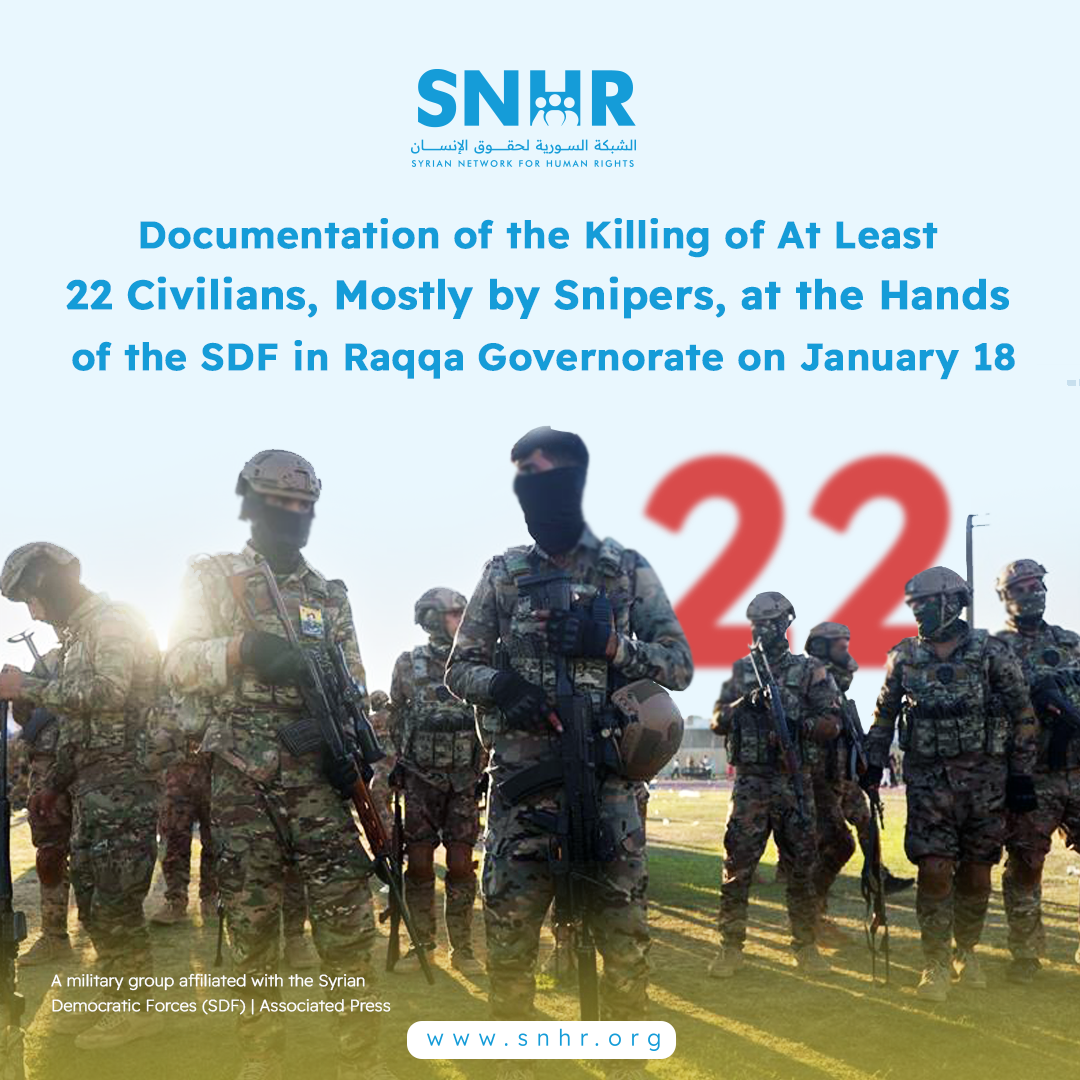
The Syrian Network for Human Rights documented, in a preliminary count, the killing of at least 22 civilians, including 3 children, by the Syrian Democratic Forces in Raqqa Governorate, during the events that took place in the governorate on Sunday, January 18, 2026. The Network verified that all the victims documented in this count did not participate in the clashes or in the attacks by tribal fighters on the Syrian Democratic Forces’ positions.
According to the SNHR’s field monitor in Raqqa, and based on reliable local sources, the patterns of killing targeting documented civilian victims were as follows:
- 12 civilians killed by sniper fire.
- 5 civilians, including a child, killed by direct gunfire.
- 2 children killed by ground shelling targeting residential areas.
- 2 civilians killed by a suicide drone strike.
- 1 civilian abducted by members of the Syrian Democratic Forces on January 18, 2026, and found dead the following day.
SNHR was also able to identify the locations of the documented civilian deaths so far as follows:
- Raqqa City: 12 civilians, including one child.
- Tabqa City/Western Countryside: 5 civilians, including two children.
- Al-Karama District/Eastern Countryside: 1 civilian.
- Al-Jadidat Village/Eastern Countryside: 1 civilian.
- Al-Hawas Area/Eastern Countryside: 1 civilian.
- Hazima Road/Northern Countryside: 1 civilian.
- Near Al-Aqtan Prison/North Raqqa: 1 civilian.
In addition, SNHR documented the killing of one civilian in a car bomb explosion in the al-Karama area of eastern Raqqa countryside. At the time of this statement, the Network was unable to definitively determine who was responsible for planting the car bomb. However, available information and the context of military control in the area suggest a connection to the Syrian Democratic Forces, which were deployed in the area before their withdrawal.
The Syrian Network for Human Rights (SNHR) confirms that it continues to monitor all reports of violations and is conducting investigations into abuses committed by all armed forces and parties involved in military operations, particularly extrajudicial killings of civilians. This monitoring has been ongoing since the escalation of military operations in Aleppo on January 6, 2026, and their subsequent spread to the eastern countryside and the governorates of Raqqa, Deir ez-Zor, and Hasakah. The SNHR is reviewing and collecting further evidence, information, and field testimonies. Therefore, the SNHR urges anyone with information or details related to this incident to provide them via its official email address: [email protected]
Condemnation, Recommendations, Conclusions:
The Syrian Network for Human Rights condemns in the strongest terms the targeting and killing of civilians directly by the Syrian Democratic Forces in Raqqa Governorate. These actions constitute a flagrant violation of international humanitarian law and the rights of civilians, and calls on all parties to commit to protecting the civilian population and ensuring that these crimes are not repeated.
Legal Conclusions:
- Targeting unarmed civilians, including children, constitutes a grave violation of international humanitarian law and amounts to a war crime under the Rome Statute of the International Criminal Court.
- The use of snipers to target individuals outside the scope of hostilities constitutes the willful killing of civilians and violates the fundamental principles of distinction between civilians and combatants.
- Targeting populated civilian areas with ground and drone strikes may amount to indiscriminate or disproportionate attacks, which are prohibited under international humanitarian law, particularly the Geneva Conventions and their Additional Protocols.
- Destroying bridges and obstructing the movement of civilians without clear military justification constitutes an attack on civilian infrastructure and violates the rights of civilians to freedom of movement and to conduct their daily lives.
- The abduction of a civilian and his subsequent killing constitutes the crime of enforced disappearance followed by extrajudicial killing, a grave violation of the protection obligations set forth in the International Covenant on Civil and Political Rights and of the peremptory norms relating to the protection of the right to life.
Recommendations by SNHR:
- Investigation and Accountability: SNHR calls on national authorities and relevant international bodies to conduct independent and transparent investigations into the killings of civilians in Raqqa Governorate on January 18, 2026, identify those responsible, and bring them to justice in accordance with international law.
- Protection of Civilians: SNHR emphasizes the need to adhere to the principles of distinction, proportionality, and due process during military operations, and to protect civilians and civilian infrastructure from any direct or indiscriminate targeting, in accordance with the rules of international humanitarian law.
- Ending Impunity: Working to establish effective mechanisms to prevent impunity for crimes committed, including strengthening oversight of the conduct of forces and warring parties, and ensuring accountability for any entity or individual found to be involved in violations.
- Supporting Victims and Those Affected: Providing protection and care for victims and their families, including psychosocial support, and ensuring redress and compensation for losses of life or property.
- Continuous documentation: Continuing independent monitoring and documentation of all violations, including the collection of evidence and field testimonies, thereby enhancing accountability opportunities and safeguarding the victims’ right to truth and justice.
