


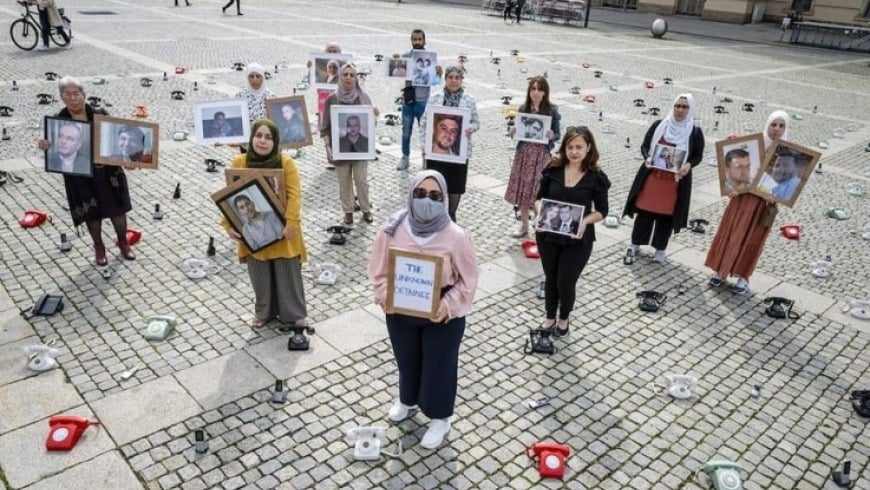
People hold portraits and a placard during a protest as around 300 landline telephones placed by Syrian families stand at the Bebelplatz as a call to governments to do more to seek information about detained people in Syria, in Berlin, Germany August 28, 2021. REUTERS/Hannibal Hanschke
Available in:
Fadel Abdulghany
The special nature of the missing persons file in the Syrian conflict
The issue of enforced disappearance in Syria is one of the most sensitive and complex in the records of gross human rights violations witnessed during the armed conflict since 2011. The Assad Regime has systematically employed enforced disappearance as a weapon of war, targeting individuals first, and later their families and communities, in an attempt to dismantle the social fabric and establish a climate of terror and subservience. According to the Syrian Network for Human Rights’ database, at least 177,000 people remain forcibly disappeared by various parties to the conflict, placing this issue at the forefront of transitional justice priorities after the fall of the Assad regime in December 2024.
From this perspective, the issue of missing persons cannot be addressed in isolation from the comprehensive process of transitional justice, given its legal, political, and social dimensions that extend beyond the individual impact of the missing person to encompass the entire societal fabric. Therefore, addressing it requires a comprehensive approach that links truth-telling, accountability, reparations, and institutional reform.
Institutional challenges to establishing a separate body for missing persons
Presidential Decree No. 19 of 2025 establishing a national commission for missing persons raises a set of complex institutional challenges that could undermine the comprehensive human rights response to the tragedies of enforced disappearance.
The lack of institutional coordination is one of the most significant risks resulting from the structural separation of the Commission on Missing Persons from the truth commission and other components of transitional justice. Addressing cases of enforced disappearance is not limited to documenting physical absences or identifying places of detention; it requires direct interaction with accountability mechanisms, compensation and reparations committees, and their role in reforming the security and judicial institutions responsible for the crime. This organizational separation may create a knowledge and information gap and prevent the exchange of evidence, data, and records between relevant bodies, leading to duplication of assessments, weak accountability, and a hindrance to the course of justice.
Establishing a new body outside the transitional justice system also necessarily requires the establishment of separate administrative and organizational structures (including documentation teams, legal support, psychological support, and complaints management), which increases bureaucratic costs and creates functional conflicts with existing structures. For example, the new body will be responsible for collecting victims’ testimonies and documenting cases, which fundamentally overlaps with the mandate of the truth commission. This raises normative and procedural issues, potentially leading to inconsistencies in official recommendations and reports, or duplication in victim representation and amplification.
This institutional division could undermine the comprehensive vision required by transitional justice and delay its complementary processes, such as investigation, accountability, and reparations. This would negatively impact victims’ confidence in the ability of the new institutions to provide them with justice and restore their rights.
The Syrian experience, given its complexities and the accumulation of violations, imposes the need for a coherent transitional justice system that ensures the smooth functioning of institutional processes. This requires not parallel entities, but rather interconnected units within a unified structure capable of collectively responding to post-conflict challenges.
The vision put forward by the Syrian Network for Human Rights last April proposed subsuming the Commission for Missing Persons within the Truth Commission. This is a functional and methodological necessity based on the complex nature of enforced disappearance, which requires a comprehensive understanding of its political and institutional contexts. This is the role typically assumed by truth commissions in comparative transitional justice experiences. Integrating the Commission for Missing Persons within the Truth Commission ensures vital functional integration with other components of transitional justice, including judicial accountability bodies, compensation and reparation committees, memorialization programs, and mechanisms for reforming security and judicial institutions.
Uncovering the fate of the disappeared is a prerequisite for holding perpetrators accountable. Documenting violations also forms the basis for determining victims’ eligibility for compensation and contributes to addressing the collective trauma resulting from continued absence and denial. Furthermore, the existence of a dedicated unit for missing persons within the Truth Commission allows for the benefit of existing technical infrastructure, legal expertise, and institutional referral mechanisms, enhancing its efficiency and avoiding duplication or conflict of tasks.
The issue of missing persons in Syria represents a crucial test of the seriousness of the transitional process in achieving justice and accountability. At its core, it embodies a national tragedy that requires a comprehensive institutional approach that addresses enforced disappearance as a multidimensional crime: humanitarian, legal, and societal. The integration of the Commission for Missing Persons into the Truth Commission embodies the philosophy of transitional justice, based on unity of process and integration of objectives. The success of the transitional justice process in Syria requires an integrated institutional design, in which the bodies are built on clear coordination and participatory foundations that provide Syrian society with an opportunity to overcome the legacy of absence and denial.
