


Available in:
Damascus – the Syrian Network for Human Rights:
In July 2026, the European Union Agency for Asylum (EUAA) released a Country of Origin Information (COI) report that addressed the developments of the security situation in Syria over the period extending from October 1, 2025, until May 31, 2026, with a particular focus on the main conflicts, the armed actors, the international involvement, and the recent security trends, in addition to the security situation and the impact of the conflict on civilians in each of Syria’s fourteen governorates.
According to what is stated in it, the report aims to provide relevant information for the assessment of applications for international protection, particularly for use in updating the agency’s country guidance on Syria. The report covers the reference period from October 1, 2025, until May 31, 2026, relying on public and specialized sources that were researched up until May 29, 2026, with limited additions introduced during the quality review until June 19, 2026. The report was prepared in accordance with the agency’s COI report methodology (2023), and it relies heavily on the Armed Conflict Location & Event Data Project (ACLED) with regard to the security incidents, and on the Syrian Network for Human Rights (SNHR) with regard to the human rights situation, alongside the bodies of the United Nations, most notably the Independent International Commission of Inquiry on the Syrian Arab Republic, and a wide range of media and research organizations.
The report is divided into two main parts; the first part offers a general description of the security situation, including an overview of the current conflicts, the armed actors operating in the country, the international involvement, and the recent security trends, including data on the security incidents, civilian casualties, the damage inflicted on infrastructure by the conflict and the explosive remnants of war, and displacement and return. As for the second part, it addresses the security situation and the impact of the conflict on civilians in each of Syria’s fourteen governorates, where each governorate chapter follows a unified structure: the administrative division and population estimates, control over territory and the most prominent armed actors, security trends, security incidents, civilian casualties, damage to infrastructure and remnants of war, and conflict-driven displacement and return.
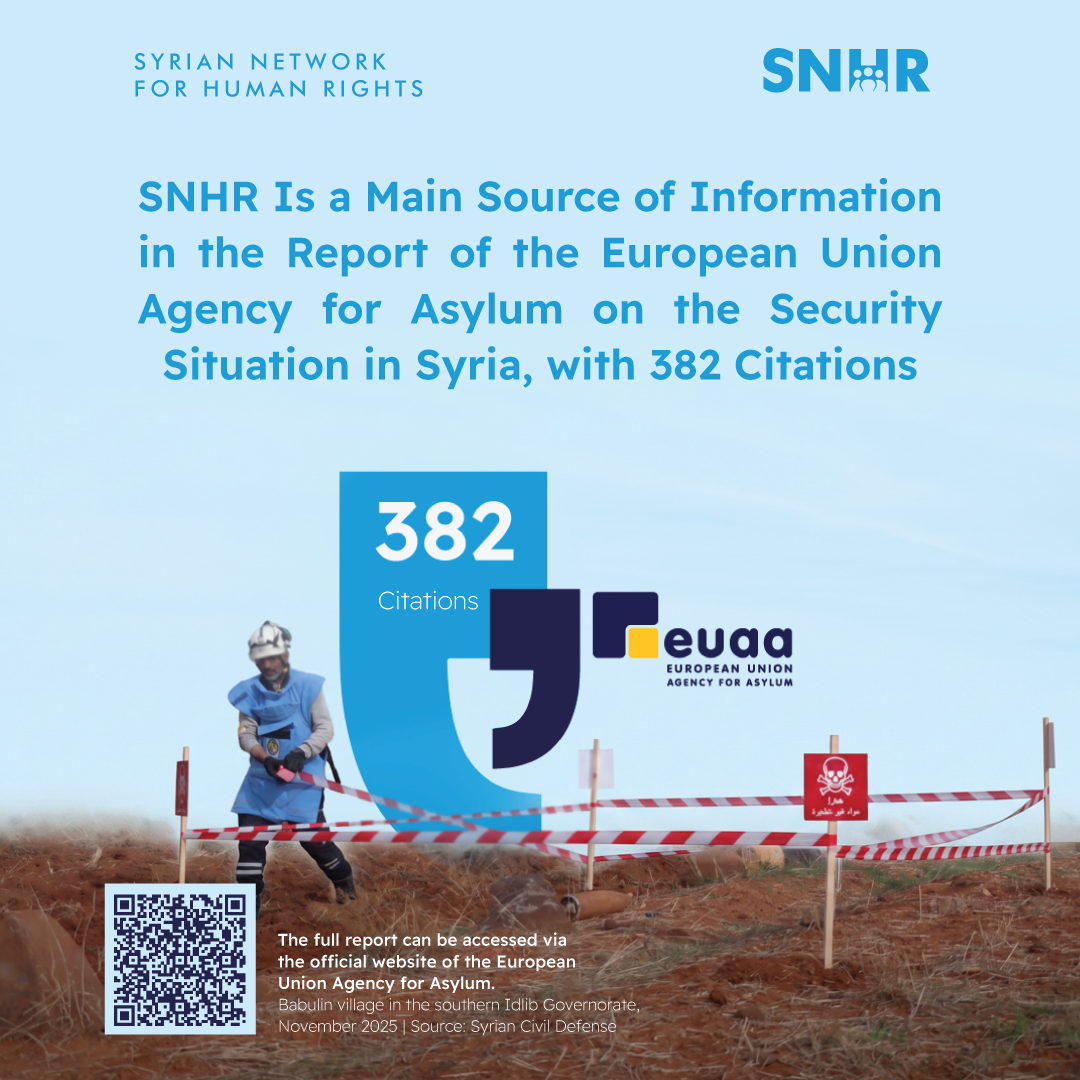
The report relied on SNHR’s reports and data as a main source for the figures of civilian casualties; SNHR was cited 382 times across the various parts of the report, alongside 284 references to ACLED, 93 references to the United Nations High Commissioner for Refugees, and 13 references to Amnesty International, in addition to multiple UN bodies and a wide range of international and local organizations.
The report places the current security landscape in the context of what followed the fall of the regime of Bashar al-Assad on December 8, 2024. It describes a transitional phase during which the new government sought to extend its control over the entirety of the Syrian territory, at a time where it faced recurrent waves of violence of a sectarian, regional, and political character. The report identifies four main theaters of conflict and instability. The first of these is in the coastal region, where attacks carried out by elements loyal to the Assad regime against the government’s security forces in early March 2025 led to wide-scale retaliatory operations in Latakia, Tartus, Homs, and Hama, during which more than 1,400 persons were killed, most of them civilians from the Alawite community. The report points to the continuation of tensions, arrest campaigns, and intermittent acts of violence in the coastal governorates during the reference period.
