


Exclusion Threatens to Weaken Legal Reform and Undermine Community Trust
Available in:
Damascus, May 22, 2025 – The Syrian Network for Human Rights (SNHR) issued a human rights statement highlighting two decisions issued by the Ministry of Justice in the Syrian Transitional Government on April 23, 2025, which stipulated the formation of two committees to amend the Code of Civil Procedure and the Evidence Law. SNHR stated that these two laws constitute the cornerstone for regulating litigation and evidence procedures in the Syrian civil judicial system.
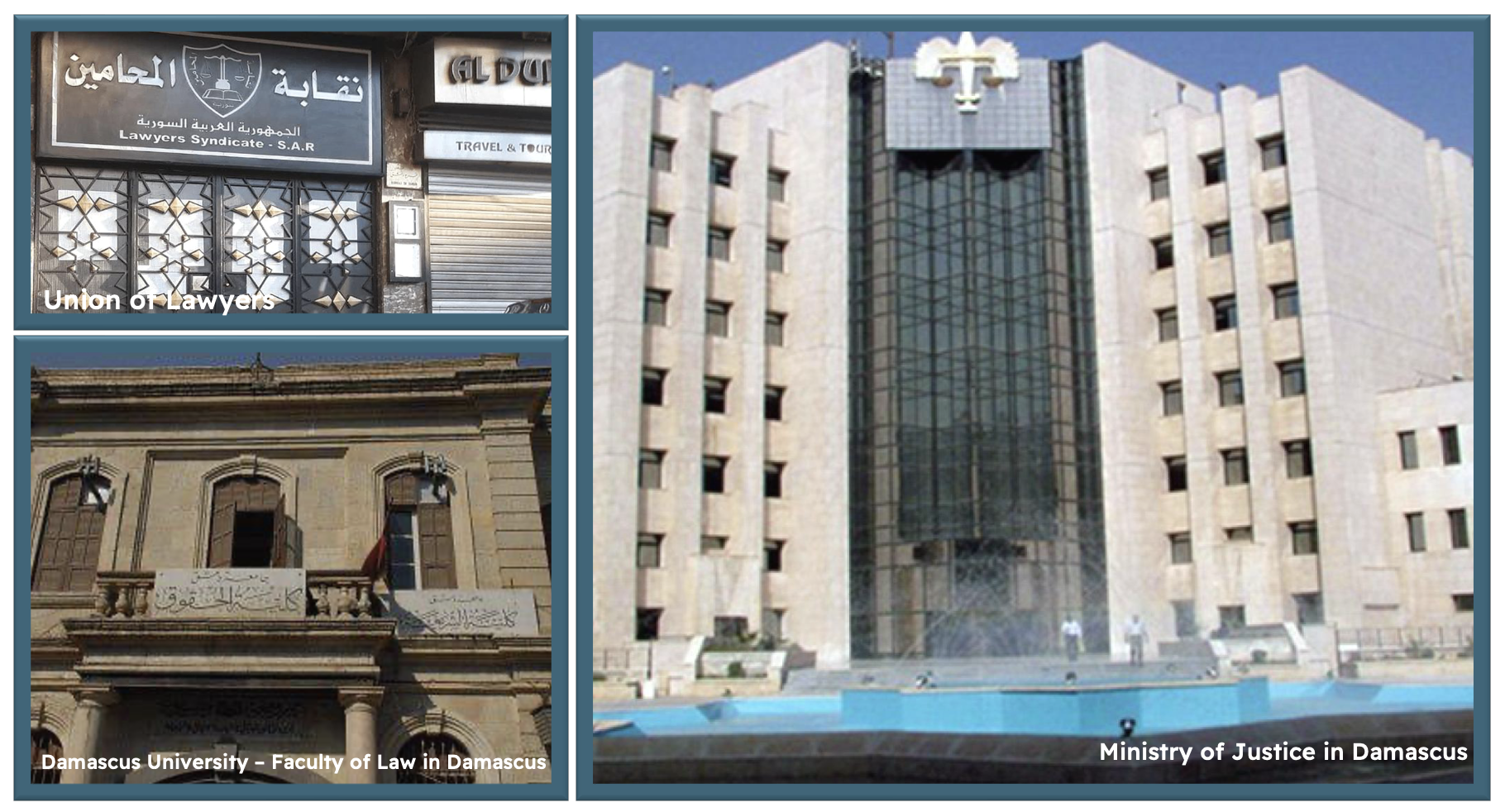
The statement explained that the network closely monitored the formation of the two committees and noted the absence of any representation from key components of the Syrian legal structure, most notably the Bar Association, law school professors, and civil society organizations, all of which are organically linked to the implementation, development, and teaching of these laws. The statement noted that this exclusion raises serious doubts about the legal reform methodology being followed and threatens to erode public confidence in it.
The statement emphasized that the Civil Procedure Code regulates the procedures that guarantee the right to litigation, from filing a lawsuit to enforcing judgments, while the Evidence Law regulates the means of proof and directly impacts individuals’ ability to protect their rights before the judiciary. It explained that both laws suffer from outdated formulation, and that the amendments to some of their articles under the former regime were made without transparency or genuine involvement of relevant parties, rendering them incapable of addressing structural gaps or keeping pace with legal and technological transformations.
The statement noted that the transitional phase represents a unique opportunity to radically reform the legal system based on participation, pluralism, and institutional oversight. It also noted that any amendments to the basic laws related to individual rights and fair trial guarantees must be undertaken within a broad, participatory approach, not through narrow administrative decisions that fail to take into account professional or community representation.
The statement noted that the network views the absence of the Bar Association, law professors, and civil society organizations as a violation of relevant international standards, such as the United Nations Principles on the Role of Lawyers (Havana 1990), the recommendations of the Special Rapporteur on the Independence of Judges and Lawyers, the Basic Principles on the Independence of the Judiciary, the United Nations Convention against Corruption, and the International Covenants on Civil and Political Rights and Economic, Social, and Cultural Rights, which are agreements ratified by the Syrian state decades ago.
The statement also emphasized that the involvement of these entities is not merely a symbolic or propaganda demand, but rather represents a fundamental guarantee for the effectiveness and efficiency of laws, and their ability to respond to the needs of reality and the aspirations of justice. It explained that the Bar Association, as the highest professional body for lawyers, possesses direct and in-depth knowledge of the details of legal application, that university professors offer critical scientific approaches, and that civil society organizations represent the link between legislation, social justice, and human rights.
In conclusion, SNHR called on the Ministry of Justice in the transitional government to review the mechanism for forming the two legal committees, expand them to include representatives from relevant professional, academic, and civil society organizations, and adhere to the highest levels of transparency in their work. This ensures that the amendments comply with legal and constitutional standards and enshrines the principle of partnership, which must be the cornerstone of any legal reform during the transitional phase in Syria.
