


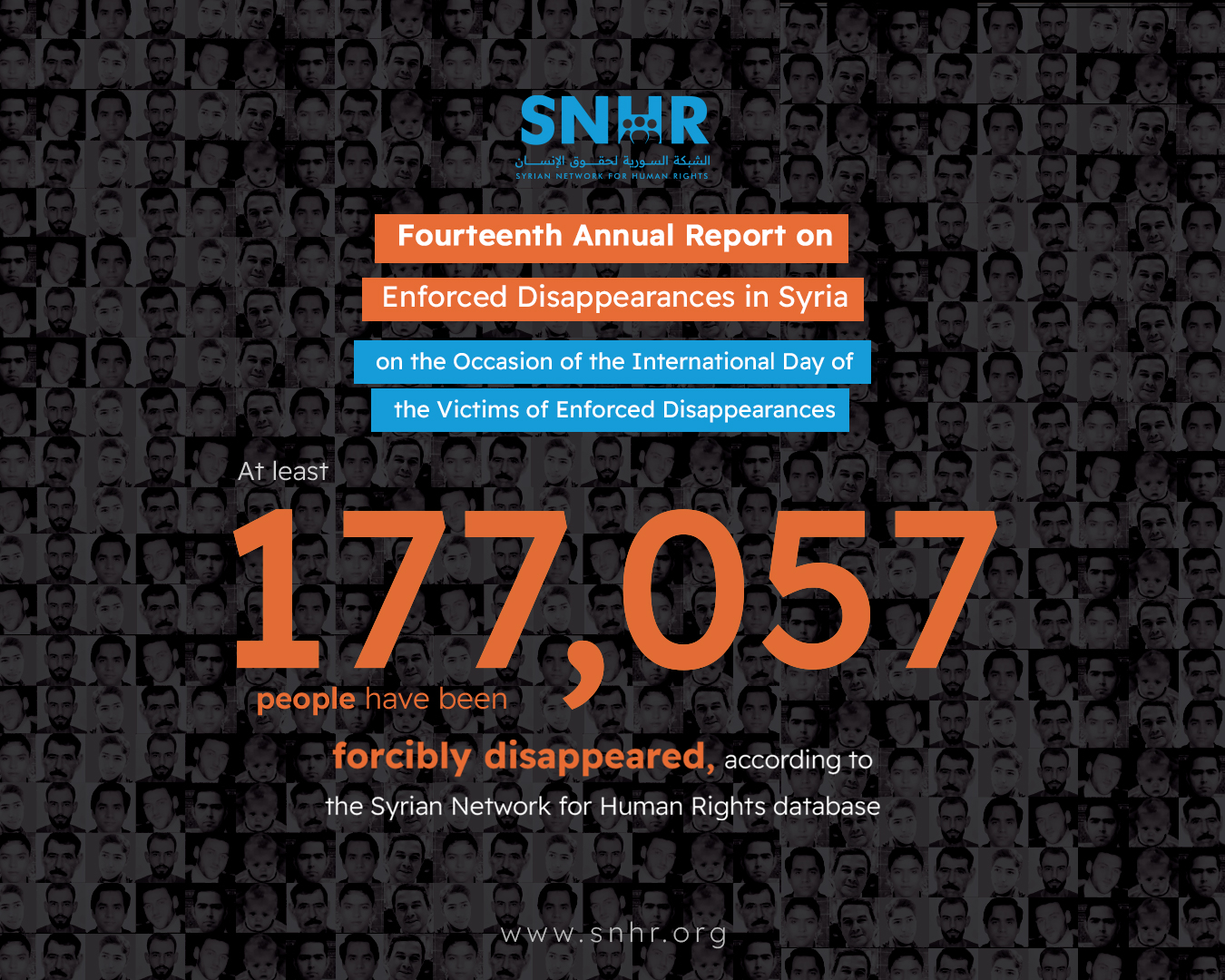
At least 177,057 people have been forcibly disappeared, according to the Syrian Network for Human Rights database
Available in:
Damascus – The Syrian Network for Human Rights (SNHR) released its fourteenth annual expanded report on enforced disappearance in Syria, marking the International Day in Support of Victims of Enforced Disappearance on August 30. This report aims to shed light on the reality of this crime and its devastating impact on hundreds of thousands of victims and their families. This publication is an extension of the network’s documentation and advocacy efforts since 2011, with the aim of uncovering the facts, supporting victims’ right to justice, and promoting accountability for the grave violations committed against them.
This edition takes on particular significance in light of the radical transformations the country witnessed following the fall of Bashar al-Assad’s regime on December 8, 2024, and the subsequent evacuation of detainees from prisons and security centers under his control. This revealed an additional aspect of the scale of the humanitarian catastrophe caused by enforced disappearances in Syria over more than fourteen years. A limited number of detainees were released alive, while the fate of tens of thousands remained unknown, rendering them forcibly disappeared. This revealed a major tragedy that affected Syrian society as a whole, reflecting the structural and pervasive nature of enforced disappearances in the Syrian context.
Since 2011, Bashar al-Assad’s regime has systematically adopted a policy of enforced disappearance to terrorize and collectively punish society, targeting dissidents and civilians from various regions and affiliations. The Syrian Network for Human Rights has documented this crime through analytical and statistical reports that reveal the role of the security and judicial apparatuses in entrenching it and its devastating effects on Syrian society.
The Syrian Network for Human Rights’ database reveals that Bashar al-Assad’s regime is responsible for more than 90% of enforced disappearances, a crime associated with arbitrary detention, torture, and denial of a fair trial, leaving victims’ families with collective suffering. The report seeks to highlight the human dimensions of this crime through live testimonies and an analysis of systematic patterns, offering recommendations to achieve justice, uncover the truth, and ensure its non-recurrence.
The number of enforced disappearances recorded by the Syrian Network for Human Rights (SNHR) has significantly increased since the fall of the Bashar al-Assad regime. This has been due to the release of detainees previously considered disappeared, the transfer of others to the category of “disappeared,” the expansion of documentation, and the strengthening of evidence and data. These developments have contributed to a more accurate update of the database, revealing the true extent of the catastrophe and its profound repercussions on Syrian society.
According to the Syrian Network for Human Rights database, at least 181,312 individuals, including 5,332 children and 9,201 women (adult females), remain arbitrarily detained or forcibly disappeared in Syria from March 2011 to August 2025. Of these, 160,123 individuals, including 3,736 children and 8,014 women (adult females), are in detention centers run by the former Bashar al-Assad regime, and 21,189 individuals, including 1,596 children and 1,187 women (adult females), are in detention centers run by other parties to the conflict in Syria.
Statistics also indicate that the former Bashar al-Assad regime was primarily responsible for the vast majority of enforced disappearances, with its centers alone responsible for approximately 90% of the total documented cases, equivalent to 9 out of 10 disappeared persons. Detainees often become forcibly disappeared within a short period of their arrest or immediately after their detention, reflecting the systematic and planned nature of this practice, carried out on a large scale with direct or implicit support from senior levels within the regime.
According to the Syrian Network for Human Rights’ database, at least 177,057 people, including 4,536 children and 8,984 women (adult females), have been forcibly disappeared in Syria since March 2011 until August 2025. Of these, 160,123 people, including 3,736 children and 8,014 women (adult females), are in detention centers run by the former Bashar al-Assad regime, and 16,934 people, including 800 children and 970 women (adult females), are in detention centers run by other parties to the conflict in Syria.
The report stated that the Syrian Network for Human Rights has continued to document arbitrary detention and enforced disappearance for more than 14 years, developing its national database and relying on diverse field sources to ensure accuracy, making its reports a reliable international reference. The network works in cooperation with the United Nations and human rights organizations, in addition to coordinating with the National Commission for Missing Persons in Syria, with the aim of uncovering the truth, protecting the rights of victims and their families, promoting accountability, and preventing impunity.
Presidential decrees issued on May 17, 2025, established the National Commission for Transitional Justice and the National Commission for Missing Persons, with mandates including truth-telling, accountability, reparations, and national reconciliation. The Syrian Network for Human Rights believes that the success of these two commissions depends on their independence, complementarity with previous human rights documentation efforts, and the involvement of victims and civil society in policymaking. It is also essential to adopt a comprehensive approach to justice that ensures truth-telling, accountability, compensation, and non-repetition.
The report was concluded with a set of legal conclusions and recommendations to address the issue of enforced disappearances in Syria:
Legal conclusions:
- Enforced disappearance is an ongoing crime under international law:
Data from the Syrian Network for Human Rights shows that enforced disappearances committed since 2011 constitute an ongoing crime under international human rights law, including the Declaration on the Protection of All Persons from Enforced Disappearance (UN General Assembly Resolution 47/133 of 1992) and the International Covenant on Civil and Political Rights, and may, in certain contexts, amount to a crime against humanity under international criminal law.
This crime continues to have enormous humanitarian and legal dimensions, with at least 181,312 people still arbitrarily detained or forcibly disappeared as of August 2025, including 5,332 children and 9,201 women (adult females), according to the Syrian Network for Human Rights database, indicating that its effects extend for years and require long-term solutions.
The crime of enforced disappearance has been one of the greatest human rights and humanitarian challenges since 2011. Addressing it requires sustained legal and human rights commitments and comprehensive measures that include uncovering the truth, holding officials accountable, supporting victims, and strengthening independent state institutions to ensure non-recurrence.
- The responsibility of the former Bashar al-Assad regime and other parties:
The SNHR’s database indicates that the vast majority of enforced disappearances were committed by the former Bashar al-Assad regime (approximately 90% of documented cases), with other parties to the conflict also bearing responsibility for similar violations to varying degrees. This requires legal accountability in accordance with international standards, which stipulate the prevention of impunity, the application of fair trial rules, and individual criminal responsibility.
- The impact of enforced disappearance on victims and their families:
The report demonstrates that enforced disappearance is not merely an individual violation, but rather results in widespread collective harm to families and communities, with psychological, social, economic, and legal dimensions. This reality imposes an obligation on the state and national transitional justice bodies to provide appropriate legal and humanitarian support to victims and their families and ensure effective reparations.
- The necessity of comprehensive and independent documentation:
Accurate and independent documentation is the cornerstone of any prosecution or reparations policy. The work of the Syrian Network for Human Rights and other human rights organizations is a primary source of evidence that can be used in national and international courts, while ensuring strict adherence to verification standards, witness protection, and the integrity of the chain of custody.
- The Role of New National Institutions:
The establishment of the National Transitional Justice Commission and the Commission for Missing Persons is an important legal step, but their effectiveness depends on their actual independence and full access to information and documents. The legal frameworks regulating their work must be formulated to ensure the representation of victims and civil society, and to consolidate the comprehensiveness of justice, from truth-telling to accountability, reparations, and prevention of recurrence.
- Legal Framework to Ensure Non-Impunity:
A sound legal approach to the effects of enforced disappearances is based on uncovering the truth, identifying individual responsibilities, and bringing those involved to justice. Data confirms that any attempt to ignore or restrict accountability, whether against the former Bashar al-Assad regime or other parties, will perpetuate impunity and undermine confidence in national institutions and the transitional justice process.
Recommendations for addressing the issue of enforced disappearances in Syria
- Disclosure of information and the right of families to know their fate:
Conduct comprehensive and independent investigations that include all officials, from field personnel to administrative and security leaders, directly or indirectly implicated.
Involve international experts and independent lawyers to ensure integrity and transparency and apply international principles for investigating gross human rights violations.
Ensure the participation of victims’ representatives in monitoring investigations and receiving periodic updates.
- Identifying burial sites and exhuming bodies:
Requiring previously detained parties to disclose the locations of mass burials and any records related to the transfer or burial of victims.
Using advanced technologies, including aerial photography and satellite imagery, to locate the sites without compromising the preservation of evidence and the protection of the crime scene.
- Families’ Rights:
Providing families with accurate and documented information about the circumstances of the disappearance and the circumstances of death, if any.
Providing ongoing psychological and social support in accordance with international standards for victims’ rights.
- Documenting the details of the deaths of forcibly disappeared persons:
Clarifying the circumstances of death and accurately determining its causes, whether as a result of torture, medical negligence, or extrajudicial execution.
Investigating any potential role of security or medical agencies in facilitating or covering up crimes.
Obtaining relevant official documents (death records, administrative correspondence, detention records) and verifying their authenticity through independent reviews to ensure the reliability of the evidence.
Returning the remains of victims to their families with respect for human dignity, providing official reports on the circumstances of death, and providing psychological and logistical support to families during the recovery process, while documenting them to ensure transparency.
- Dealing with Mass Graves:
Monitoring and documenting sites based on survivor and witness testimonies, remote sensing techniques, and satellite imagery.
Protecting sites from tampering and preserving the legal chain of custody of evidence.
Conducting DNA tests to match remains with missing persons’ records and documenting physical evidence for presentation to competent judicial authorities.
Publishing periodic and detailed reports on the results of investigations and making them available to victims’ families and the international community.
- Investigations and Accountability:
Establish specialized judicial mechanisms (national, mixed, or international, depending on jurisdiction) to prosecute perpetrators of enforced disappearances.
Cooperate with the International Criminal Court, regional judicial bodies, and existing mechanisms to implement the principle of individual criminal responsibility for crimes against humanity.
Issuance of international arrest and prosecution warrants, cooperation with INTERPOL, and implementation of sufficient measures and travel bans for wanted persons wherever possible.
Establish a fund to compensate victims and their families financially and morally and provide psychosocial support services and reintegration programs for affected communities.
- Ensuring Non-Recurrence of Crimes:
Reform the security and judicial institutions by dismantling the agencies involved and restructuring them according to standards of independence, oversight, and accountability, under independent professional supervision.
Enact clear laws criminalizing enforced disappearance, ensuring accountability for perpetrators, and safeguarding victims’ rights.
Include explicit provisions in the new constitution that protect human rights and prohibit grave violations.
Launch national awareness-raising and capacity-building programs for personnel involved in documentation and accountability and promote a legal culture of victims’ rights.
- Strengthening International Cooperation:
Working with relevant international bodies, including the International Committee of the Red Cross, the Office of the United Nations High Commissioner for Human Rights, relevant commissions of inquiry, and international institutions concerned with missing persons, and exchanging information with international human rights organizations to ensure comprehensive and shared documentation.
Concluding bilateral and multilateral cooperation agreements with countries where perpetrators or witnesses may be located, and developing mechanisms for the exchange of evidence, mutual judicial assistance, and cross-border prosecution of those responsible.
