


Available in:
Damascus – The Syrian Network for Human Rights (SNHR):
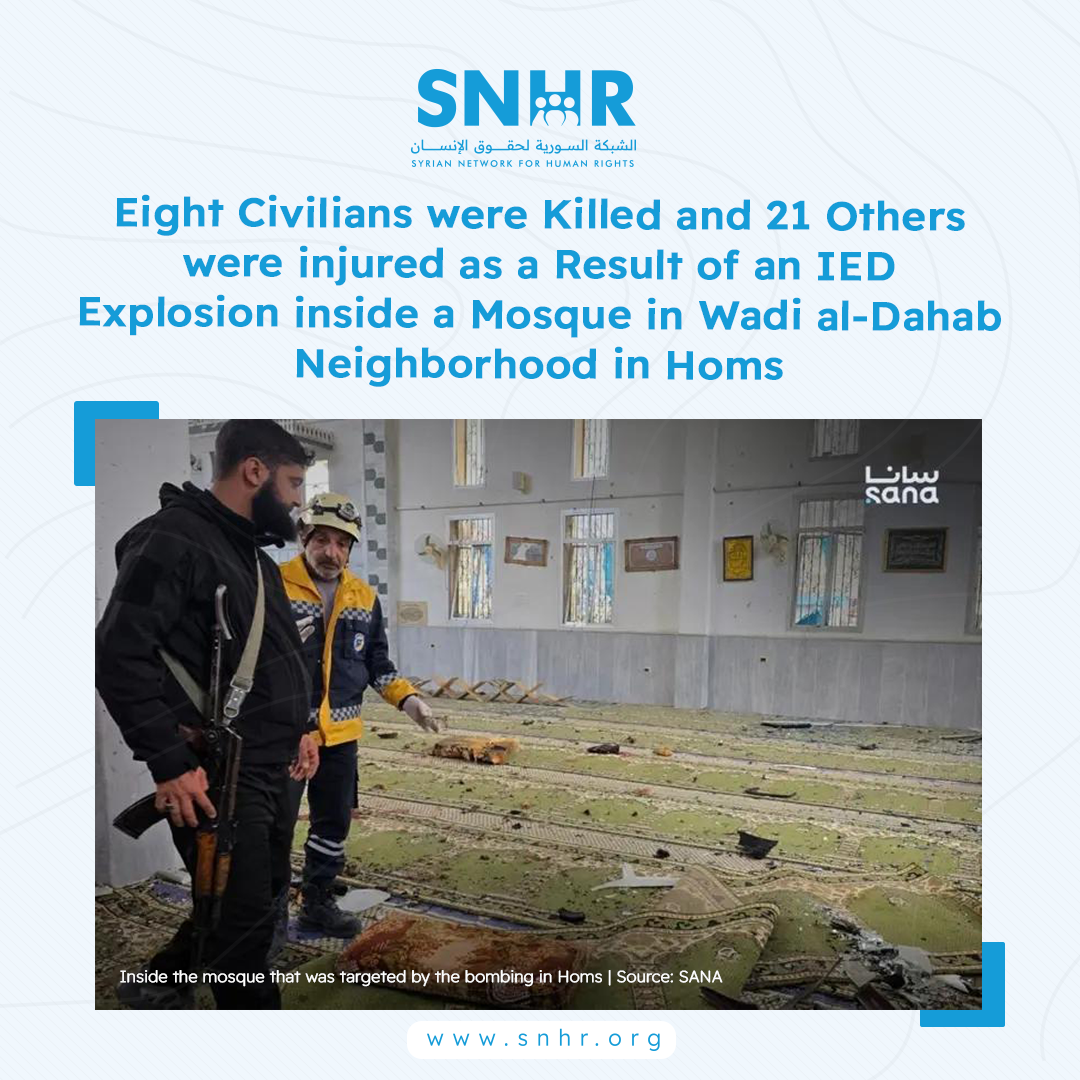
On Friday, December 26, 2025, eight civilians, including a child, were killed and more than 21 others were injured, some critically, when an improvised explosive device (IED) planted by unknown individuals detonated inside the Imam Ali bin Abi Talib Mosque in the Wadi al-Dahab neighborhood of Homs, a city predominantly inhabited by members of the Alawite sect, during Friday prayers. The explosion partially destroyed the mosque building and caused significant material damage to the surrounding area. The area is under the control of the Syrian government. The Syrian Network for Human Rights was able to document the names of the eight victims.
Sources reported that a group calling itself Saraya Ansar al-Sunna, allegedly affiliated with ISIS, claimed responsibility for the attack. However, the Syrian Network for Human Rights has not yet been able to independently verify this information.
SNHR condemns this bombing that targeted civilians and places of worship. It affirms that such attacks constitute a grave violation of international humanitarian law and international human rights law and fall under the category of atrocities committed against the civilian population. The Network mourns all the lives lost in this attack, expresses its solidarity with the victims and their families, and extends its deepest condolences to the families of the victims. It also wishes a speedy and full recovery to all those injured. The Network confirms that it is continuing its efforts to investigate and gather relevant evidence and information. Therefore, the Network calls upon anyone with information or details related to this incident to provide them via its official email address: [email protected]
Legal Conclusions:
- Legal Characterization of the Act and Nature of the Target: Planting an explosive device inside a mosque during Friday prayers and targeting a civilian gathering in a place of worship constitutes, by its very nature, an attack directed against civilians and/or an indiscriminate attack. This is because an explosive device is a weapon that cannot be precisely aimed at a specific military target within a place crowded with worshippers, making the anticipated harm to civilians generally uncontrollable. A mosque remains a civilian object and a facility dedicated to religion, enjoying special protection unless it is proven that it lost this protection by being converted into an effective military use at the time of the incident.
- The Right to Life and the State’s Positive Obligations: Regardless of the security situation, the incident directly affects:
- The right to life under the International Covenant on Civil and Political Rights (Article 6).
- The right to physical integrity and personal security, and the associated protection from violence.
- Freedom of religion and worship (Article 18), including the protection of places of worship from attacks that prevent the practice of religious rites or intimidate worshippers. As the controlling authority in the territory, the State has positive obligations that extend beyond refraining from unlawful killings. These obligations include taking reasonable measures to prevent anticipated attacks, protecting religious gatherings, and effectively assessing risks, particularly in light of the proliferation of improvised explosive devices and remnants of war.
- The Duty to Conduct a Prompt and Effective Investigation and Procedural Standards: The authorities have legal obligations to conduct an investigation that is:
- Prompt, effective, independent, and impartial, and capable of establishing the facts, the perpetrator(s), and the chain of command.
- Compliant with international standards for investigating violent or suspected unlawful deaths, including the preservation of evidence, the integrity of the crime scene, the protection of witnesses, and the provision of adequate information to the public and victims’ families.
- Failure to conduct an investigation that meets these standards may itself constitute a breach of the State’s obligations under the International Covenant on Civil and Political Rights.
Recommendations for Stakeholders
First: The Competent Syrian Authorities
- Investigation and Accountability
- Launch an immediate criminal investigation, adhering to standards of independence and impartiality, and form a specialized investigation team comprising explosives experts, forensic experts, and medical examiners.
- Secure the crime scene, establish the chain of evidence, and preserve relevant recordings, cameras, and communications.
- Prosecute those responsible, including direct perpetrators, instigators, financiers, and any logistical contributions or support networks.
- Protection of Witnesses and Victims
- Implementing a witness and whistleblower protection program, preventing any acts of reprisal or intimidation, and providing safe channels for reporting.
- Preventive Measures to Protect Places of Worship
- Developing a phased security plan based on risk assessments for places of worship, including non-intrusive and organized inspections, coordination with mosque administrators, designation of entry and exit points, and training of security personnel on human rights standards during inspections and the prevention of sectarian discrimination.
- Transparency and Public Communication
- Issuing periodic official statements that include information that can be released without jeopardizing the investigation, avoiding inflammatory rhetoric or sectarian generalizations, and adopting a discourse that protects civil peace and focuses on the protection of civilians.
- Reparation
- Establish a clear path for reparation in accordance with international standards, including compensation, rehabilitation, restitution, and guarantees of non-repetition, with a simplified mechanism for proving damage and disbursing compensation.
Second: The Public Prosecution and the Judiciary
- Proper Legal Classification
- Consideration of multiple classifications based on the evidence: premeditated/manslaughter, attempted murder, causing permanent disability, destruction of public property, explosives crimes, and organized crime, while adhering to international standards for a fair trial.
- Effectiveness of Procedures
- Expediting arrest warrants, activating cooperation between governorates, issuing judicial orders for the preservation of digital data, and tracking financing and communications.
- Victims’ Rights in Proceedings
- Enabling victims’ families to participate in the proceedings to the extent permitted by law, informing them of the progress of the investigation, and facilitating their access to case files within the established regulations.
Third: Security Agencies, Police, and Local Authorities
- Enhancing Explosives Detection Capabilities
- Increasing the efficiency of explosives detection units and canine units, and updating security screening procedures around places of worship and gathering places.
- Regulating Security Conduct
- Ensuring that search and seizure procedures are proportionate, non-discriminatory, accountable, and carried out with respect for human dignity.
- Early Warning and Community Participation
- Establishing early warning channels in cooperation with local councils and those in charge of places of worship, and developing mechanisms for receiving reports quickly.
Fourth: Religious and Community Leaders
- Combating Incitement and Hate Speech
- Issuing public statements condemning the targeting, preventing its exploitation to incite sectarian strife, and supporting de-escalation based on rights and accountability.
- Enhancing Safety within Places of Worship
- Cooperating with authorities in regulating entry and exit, and training volunteers in safety and evacuation procedures, without turning places of worship into security spaces that violate religious privacy.
Fifth: The United Nations, International Mechanisms, and Supporting Entities
- Technical Support for Explosive Ordnance Disposal
- Supporting programs for the removal of improvised explosive devices and remnants of war in civilian areas, providing local teams with equipment and training, and expanding explosive ordnance risk awareness activities.
- Support for Investigations and Capacity Building
- Providing technical assistance in forensics, evidence management, crime scene safety, and building specialized units, while emphasizing the independence of investigations and respect for the rule of law.
- Human Rights Monitoring and Protection of Civilians
- Strengthening monitoring and documentation, supporting measures to protect civilians, and providing public recommendations to reduce the risk of targeting based on religion or sect.
