


Available in:
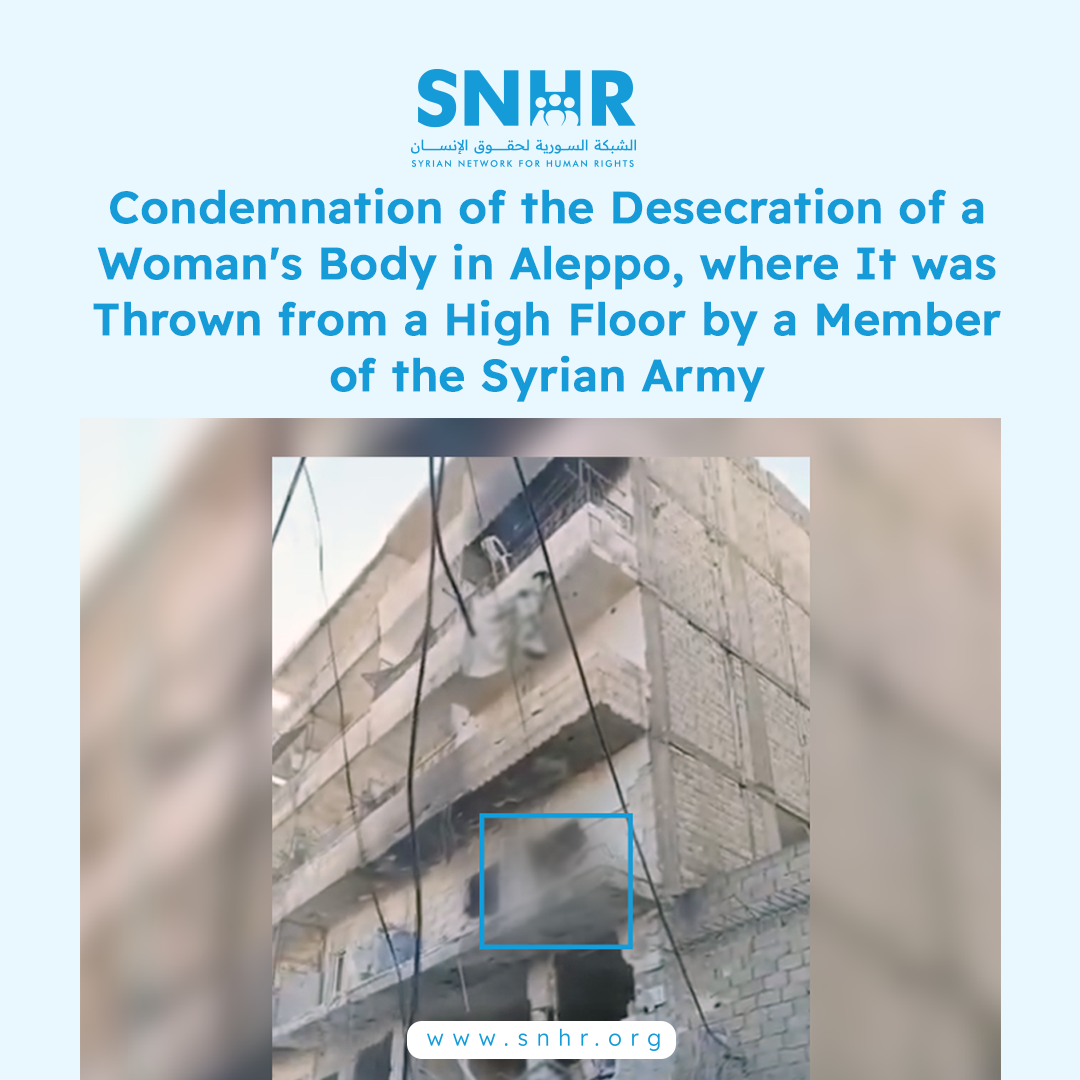
On Saturday, January 10, 2026, a video, which we were able to verify, circulated online and on social media platforms showing a member of the Syrian army throwing the body of a woman from a high floor of a building in a neighborhood of Aleppo that was then under the control of the Syrian Democratic Forces. This act constitutes a violation of international humanitarian law, which requires respect for the dead and the preservation of their dignity, regardless of their status or affiliation, and prohibits mutilation or degrading treatment of corpses.
In an attempt to justify this violation, voices emerged describing the woman as a fighter and sniper who had been killing civilians in Aleppo, particularly in the neighborhoods surrounding Ashrafieh and Sheikh Maqsoud. Even assuming the veracity of this claim, what was attributed to her constitutes a violation warranting legal accountability under the appropriate frameworks, but it does not justify further violations against her. Regardless of her status, whether civilian or military, the prohibition against mutilating corpses is a binding customary rule that cannot be violated under any circumstances.
The Syrian Network for Human Rights (SNHR) condemns the mutilation of corpses, affirming that it constitutes a violation of international humanitarian law, particularly the rules obligating parties to the conflict to respect the bodies of the dead and prohibiting their mutilation or degrading treatment. The Network also emphasizes that human dignity remains inviolable even after death and must not be violated under any circumstances.
Recommendations to the Syrian Government
- Open an immediate, serious and independent investigation, listen to witnesses, and preserve relevant clips and materials in accordance with procedural safety standards.
- The individual in question shall be temporarily suspended from duty and immediately referred to the competent judicial authorities, ensuring that the investigation is not influenced, witnesses are not intimidated, and evidence is not tampered with.
- Clear and public military orders shall be issued prohibiting any conduct that violates the dignity of the deceased. These orders shall be disseminated to all formations and units and incorporated into the rules of engagement and military discipline.
- Adopt mandatory and regular training measures in international humanitarian law for all combatants and commanders, including prohibitions on mutilating corpses, obligations regarding the handling of the dead and their remains, and internal reporting mechanisms.
- Establish an effective internal mechanism for reporting, accountability, and discipline, allowing for the receipt of complaints, ensuring the protection of whistleblowers and witnesses, and outlining clear procedures for disciplinary and criminal sanctions.
- Publishing the results of the investigation and its main conclusions to the public within the limits of the requirements of justice, in a way that enhances transparency, rebuilds trust, and confirms zero tolerance for violations.
