


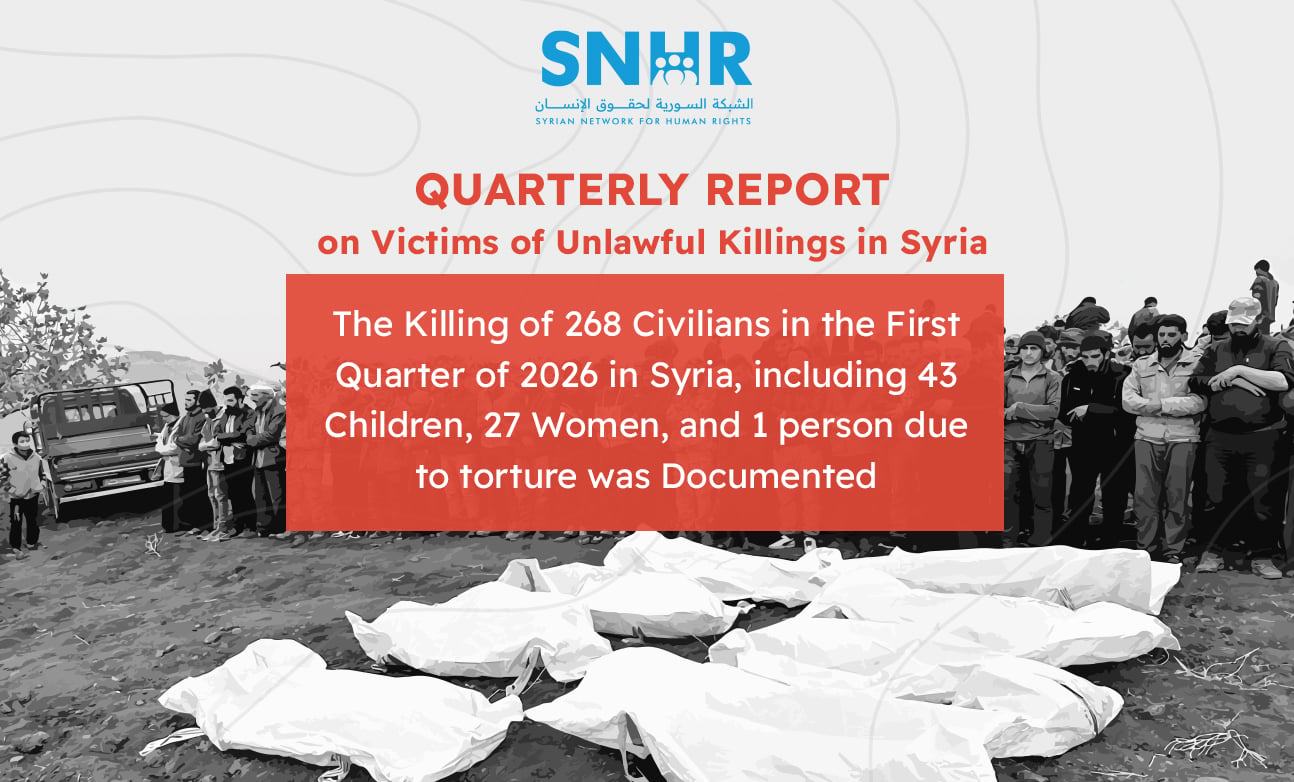
The Killing of 268 Civilians in the First Quarter of 2026 in Syria, including 43 Children, 27 Women, and 1 person due to torture was Documented
Available in:
Damascus – The Syrian Network for Human Rights:
The Syrian Network for Human Rights (SNHR) today released its quarterly report on the toll of unlawful killings and attacks on civilian objects in Syria during the first quarter of 2026, documenting the killing of 268 civilians, including 43 children and 27 women, in addition to the death of one person due to torture, and recording 4 massacres during the period from January to the end of March 2026. The report also documented the killing of 8 medical personnel and one media worker within the total toll.
The report emphasizes that this tally represents the minimum number of deaths the network was able to document and verify during the reporting period, given the logistical and financial challenges that impacted its ability to conduct field monitoring and follow-up. It also clarifies that some of the documented deaths during this quarter may have occurred months earlier; therefore, the report distinguishes between the date of documentation and the estimated date of the incident. The network bases this tally solely on the number of civilians, or those considered as such, and does not include combatants killed during clashes or while carrying out military operations.
According to SNHR’s documentation, civilian casualties were distributed according to the responsible party or pattern of violence as follows: 126 civilians were killed by gunfire from sources the network could not identify; 57 civilians were killed by the Syrian Democratic Forces, including one person who died as a result of torture; 25 civilians were killed by landmines of unknown origin; 23 civilians were killed in bombings whose perpetrators could not be identified; 20 civilians were killed by unidentified individuals; 11 civilians were killed by Syrian government forces; 4 civilians were killed by remnants of the Assad regime; and 2 civilians were killed by ISIS. These figures indicate that civilians in Syria continue to face risks from multiple sources, including acts of violence for which responsibility remains undetermined in a significant number of cases.
The report indicates that children and women constituted approximately 27% of all documented civilian casualties, reflecting the severe impact of violence on the most vulnerable groups. The geographical distribution of victims also shows that Aleppo Governorate recorded the highest number of casualties, accounting for nearly 28% of the total, followed by Homs Governorate with approximately 15%. These data suggest a continued high concentration of violence in certain governorates, with varying patterns of responsibility and risk across different regions.
Regarding attacks on civilian objects, the report documented at least 17 attacks on civilian facilities during the first quarter of 2026, including three attacks targeting educational facilities, four targeting medical facilities, and one targeting a place of worship. The report documented that 10 of these attacks were carried out by the Syrian Democratic Forces (SDF), four were caused by projectiles whose source the network could not determine, two by unidentified actors, and one by Syrian government forces. January 2026 saw the highest number of these incidents, with 14 out of the 17, and Aleppo Governorate was the most affected, recording nine attacks.
SNHR affirms that killings resulting from torture, attacks on protected civilian objects, and any disproportionate, indiscriminate, or non-directed attacks constitute grave violations of international human rights law and international humanitarian law, and warrant independent and effective investigations and legal accountability for those responsible. Furthermore, the high number of deaths caused by landmines, explosions, and unexploded ordnance reflects the continued failure to protect civilians.
The Network calls on the Syrian government to open serious and independent investigations into all incidents of killing civilians, particularly deaths under torture and attacks on civilian infrastructure, and to make the results of these investigations public. It also calls for urgent measures to protect civilians, control weapons, enhance demining and the removal of explosive remnants of war, and cooperate with relevant international mechanisms, including by supporting the preservation of evidence and the protection of crime sites. The Network further calls on the Syrian Democratic Forces to cease all attacks that violate international humanitarian law, disclose the fate of those responsible for documented violations, publish the results of investigations, provide compensation to victims and their families, and provide maps of the locations of mines planted by its forces in civilian areas.
The Network also calls on the Office of the High Commissioner for Human Rights to support capacity building for Syrian authorities in investigating cases of arbitrary deprivation of life in accordance with international standards, particularly the Minnesota Protocol. It further calls on the Independent International Commission of Inquiry and the International, Impartial and Independent Mechanism to give special priority to patterns of killing related to the transitional period, including killings by unidentified actors and attacks on civilian objects, and to work on preserving and analyzing evidence to support future accountability. The network also appeals to the international community to increase funding for mine clearance and support independent investigations.
The Syrian Network for Human Rights believes that the documentation in this report clearly demonstrates that the decrease in the intensity of the armed conflict in Syria has not automatically led to effective protection for civilians. The continued killings, the widening scope of violence perpetrated by unknown perpetrators, and the repeated attacks on civilian infrastructure all point to the fragility of the security and legal situation in Syria. Therefore, protecting the right to life, ensuring accountability, and preventing the recurrence of violations must be at the heart of any national or international approach to the transitional phase in Syria.
