


Available in:
Fadel Abdulghany
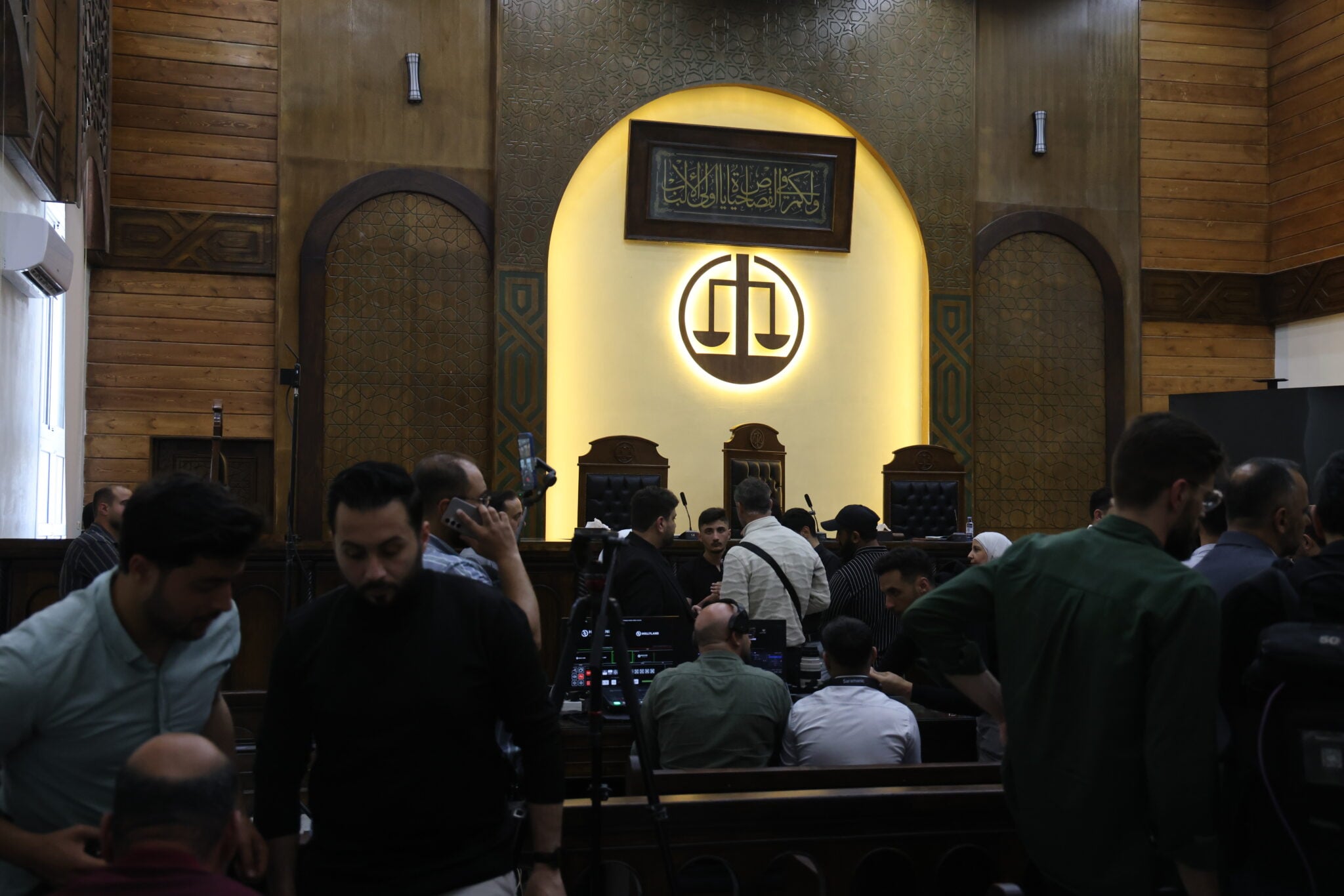
The trial of Atef Najib opened on 26 April before the Fourth Criminal Court in Damascus, constituting the first national criminal proceeding against a senior figure in Assad’s security apparatus in post-regime Syria. Najib is the maternal cousin of Bashar al-Assad and the former head of the Political Security Branch in Daraa. He was a member of the Security Committee in Daraa Governorate, a senior coordination mechanism that brings together the heads of the security agencies operating in the governorate within a single framework to direct security operations, including detention, repression, and the suppression of protests.
Najib appeared in a public session attended by the families of victims from Daraa and representatives of human rights organizations, opening a national judicial track for individual criminal responsibility. Bashar al-Assad and Maher al-Assad were also summoned as defendants in absentia in the same case. Nevertheless, the trial reveals a number of structural constraints that delineate the limits of what Syrian national law can achieve in the field of accountability.
The fundamental problem lies on the legislative side; the Syrian Penal Code does not define war crimes or crimes against humanity as independent legal categories. The conduct attributed to Najib—including systematic killing, torture, arbitrary detention, and the persecution of civilians—satisfies the material elements of crimes against humanity under Article 7 of the Rome Statute.
Nevertheless, the charges will most likely be classified under ordinary criminal provisions, such as murder, torture, and abuse of authority, given the absence of provisions in national law that incorporate the elements of international crimes. This is not a matter of judicial discretion, but rather a direct consequence of the absence of legislative text. The implication is that any judgment issued will be unable to reflect the systematic and widespread nature of the crimes.
However, this legislative gap does not render the proceedings devoid of a legal basis. Article 15(2) of the International Covenant on Civil and Political Rights, which Syria has ratified, permits the prosecution of acts that were considered criminal under customary international law at the time of their commission, even in the absence of corresponding national legislation. Crimes against humanity have been entrenched in international custom since before the Nuremberg trials. Therefore, applying this classification to conduct committed in 2011 does not constitute retroactive criminalization.
However, Article 15(2) addresses the principle of legality and does not address the mechanism of application. The Syrian court does not possess, within its national law, any text defining the elements of crimes against humanity, their components, or the modes of liability associated with them, which means that the legal basis for the trial exists in principle, but the legislative instrument required to apply it before a national court is in practice absent.
The presence of the victims’ relatives, who travelled from Daraa as personal claimants under the Syrian Code of Criminal Procedure, carries significant procedural meaning. Syrian law grants personal claimants the right to file claims alongside the public action, and a victim’s filing of a claim obliges the Public Prosecution to pursue the case. This grants victims genuine standing as participants, a feature consistent with the principle of victim participation in international criminal justice.
Alongside the legislative gap, the question of fair trial guarantees emerges as a test of the credibility of the proceedings. The challenge here is that establishing fair trial guarantees in a transitional context requires an institutional infrastructure that has not yet been completed, including the independence of the public prosecution, the competence of the defense bar, and the transparency of the proceedings.
The question of the death penalty raises a direct conflict between Syrian national law and international obligations. Syrian law permits the death penalty for crimes that go far beyond murder, placing it outside the scope of compliance with Article 6(2) of the International Covenant on Civil and Political Rights, which the Human Rights Committee has interpreted as restricting the death penalty to cases involving intentional killing.
The causal problem here is specific: a defendant facing execution has no incentive to cooperate in disclosing command structures, the locations of mass graves, or the fate of the forcibly disappeared, whereas a defendant serving a long term of imprisonment retains such an incentive. Beyond treaty law, the prohibition of public execution is widely regarded as part of customary international human rights law standards.
The trial of Atef Najib establishes a national judicial precedent, carries significant symbolism for the families of his victims, and demonstrates a degree of seriousness in the path of accountability, but it does not close the structural gaps. The government has not yet enacted a transitional justice law, has not established a special court, and has not integrated crimes against humanity into national legislation. Building the institutional infrastructure remains essential, including legislative reform that incorporates the categories of international criminal law, judicial appointments that guarantee independence, and systematic coordination between national proceedings and international mechanisms.
Originally published on the Syrian newspaper Al-Thawra website (in Arabic)
