


Available in:
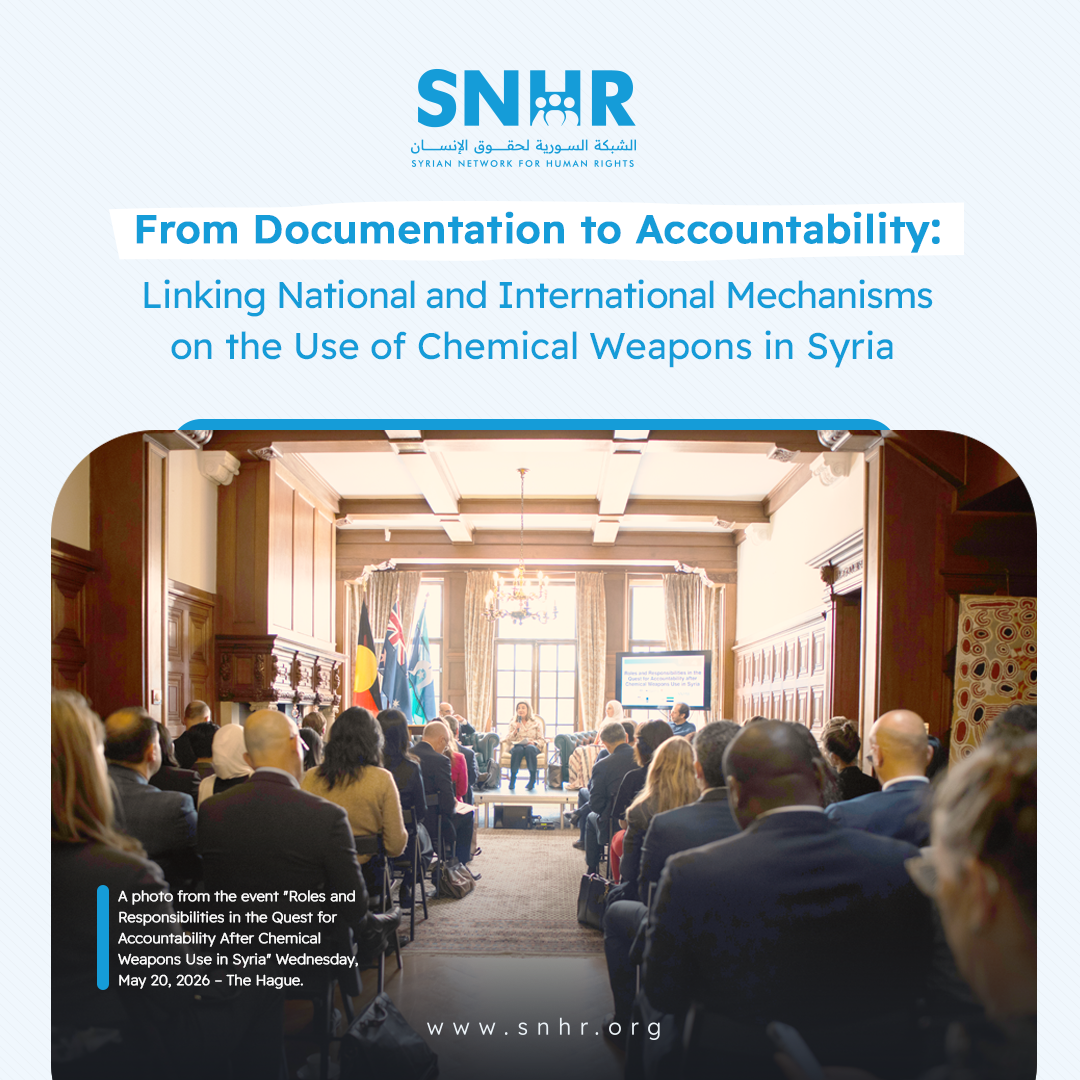
Damascus, The Syrian Network for Human Rights (SNHR), in cooperation with the Permanent Mission of the Syrian Arab Republic to the Organisation for the Prohibition of Chemical Weapons (OPCW) in The Hague, and under the patronage of Australia, Germany, France, the Netherlands, and Switzerland, held an international event titled: Roles and Responsibilities in the Quest for Accountability After Chemical Weapons Use in Syria, on Wednesday, 20 May 2026. The event coincided with the launch of the English edition of Fadel Abdulghany’s book, titled: The Assad Regime’s Use of Chemical Weapons in a Non-International Armed Conflict, Russian Protection of It in the Security Council, and the International Community’s Failure to Prevent the Recurrence of Their Use, with the aim of signing and distributing copies of the book. The event brought together diplomats, including a number of ambassadors, legal experts, and human rights defenders, to discuss ways of converting the documented evidence on the use of chemical weapons in Syria into actual accountability measures.
The chemical weapons file in Syria represents one of the most complex challenges facing the global prohibition regime; the repeated use of these weapons during the Syrian conflict has revealed a glaring deficiency in the areas of identifying responsibility, enforcement, and accountability. The Syrian Network for Human Rights has documented 222 chemical weapons attacks in Syria from the first documented use on 23 December 2012 up until 8 December 2024, of which the Assad regime carried out 217 attacks (approximately 98%), resulting in the killing of 1,514 individuals, including 214 children and 262 women, and the injury of more than 11,080 others, while ISIS carried out the remaining five attacks in Aleppo governorate, injuring 132 individuals. At the UN level, the Independent International Commission of Inquiry on the Syrian Arab Republic (CoI) has documented the Assad regime’s use of chemical weapons on at least 32 occasions, while the OPCW Fact-Finding Mission (FFM) has confirmed the use of these weapons in 43 incidents out of 58 incidents investigated.
The event included statements from a number of prominent diplomatic and human rights figures, among the most notable of whom were: Dr. Gregory French, Ambassador and Permanent Representative of Australia to the OPCW; Ambassador Thomas Schieb, Permanent Representative of Germany to the Organisation; and Ambassador Paul Huijts, Permanent Representative of the Netherlands; alongside Mohammed Katoub, the Permanent Representative of the Syrian Arab Republic to the Organisation; and Dr. Yasmin Al-Nahlawi from the National Commission for Transitional Justice in Syria; and Aditya Menon, Head of the Investigations and Analysis Section at the International, Impartial and Independent Mechanism for Syria (IIIM). The session was moderated by Kathryne Bomberger, Director-General of the International Commission on Missing Persons, and the OPCW Legal Adviser, Mr. Johan Rautenbach. Fadel Abdulghany, the Executive Director of the Syrian Network for Human Rights, also delivered a detailed statement in which he reviewed the legal and humanitarian framework surrounding the Syrian chemical weapons file, drawing on his academic book and on years of field documentation.
Abdulghany reviewed the patterns of use between 2012 and 2019, noting that their earliest instances were in December 2012 in Homs, before escalating to its peak on 21 August 2013, when the Assad regime carried out a sarin gas attack on Eastern and Western Ghouta. He clarified that the Syrian Network for Human Rights’ documentation records the killing of 1,144 individuals in this attack, including 99 children and 194 women, in addition to the injury of around 5,935 others. He noted that the lethality of the attack was compounded because the sarin gas seeped into the basements where civilians had taken refuge to escape conventional shelling, thus turning their shelters into sites of mass asphyxiation.
Abdulghany concluded that chemical weapons were not used to achieve direct military gains, but rather were deployed as a tool of terror, siege, and forced displacement, and that the patterns of their use point clearly to a command-and-control chain extending to the highest levels of the former Syrian military and political leadership.
In the course of his remarks on the failures of accountability, Abdulghany summed up the problem in a comprehensive phrase: “The evidence exists, but the judicial institution capable of using it doesn’t exist.” Syria is not a State Party to the Rome Statute of the International Criminal Court, and the Court therefore has no jurisdiction over the situation except by way of a referral from the UN Security Council under Article 13(b), a referral which Russia and China blocked by using the right of veto in May 2014. Despite what the UN mechanisms and the OPCW have achieved in establishing an extensive factual record, this effort hasn’t translated, thus far, into actual criminal prosecutions.
Abdulghany addressed the phase following the fall of the Assad regime in December 2024, noting that it has produced new conditions that haven’t ended the existing legal and institutional dilemmas, but have opened up promising horizons. Within the past few months, the OPCW has identified 26 new sites that hadn’t previously been declared, in addition to more than 100 sites suspected of being linked to the chemical program. He affirmed that the new Syrian government’s cooperation with the Organisation, including its acknowledgement of the mandate of the Investigation and Identification Team, constitutes a positive step that deserves to be reinforced.
Abdulghany pointed out, in this context, that the case of Brigadier General Adnan Aboud Hilweh, the Deputy Director of the Artillery and Missile Directorate in the Damascus countryside, who served in Units 155 and 157 (which are accused of using missiles and chemical weapons against areas outside the regime’s control), represents a concrete test of the seriousness of the new path. He clarified that the Syrian Network for Human Rights describes him as one of the most prominent officers responsible for the sarin gas massacre in Eastern Ghouta on 21 August 2013, and that he remains in detention with the Syrian authorities in Damascus as of April 2026, without any public confirmation of the procedural status of any judicial investigation against him, nor whether the IIIM or the Investigation and Identification Team (IIT) or any national prosecuting authority exercising universal jurisdiction has sought to access him. He affirmed that his detention constitutes one of the few concrete developments in the area of accountability since December 2024, and that an officer of this institutional standing is capable, in the event of his cooperation with investigators, of giving testimony regarding the chain of command for the Eastern Ghouta attack, the role of the Scientific Studies and Research Center (SSRC) in preparing the chemical munitions, and the authorization mechanism that links the political decision to tactical execution, and this last point is specifically the most significant gap in the current evidentiary record. He stressed that the obligations of the new Syrian government, under customary international humanitarian law and Article VII of the Chemical Weapons Convention, require that this detention should lead to judicial proceedings that meet international standards and within which international bodies are afforded the possibility of access, warning that a rushed or procedurally flawed trial isn’t a lesser form of justice, but rather a harm in its own right that may close the door to retrial and distort parallel evidentiary records.
Abdulghany called for the chemical weapons file to be incorporated within the comprehensive transitional justice system built on four pillars: criminal accountability, truth-seeking, reparations for victims, and guarantees of non-recurrence. He stressed that survivors and the families of victims aren’t merely witnesses, but rather are holders of a firmly established right to truth, justice, reparation, and rehabilitation.
The statement concluded with the necessity of closing the gap between documentation and accountability through innovative legal mechanisms that go beyond the current political and institutional barriers, within the framework of cooperation between the national judiciary and the international mechanisms. He affirmed that the extensive record of evidence established by the OPCW and the international commissions of inquiry represents a solid foundation that should be drawn upon in the pathways of judicial prosecution at the national and international levels, whether through the exercise of universal jurisdiction, or the establishment of specialized judicial mechanisms that ensure accountability and achieve justice for the victims of chemical weapons and their families.
