


Available in:
Press Release:
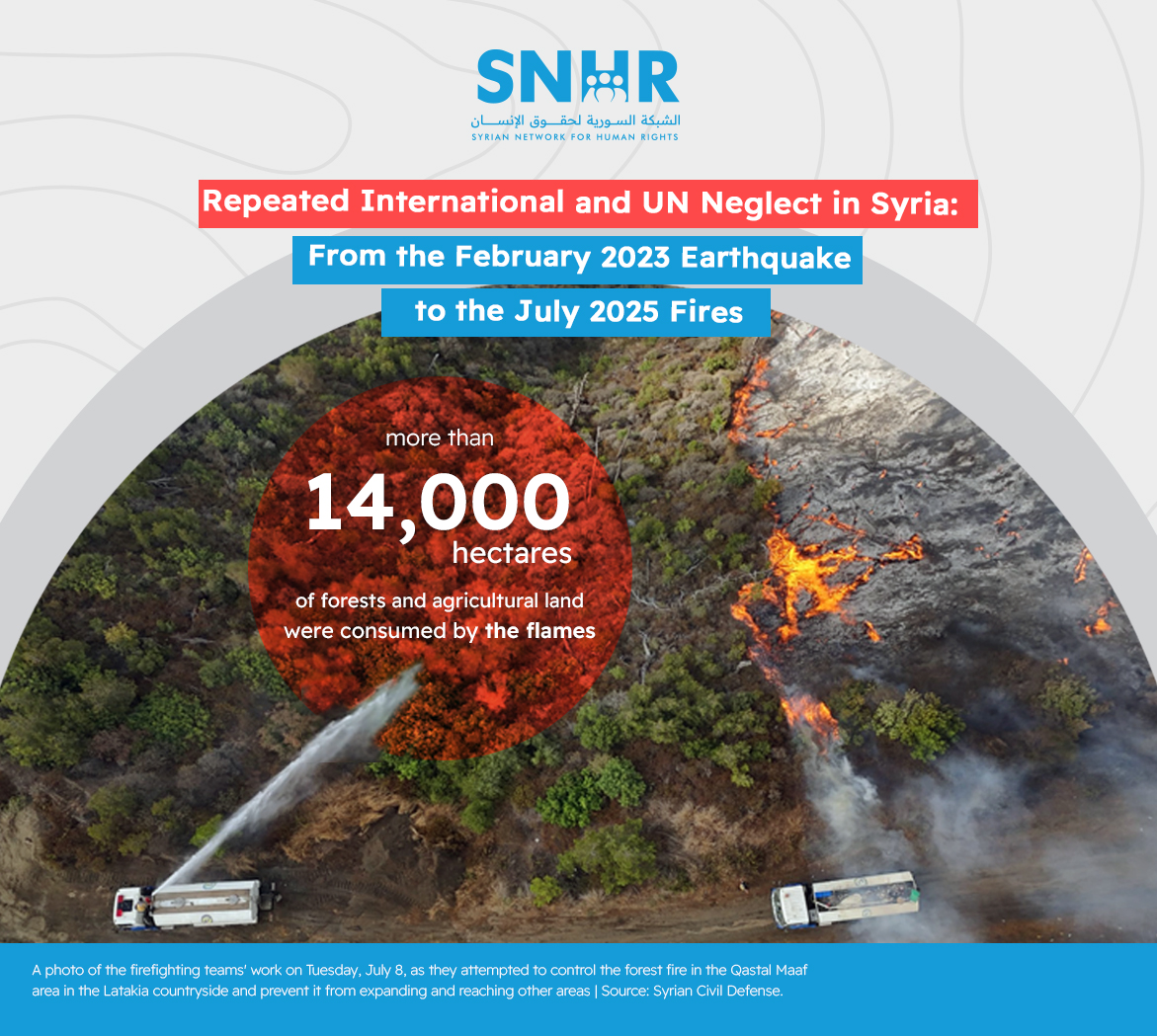
Damascus – The Syrian Network for Human Rights (SNHR) today issued a statement titled “Repeated International and UN Neglect in Syria: From the February 2023 Earthquake to the July 2025 Fires.” The statement condemned the inaction of the international community to the catastrophic environmental fires that have swept across Syria’s coastal areas since June 30, 2025. This represents one of the most violent environmental disasters in contemporary Syrian history. This catastrophe reveals a shocking level of neglect faced by Syrians, even in their most dire humanitarian circumstances.
The scale of the environmental and humanitarian catastrophe
Over six consecutive days, fires devoured more than 14,000 hectares of forests and agricultural land—equivalent to 140 square kilometers—representing more than 4% of the country’s total forest cover. The destruction extended to 34 major sites in the countryside of Latakia and Tartous governorates, including areas of vital environmental importance such as Jabal al-Turkman, al-Farnlaq, Ras al-Basit, Qastal, Ma’af, and Rabia.
The fires formed an active front extending over 23 kilometers, directly threatening the Farnlaq Reserve—the last remaining dense coastal forest in Syria. Hundreds of families were forced to evacuate their homes in the villages of Beit Ayyoush, Mazraa, Sabboura, and Al-Basit, with more than 5,000 people directly affected and hundreds more displaced.
The blatant international failure
The international community’s response to this disaster represents one of the most notable humanitarian failures in modern history. So far, the United Nations’ involvement has been limited to what it describes as “urgent assessments” four full days after the fires broke out, while thousands of hectares were being consumed every hour.
The European Union: Lack of Climate Leadership
The European Union failed to respond to the disaster for six days, despite its consistent claims of leadership on climate and environmental issues, and despite its possession of the European Civil Protection Mechanism, which allows it to dispatch specialized firefighting teams and helicopters to any point within the continent within less than 24 hours.
Regional Organizations: Deafening Silence
The Arab League failed to coordinate any collective response, despite the fact that the disaster affected an Arab region. The World Bank remained completely silent, failing to provide any emergency support, despite the direct impact of the fires on Syria’s infrastructure and economy.
Regional Response: A Model That Proves Possibility
In contrast to this international silence, Syria’s neighboring countries have provided an effective and rapid model for humanitarian response:
- Turkey: dispatched two helicopters and 11 fire engines immediately upon receiving the distress call on July 5.
- Jordan: dispatched specialized civil defense teams and two Black Hawk helicopters equipped with modern firefighting systems.
- Lebanon: Despite its deep economic crisis, it was able to dispatch two helicopters on July 7.
Legal Analysis: Violations of International Law
The delayed international response violates several fundamental principles of public international law:
Violation of the Principle of Non-Discrimination
The disparity in the speed and intensity of the international response to natural disasters between Syria and other countries constitutes a direct violation of the principle of non-discrimination, a fundamental pillar of international law.
Violation of international environmental obligations
The lack of international intervention represents a clear violation of the environmental obligations stipulated in the United Nations Framework Convention on Climate Change and the Paris Climate Agreement.
A pattern of repeated neglect
This failure recalls the same pattern of negligence that marred the response to the February 2023 earthquake, when the then-Under-Secretary-General for Humanitarian Affairs and Emergency Relief Coordinator, Martin Griffiths, was forced to acknowledge that the organization had “so far failed the people of northwest Syria.”
Urgent Demands
The Syrian Network for Human Rights demands:
The United Nations:
- Declare a state of environmental emergency in Syria and activate the Central Emergency Response Fund with an amount of no less than US$75 million.
- Deploy specialized technical teams from the Office for the Coordination of Humanitarian Affairs and the United Nations Environment Programme within 24 hours.
- Form an independent investigation committee to investigate the reasons for the delayed UN response and submit a report within 30 days.
European Union:
- Activating the European Civil Protection Mechanism to dispatch firefighting teams and specialized equipment within 48 hours.
- Launching a European climate justice initiative in the Mediterranean region, including Syria as an active partner.
What happened during the six catastrophic days can only be described as a blatant failure to uphold the most basic principles of human solidarity and the obligations enshrined in international law. Every hour of delay led to more loss and suffering, in clear violation of the obligations that must guarantee protection to every human being, without discrimination, regardless of nationality.
