


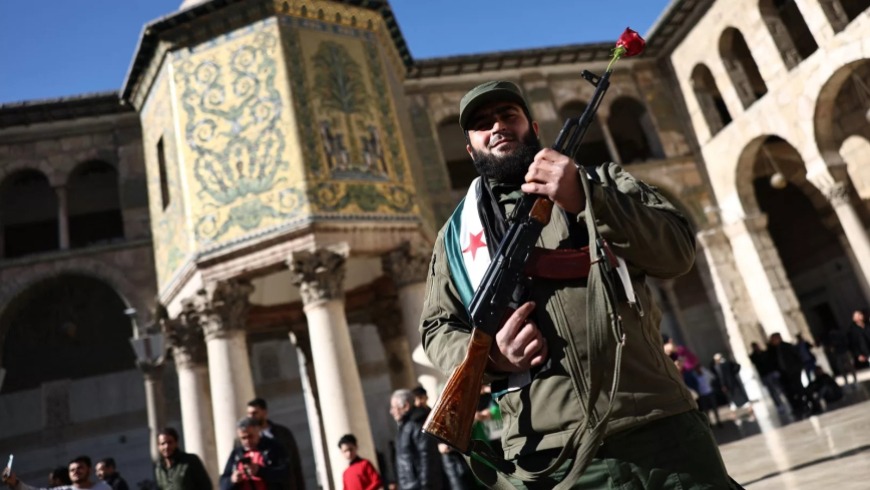
A rebel fighter outside the Umayyad Mosque in Damascus on December 13. Photo: Samir al-Doumi/AFP/Getty Images
Available in:
First: Introduction
Syria faces a fundamental challenge in how to deal with the legacy of fourteen years of armed conflict and the accompanying gross human rights violations. In this context, transitional justice emerges as a necessary framework for addressing the past and laying solid foundations for a future based on respect for human rights and the rule of law. The establishment of a transitional justice body in Syria raises the question of the optimal legal and procedural mechanism for establishing such a body. This question revolves around two main options: the first is to establish the body through an executive decree issued by the executive authority, and the second is to establish it on the basis of a law issued by the legislative council. This issue is important because of its profound impact on the independence, effectiveness, and legitimacy of this body, and thus on its ability to achieve the goals of transitional justice in the complex Syrian context.
Given the enormous challenges facing Syria in its transitional phase, choosing the appropriate institutional mechanism for establishing the transitional justice body is a prerequisite for the success of the entire transition process. The decisions taken regarding the establishment of this body will largely shape the future of justice, reconciliation, and stability in Syria, and will determine the country’s ability to confront the legacy of the past and build a more just and stable future.
Second: The fundamental dimensions of the Legislative Council’s role in establishing the transitional justice body
The concept of “legislative dignity” is a central theoretical framework for understanding the distinctive institutional value of legislative processes compared to executive actions. This concept is based on the idea that laws enacted by an elected, multiparty legislative body acquire a distinctive moral authority that transcends mere formal legal obligation. This moral authority is inherent in the nature of the deliberative process, which involves open and representative discussions that reflect the diversity of views within society and are accountable to the public.
The Syrian Network for Human Rights affirms that the legislative council, which will be formed after the constitutional declaration is issued, is the body that should draft a founding law to regulate the transitional justice process. This proposal is particularly important in the Syrian transition, where the “mandate dilemma”—a problem faced by transitional institutions—is being addressed.
The importance of the dignity of legislation is particularly salient in the Syrian context given the exceptional complexity of the country’s social and political fabric. Syria’s profound ethnic, religious, and political diversity calls for a constitutional process that reflects and accommodates this diversity. The legislative path, by its deliberative and representative nature, provides the ideal institutional framework for accommodating this diversity by allowing space for public debate, representing different points of view, and reaching broad consensus.
Comparative international experiences clearly demonstrate the importance of this dimension. In South Africa, the Truth and Reconciliation Commission gained exceptional legitimacy by being established under the Promotion of National Unity and Reconciliation Act of 1995, which was passed after intensive parliamentary debates that reflected input from a broad spectrum of political parties and civil society. In contrast, the truth commissions in Uganda, which were established by presidential decrees, faced significant challenges in achieving societal acceptance and institutional effectiveness, as they continued to be viewed as political tools of the executive branch rather than national mechanisms for transitional justice.
Stakeholder inclusivity
The concept of “stakeholder inclusivity” refers to the extent to which institutional processes are able to accommodate the perspectives and interests of diverse groups within society. In the context of transitional justice, this inclusivity takes on added importance, given that the success of transitional justice mechanisms is closely linked to their ability to reflect the needs and aspirations of communities affected by conflict.
Legislative engagement achieves what is known as “stakeholder inclusivity” by ensuring the participation of various social groups in the design of the transitional justice framework. I believe that the transitional justice body must be inclusive and representative of all segments of Syrian society to ensure its legitimacy and effectiveness. Legislative processes enable this inclusivity through formal consultation mechanisms and public hearings, as well as amendment procedures that are typically lacking in executive decrees.
The importance of stakeholder inclusivity in the Syrian context is evident given the multiple levels of violations and the diversity of affected groups. Various Syrian communities—regardless of their ethnic, religious, and political affiliations—have been affected by various forms of violations, requiring a legal framework that accommodates and responds to this diversity. The legislative process, through its public hearings, specialized parliamentary committees, and community consultations, provides the institutional mechanisms necessary to ensure that the interests and needs of the various affected groups are represented.
International experience shows that the absence of such authority can lead to “functional paralysis” that hinders the body’s ability to respond effectively to emerging issues. For example, in Peru, the Truth and Reconciliation Commission faced significant challenges when every non-routine expenditure required approval from the Ministry of Finance, which negatively affected the speed and independence of investigations in remote areas. In contrast, the Truth and Reconciliation Commission in South Africa enjoyed broader powers in managing its resources, which contributed to its effectiveness and ability to adapt its investigative strategies.
The experience of the Truth and Dignity Commission in Tunisia stands out as a telling example of the importance of inclusivity in a transitional context. The commission was established under the Transitional Justice Law passed by the National Constituent Assembly in 2013, following extensive consultations with civil society organizations, victims’ associations, and political parties. This legal basis allowed the commission to develop operational procedures that responded to the diverse needs of victims, including women and economically marginalized communities. In contrast, the Truth Commission in Morocco, which was established by royal decree, faced widespread criticism for the limited involvement of victims in the design of its procedures and scope of work.
Third: Independence as a prerequisite for the success of the transitional justice body
Financial and administrative independence from the executive branch is an essential condition for the success and effectiveness of a transitional justice body. I argue that the establishment of such a body must be based on solid foundations that guarantee its complete financial and administrative independence from the executive branch, in order to avoid the use of funding as a mechanism to control and dominate the body’s work.
Protecting the commission’s financial allocations is an essential guarantee of its independence, by preventing arbitrary cuts in funding, especially when the commission is conducting politically sensitive investigations. Transitional justice experiences show that control over financial resources is one of the main tools used by executive authorities to influence ostensibly independent institutions. Therefore, the commission’s budget must be prepared through transparent and clearly defined legislative procedures, away from executive allocations that may be biased or volatile.
In the Syrian context, protecting financial allocations is especially important because of the nature of the upcoming investigations, which will address highly politically sensitive violations. This might push some parties to try to influence the investigations by controlling funding. The legislative basis for the establishment of the commission ensures legal protection for the budget, making any reduction or manipulation of it subject to a full legislative process, rather than a mere executive decision.
Control over operational resources
Control over operational resources refers to the commission’s ability to make independent internal financial decisions without the need for executive approval, particularly with regard to expenditures related to highly sensitive investigations. This authority is necessary to enable the commission to manage its resources flexibly and in response to changing investigative priorities.
International experience shows that the absence of this authority can lead to “functional paralysis” that hinders the commission’s ability to respond effectively to emerging issues. For example, in Peru, the Truth and Reconciliation Commission faced significant challenges when every non-routine expenditure required approval from the Ministry of Finance, which negatively affected the speed and independence of investigations in remote areas. In contrast, the Truth and Reconciliation Commission in South Africa enjoyed broader powers in managing its resources, which contributed to its effectiveness and ability to adapt its investigative strategies.
Independence in recruitment
Independence in recruitment is a fundamental pillar of administrative independence, as the commission needs full authority over decisions regarding the recruitment, promotion, and compensation of staff, without interference or influence from the executive branch. This independence allows the commission to select the expertise and specialized skills necessary for its work and protects it from attempts to influence the course of investigations through control over appointments.
In the Syrian context, the importance of hiring independence is highlighted by the complexity and sensitivity of the issues at hand, which require diverse expertise in the fields of documentation, criminal investigation, psychological support for victims, and economic analysis of human rights violations. To ensure this independence, the commission’s founding law must clearly stipulate transparent recruitment mechanisms based on criteria of competence and integrity, free from political interference.
Protecting the appointment process
Protecting the appointment process is an essential safeguard against political manipulation in the selection of commission members. Unambiguously, candidates must have a record completely free of corruption or human rights violations, with complete independence from political parties and factions to ensure the commission’s integrity.
Independence from the Ministry of Justice allows the commission greater freedom to develop specialized approaches and working methods that meet the specific needs of transitional justice, which may differ significantly from traditional ministry procedures. It is important to draw on specialized expertise and methodologies, including experts in national and international law, documentation and evidence gathering, as well as experts in economics and psychosocial support.
There should be a multilateral selection mechanism, including the formation of a recommendation committee composed of independent experts and representatives of the judiciary, civil society, and victims to nominate potential members. This mechanism aims to achieve “appointment distance”—that is, a clear institutional separation between political authorities and the selection process, preventing partisan takeover or politicization of appointments.
Protection of tenure
Protection of tenure refers to ensuring that members cannot be dismissed or subjected to reprisals for decisions taken by the body, especially those of a politically sensitive nature. A fixed term of membership ranging from three to five years could be established, ensuring institutional stability and protecting members from the threat of arbitrary dismissal.
The founding law of the body in Syria should include specific and strict procedures for removing members, limiting the grounds for removal to serious, legally proven violations and requiring complex voting mechanisms that prevent the political use of removal powers.
Protecting operational independence
Protecting operational independence means ensuring that there is no interference in the commission’s day-to-day decisions and executive activities. The Syrian Network for Human Rights’ vision grants the commission broad investigative powers, including the power to summon witnesses, collect evidence, access official and private documents, conduct investigations into violations, and request arrest warrants from the judiciary.
The need for the commission to be independent from the Ministry of Justice
Although the commission operates within the broader judicial system, the transitional justice commission must maintain its independence from the Ministry of Justice, as part of the executive branch. This independence aims to address fundamental weaknesses that could negatively affect the effectiveness of transitional justice.
Independence from the Ministry of Justice addresses the problem of institutional legacy, i.e., the continuation of previous patterns of governance within institutions that are supposed to have undergone reform. For decades of Assad family rule, the Ministry of Justice functioned as a tool for imposing political control rather than fulfilling its primary role of protecting rights and establishing justice.
The experiences of countries such as Argentina and Chile indicate that bodies that are completely independent from ministries of justice have been more effective in investigating violations that may have been committed with collusion from within the judicial system itself.
Freedom to develop specialized methodologies
Independence from the Ministry of Justice allows the body greater freedom to develop specialized methodologies and working methods that meet the specific needs of transitional justice, which may differ fundamentally from the ministry’s traditional procedures. It is important to draw on specialized expertise and methodologies, including experts in national and international law, documentation and evidence gathering, as well as experts in economics and psychosocial support.
International experiences provide clear examples of the importance of this independence. In Colombia, the Missing Persons Unit, established as a body independent of the traditional judicial system, was able to develop specialized methodologies in criminal investigation and forensic anthropology, which contributed to determining the fate of thousands of missing persons. In Tunisia, the independence of the Truth and Dignity Commission has allowed for the development of gender-sensitive procedures for dealing with victims of sexual violence, going beyond traditional judicial procedures.
Conclusion
The establishment of a transitional justice body in Syria through a law issued by the Legislative Council is the best option to ensure the effectiveness, independence, and legitimacy of this body, thereby enhancing its ability to achieve the goals of transitional justice in the complex Syrian context. The composition and comprehensive representation of the transitional justice body are key to its success, as diversity provides access to multiple knowledge bases, contributes to building trust between different segments of society, and provides valuable operational information.
Diversity contributes to building trust between different segments of society and gives these segments a strong sense that their experiences and priorities will be given real and serious attention. This dimension is particularly important in the Syrian context, where 14 years of ongoing conflict have deepened social and political divisions and eroded trust between different groups.
Syrian society faces a particular challenge in the form of “deep institutional mistrust,” whereby large segments of society doubt the ability of any official institution to serve their interests impartially. The diverse composition of the commission is a key step in addressing this distrust, sending a clear signal that transitional justice will not be a tool for revenge or bias toward one side at the expense of another.
Originally published on Syrian TV website in Arabic
