

SNHR is a Primary Source in All Reports of the Investigation and Identification Team
Available in:
Damascus – The Syrian Network for Human Rights:
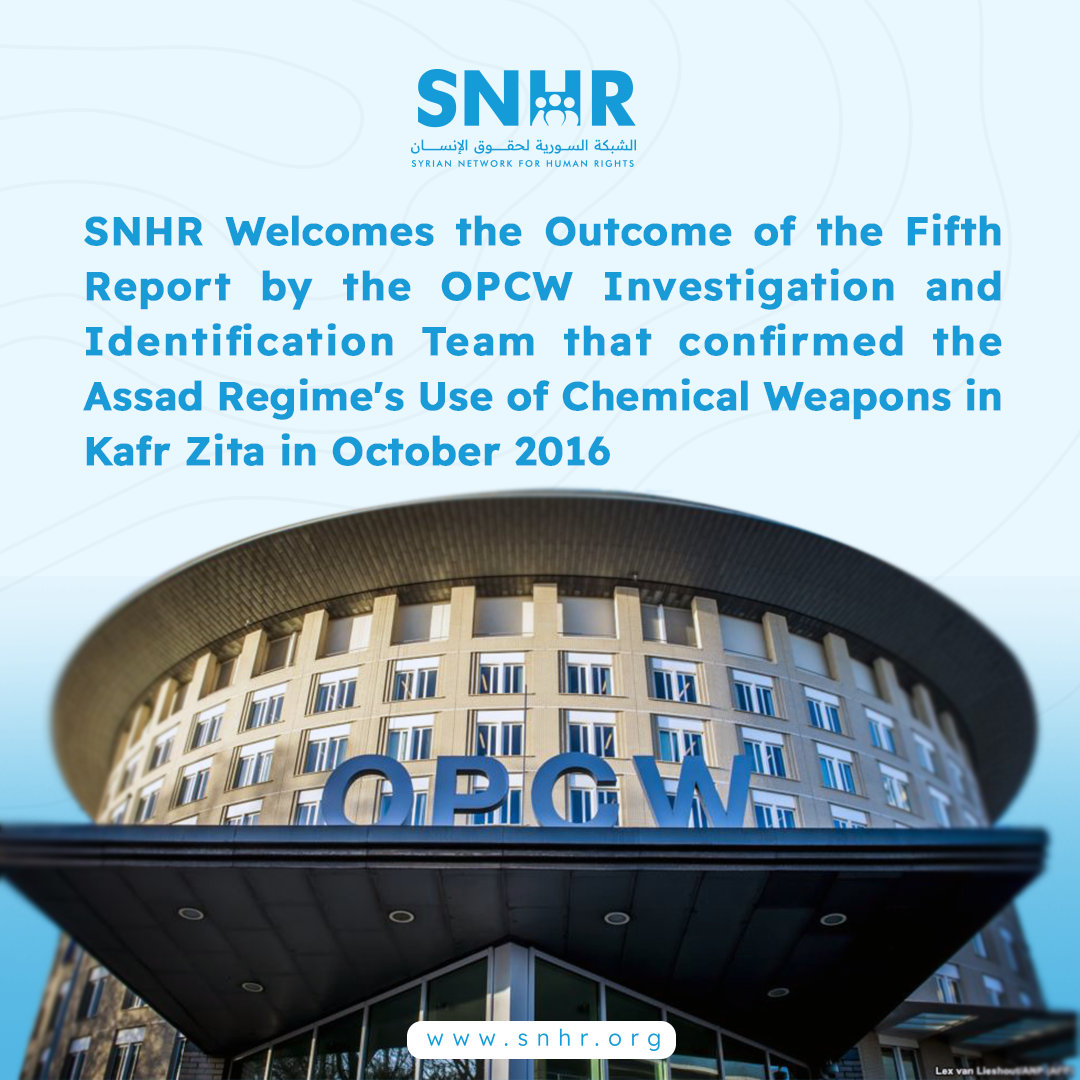
On Thursday, January 22, 2026, the fifth report of the Investigation and Identification Team (IIT) of the Organisation for the Prohibition of Chemical Weapons (OPCW), the team responsible for identifying the perpetrator of the use of chemical weapons, was released. This report addresses the responsibility of the party that carried out the chemical weapons attack on the town of Kafr Zita in Hama Governorate on October 1, 2016, noting that the fact-finding mission of the Organization for the Prohibition of Chemical Weapons had previously established that chemical weapons had been used on this date and at this location.
The report concluded that on the evening of October 1, 2016, between 19:00 and 19:40 local time, a Syrian Arab Air Force Mi-8/17 helicopter dropped at least one yellow pressurized cylinder containing chlorine gas over a cave system in Wadi al-Anz near Kafr Zita. The report indicated that the helicopter took off from Hama military airport and was operating under the control of the “Tiger Forces”.
The Military Context of the Offensive
The report places the offensive within the broader military context of northern Hama Governorate during 2016. At that time, Kafr Zita was a predominantly Sunni town under the control of opposition factions, located near vital supply routes, including areas adjacent to the M5 international highway. The city of Hama and its military airport also held significant strategic importance for government forces, particularly after the loss of other air bases earlier in the conflict.
This incident occurred in the context of a military operation aimed at halting the advance of opposition factions towards the city of Hama. The team assessed that helicopters launched from Hama airport were conducting regular air operations in the area, and that the use of chlorine, despite its limited direct military effectiveness, had been used in other locations within Syria as a means of intimidation, imposing control, and creating a broad psychological impact.
Methodology of the Investigation, Challenges, and Subsequent Cooperation
Throughout most of its work, the IIT faced significant obstacles due to the lack of cooperation from the former Syrian authorities, including denial of entry into the country and failure to provide the necessary information. This limited the possibility of conducting field visits, forcing the team to rely on remote investigation methods.
However, following the fall of the Assad regime in December 2014, the new Syrian authorities offered unprecedented cooperation, including granting the team full access to the country and providing it with preliminary documentation relevant to the investigation. Although security and logistical constraints prevented a visit to the Kafr Zita site itself, the team concluded that such a visit would have added limited value given the passage of time and the site’s subsequent destruction.
The IIT reached its conclusions based on the evidentiary standard known as “reasonable grounds,” a standard consistently adopted by international fact-finding bodies and commissions of inquiry. The assessment incorporated information from the Fact-Finding Mission (FFM), from States Parties, and from interviews conducted by the Independent Investigation Team, as well as sample analyses, computer models, satellite imagery, frontline maps, documented videos and photographs, and other relevant data.
SNHR’s Cooperation with the Investigation and Identification Team
SNHR has been sharing data with the Investigation and Identification Team (IIT) of the Organisation for the Prohibition of Chemical Weapons (OPCW) since its inception, contributing to the team’s current and future investigations. This cooperation is based on the Principles of Cooperation signed between the Network and the IIT. The Syrian Network for Human Rights is a primary source for all reports issued by the team, given its extensive database on the use of chemical weapons in Syria.
