


Available in:
Damascus – The Syrian Network for Human Rights:
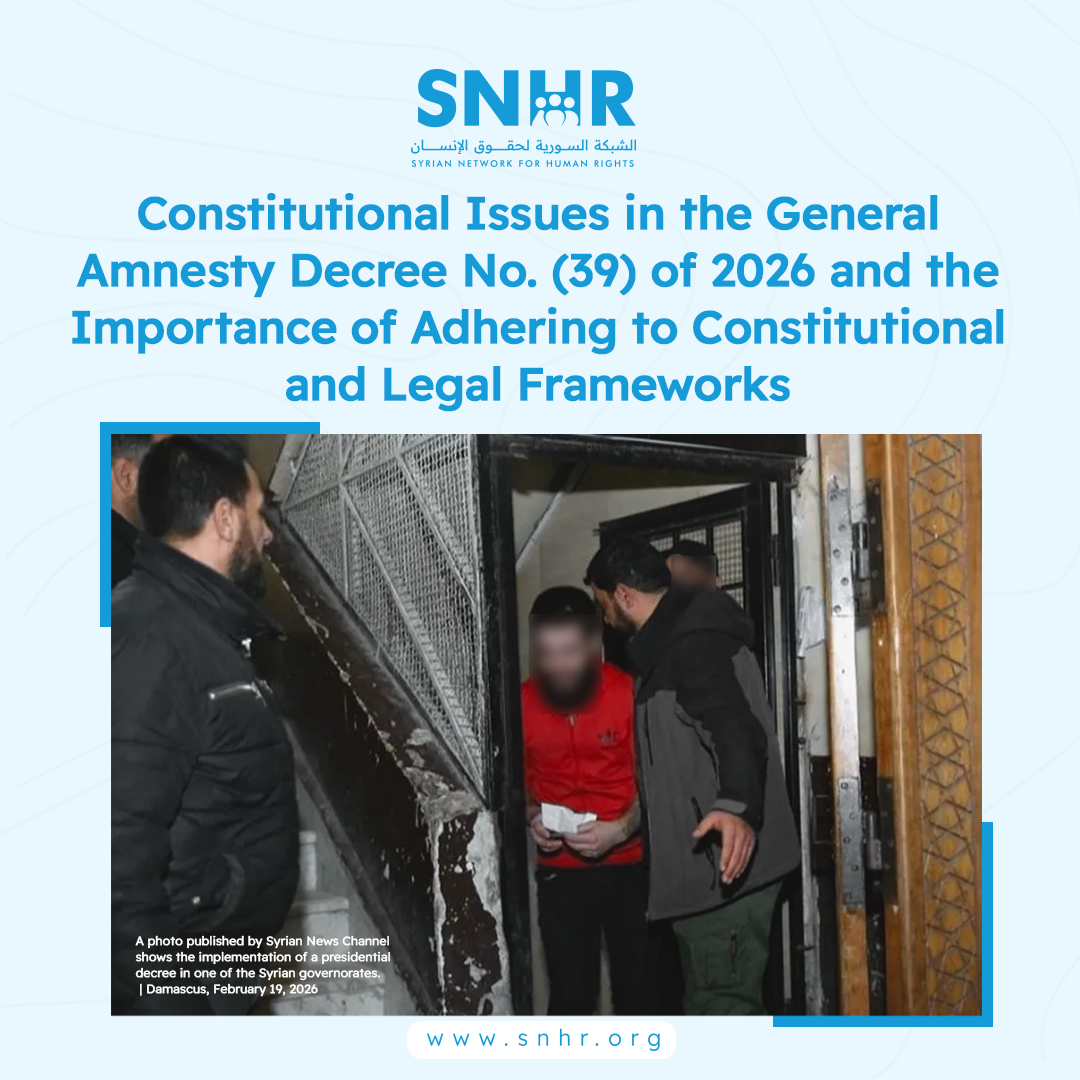
On February 18, 2026, Decree No. (39) of 2026 was issued, granting a general amnesty for crimes committed before its issuance date. While SNHR recognizes the complexities of the transitional phase and the need for measures that contribute to achieving stability and reforming the justice system, it emphasizes that such measures, with their broad impact on rights and freedoms, require the utmost clarity in their constitutional and legal basis, and necessitate a clear definition of their scope and limitations in a manner that does not compromise the principles of accountability and the rule of law.
First: The Issue of Jurisdiction According to the Constitutional Declaration
The Constitutional Declaration stipulates the principle of separation of powers and defines the jurisdiction of each authority during the transitional period. According to its provisions regarding the distribution of powers, the authority to grant a general amnesty falls within the purview of the People’s Assembly, while the President’s authority is limited to granting pardons and restoring civil rights.
Therefore, SNHR believes that issuing a general amnesty in the form of a decree raises constitutional questions regarding the competent authority and the legal instrument that must be followed to approve it under the current constitutional declaration, which may amount to a defect in jurisdiction that affects the essence of the constitutional legitimacy of the procedure.
Second: Impact on the Rule of Law and the Separation of Powers
SNHR affirms that respecting the rules governing the distribution of powers among the authorities constitutes a constitutional guarantee that prevents overlapping jurisdictions, supports the principle of accountability, and prevents institutions from being stripped of their roles during the transitional phase.
Adherence to the procedures stipulated in the Constitutional Declaration also ensures the uniformity of legal and institutional practice, limits divergent interpretations during implementation, and enhances the subjectivity of decisions to judicial oversight and review, thereby strengthening public confidence in the legitimacy of the measures taken.
Third: The Need for Clear Standards and Guarantees
The decree includes exceptions related to “grave violations against the Syrian people,” a general formulation open to multiple interpretations unless it is clarified with precise legal definitions that specify its content, standards, and limits.
SNHR emphasizes that any amnesty framework, especially if it is broad in scope, must be accompanied by specific objective criteria, transparent procedures, and effective judicial safeguards to ensure consistent application, prevent discrepancies in interpretation, protect the rights of victims, and prevent any unintended consequences for the course of accountability and non-impunity.
Fourth: Recommendations
- Review the constitutional and procedural basis of the decree to ensure its consistency with the text of the constitutional declaration and the distribution of powers between the authorities, and address any suspicion related to the defect of jurisdiction in a clear institutional manner.
- Clarify the definitions and criteria for exceptions related to serious violations and announce the mechanisms for their implementation and verification guarantees in a transparent and auditable manner.
- Ensure that any steps related to amnesty are consistent with declared commitments on victim-centered transitional justice, with the principles of accountability and non-impunity, and with safeguarding the right to effective redress.
- Emphasizing the principle that decisions and measures related to the implementation of the decree are subject to judicial oversight and are not immune from prosecution, as this is an essential guarantee for protecting rights, unifying application and preventing abuse.
Conclusion
The Syrian Network for Human Rights affirms that addressing the effects of the previous era and reforming the justice sector require a disciplined legal path that balances the requirements of stability on the one hand, and the requirements of constitutional legitimacy and the protection of victims’ rights on the other, in a way that supports building the institutions of the rule of law on sound and sustainable foundations.
