


Available in:
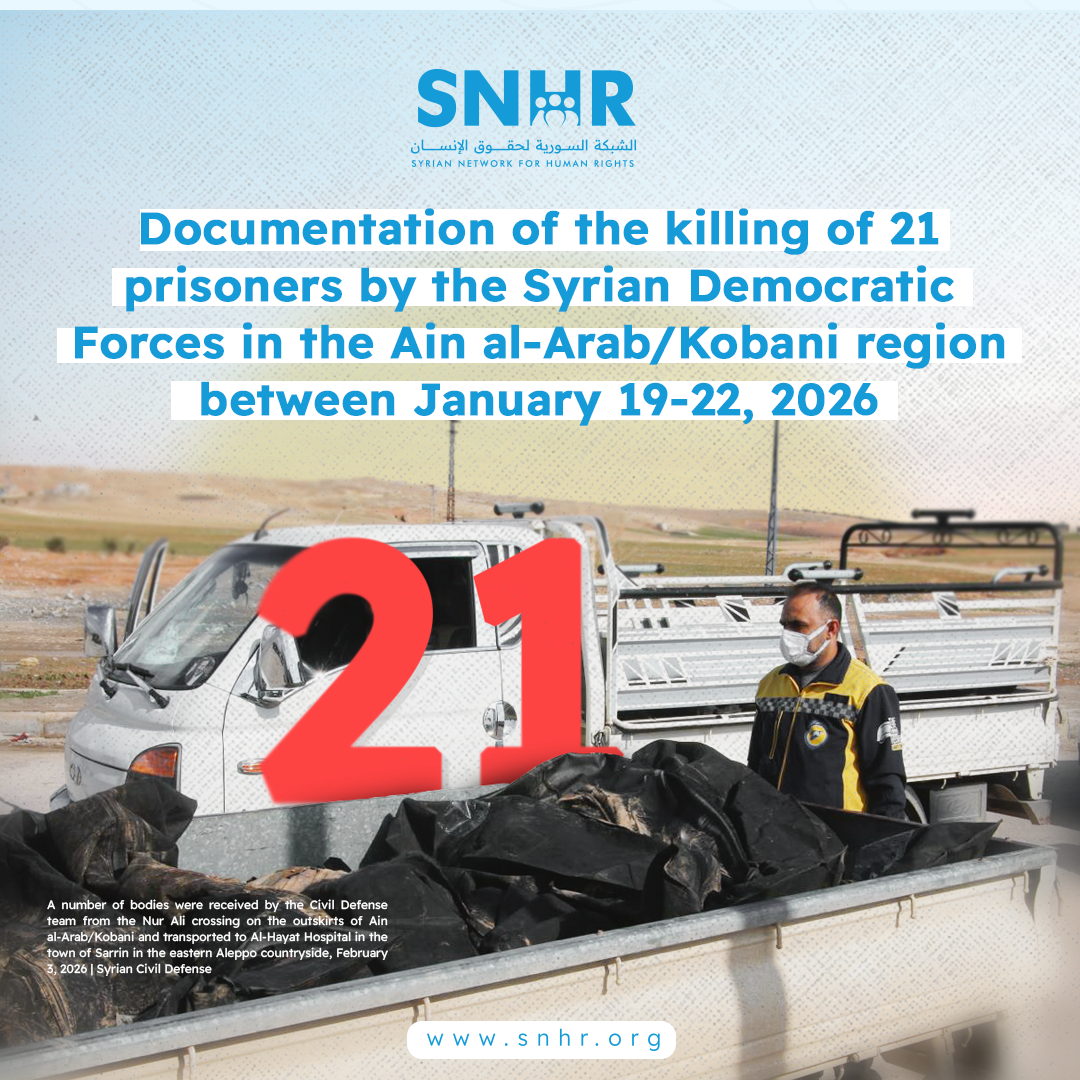
Damascus – The Syrian Network for Human Rights issued a report documenting the killing of 21 prisoners by the Syrian Democratic Forces in the Ain al-Arab/Kobani area between January 19-22, 2026. The report details the extrajudicial killing of prisoners at a detention center in the rural area of Ain al-Arab/Kobani, controlled by the Syrian Democratic Forces (SDF), following protests against the inequitable application of an amnesty and the escape of prisoners, some of whom were pursued and summarily executed. It also links the incident to military tensions in early 2026 and the SDF’s declining control. The report provides a legal analysis holding the controlling party accountable under international law, along with recommendations to strengthen accountability and prevent recurrence.
The Syrian Network for Human Rights adopted a multi-source methodology in documenting the incident, combining technical analysis of video footage, verification of open-source information, and documentation of witness testimonies, along with a review of the field and legal contexts. This included verifying two video clips through visual, geographical, and temporal analysis and correlating them with available data, in addition to conducting interviews with witnesses and local sources according to strict protection protocols. Precise standards were also used to document victims, with reference to cases where verification was incomplete. The legal analysis was based on the rules of international humanitarian law and human rights law. The report faced challenges, most notably the lack of field access, the poor quality of one of the clips, and the presence of unidentified victims, while investigations and evidence gathering continued.
The incident occurred at a detention center in the village of Yedi Qoy near Ain al-Arab/Kobani between January 19 and 22, 2026, following protests inside the prison due to the unequal application of an amnesty decision, which was followed by the escape of hundreds of prisoners, who were then pursued and some of them were killed extrajudicially. Analysis of two videos that circulated online revealed 21 bodies at the same location, with clear consistency confirming that they documented the same incident. The nighttime footage suggests a closer timeframe to the killings. Evidence revealed concentrated gunshot wounds to the head inflicted at close range, in addition to victims with their hands bound, indicating summary executions of individuals who were either detained or incapacitated. Geographical features, site analysis, and witness testimonies further supported the connection between the incident and the control exerted by the Syrian Democratic Forces (SDF). Investigations revealed gunfire and assaults during the escape, followed by screening, arrests, enforced disappearances, and subsequent extrajudicial killings. On February 3, 15 bodies were transported by the Civil Defense. The Syrian Network for Human Rights documented the killing of at least 21 people, with the number likely rising to 40–45 victims, including those missing. The SDF acknowledged the authenticity of the video and claimed that government fighters were killed, but the Network’s documentation and analysis of the evidence confirm that they were civilians extrajudicially killed between January 19 and 22, 2026.
The report concludes that the events of January 19–22, 2026, in Ain al-Arab/Kobani constitute grave violations of international humanitarian law and human rights law, as the killing of prisoners was extrajudicial and not the result of clashes. Evidence points to the unlawful use of lethal force, with individuals being shot at close range and aimed at the head while unable to defend themselves, a violation of the right to life and Common Article 3 of the Geneva Conventions. The report also documented the victims’ exposure to cruel treatment, including stabbing, beatings, threats, arbitrary detention, discriminatory screening, and subsequent extrajudicial killings. The data showed that some victims were handcuffed, confirming the controlling party’s failure to uphold its obligations to protect detainees. Given the nature of the conflict, these acts may constitute war crimes. The Syrian Democratic Forces bear direct and command responsibility for these violations, and their announced measures are inadequate. The report emphasizes the need for independent and impartial investigations to ensure accountability, protect witnesses, and prevent impunity.
The report was concluded with a set of recommendations to the relevant parties:
To the Syrian Democratic Forces:
- Launch an immediate, independent, and transparent investigation into the extrajudicial killings and summary executions that occurred between 19 and 22 January 2026, ensuring that the investigation complies with international standards, particularly the Minnesota Protocol on the Investigation of Unlawful Deaths.
- Hold accountable all those directly and indirectly responsible for the killing of persons deprived of their liberty, including those in command and the chain of command, and ensure that they do not escape punishment.
- To disclose the fate of all prisoners who went missing during and after the escape, to provide official lists of their names and places of detention, and to ensure their families have the right to know.
- To guarantee respect for the rules of international humanitarian law in the treatment of detainees, including the explicit prohibition of summary executions, the prohibition of torture or cruel, inhuman, or degrading treatment, and the absolute obligation to protect persons who are no longer in hostilities.
- Restrict the use of lethal force to cases that are strictly necessary and lawful, in accordance with the principles of necessity and proportionality enshrined in international human rights law.
- Improve detention conditions in all detention centers under the control of the Syrian Democratic Forces, and ensure their compliance with the United Nations Standard Minimum Rules for the Treatment of Prisoners.
- Allow local and international human rights organizations access to detention centers and permit them to conduct independent and regular assessment visits.
- Provide compensation and redress to victims’ families in accordance with transitional justice standards, including formal recognition and material and moral redress.
- Take immediate measures to preserve all evidence related to the incident, including official records, operational orders, and communications data, and prevent its destruction or tampering.
To the Syrian Government:
- Guarantee the protection of civilians and prisoners deprived of their liberty within its jurisdiction and in the areas where the victims’ remains were received, in accordance with its obligations under international humanitarian law and international human rights law.
- Enable forensic medical services to conduct full and impartial examinations of the remains transferred to Aleppo and to document the causes of death in accordance with relevant international standards.
- Facilitate communication between the victims’ families and the relevant official authorities to ensure they receive information and documentation related to the deaths without political or security obstacles.
- Coordinating with local and international human rights organizations to follow up on investigations and their results.
To the UNCOI and the UN IIIM:
- Include this incident within the scope of ongoing investigations into violations committed in Syria, given its potential to constitute war crimes.
- Collect, archive, and analyze digital and visual evidence related to the two video clips in accordance with international criminal standards, in preparation for its use in future accountability proceedings.
- Request formal cooperation from the controlling parties to obtain data related to the victims, crime scenes, and detention sites.
To the United Nations and countries supporting local forces in northeast Syria:
- Press the Syrian Democratic Forces (SDF) to strictly adhere to international humanitarian law and ensure the protection of detainees.
- Link all forms of military and political support to verifiable and concrete steps in the areas of investigation, accountability, and prevention of recurring violations.
- Support capacity-building initiatives related to the management of detention centers, human rights, the chain of command, controls on the use of force, and internal investigation mechanisms.
To civil society and human rights organizations:
- Continue documenting extrajudicial killings, summary executions, and enforced disappearances in the Ain al-Arab/Kobani region according to established professional standards, thereby contributing to the preservation of evidence and enhancing opportunities for future accountability.
- Provide legal and technical support to the families of victims, including assisting them in accessing information regarding the fate of their loved ones, supporting them in the identification of remains, and ensuring their right to redress and reparation.
- Cooperating with relevant international mechanisms by sharing verified information and evidence to support accountability efforts.
- Strengthening monitoring and awareness programs related to the rights of detainees and disseminating knowledge of international standards for the treatment of persons deprived of their liberty.
- Advocating for humanitarian and human rights organizations’ access to places of detention to improve detention conditions and reduce the risk of violations.
To all actors and controlling parties in Syria:
- Respect the absolute prohibition of extrajudicial killings as a peremptory norm of customary international law.
- Guarantee the protection of persons who are no longer in hostilities, regardless of their status, and refrain from any reprisals or summary executions.
