

No less than 210 Cases of Arbitrary Arrests and Detentions in the First Quarter of 2026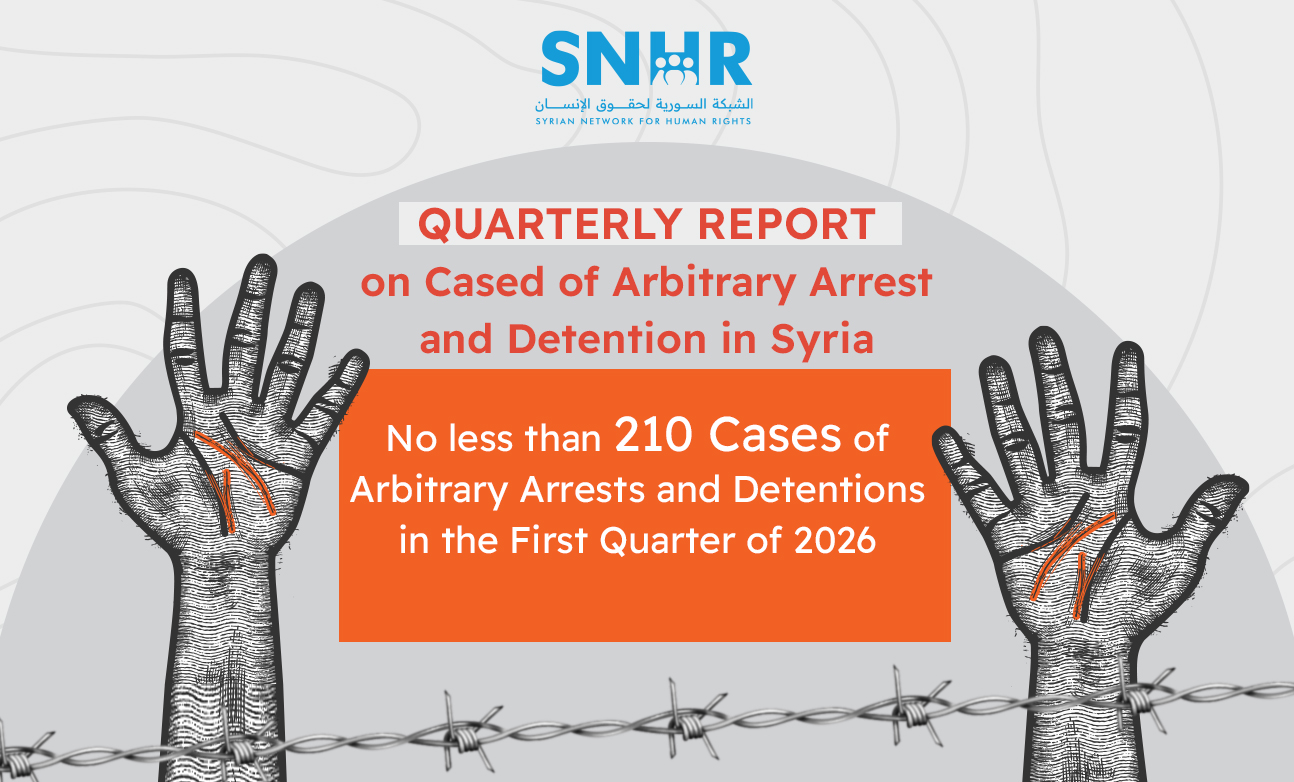
Available in:
Damascus – April 5, 2026 – Syrian Network for Human Rights:
The Syrian Network for Human Rights (SNHR) today released its quarterly report on arbitrary arrests and detentions in Syria during the first quarter of 2026 (January-March), documenting at least 210 cases of arbitrary arrest and detention, including 11 children and 3 women, in addition to 512 releases from various detention centers. The report distinguishes between two categories: arbitrary arrests targeting civilians, and detentions related to the prosecution of those accused of committing violations under the Assad regime. This tally represents the minimum number of cases that SNHR was able to document and verify, given the field and logistical challenges that have hampered its monitoring capabilities since the fall of the regime.
Distribution of Arbitrary Arrests by Party
The number of arbitrary arrests and detentions was distributed as follows: 122 cases by Syrian government forces, including two women; 46 cases by Israeli forces, including 11 children; and 42 cases by the Syrian Democratic Forces (SDF), including one woman. February saw the highest increase, accounting for approximately 37% of the total cases. These arrests targeted civilians for criticizing the SDF’s practices in areas under its control. Geographically, Deir Ez-Zour and Quneitra governorates recorded the highest number of arrests, followed by Homs, Tartus, and Hasaka.
Detentions in the Context of Accountability: Between Legal Obligation and the Requirements of the Rule of Law
The report documented the detention of at least 59 individuals in nine governorates as part of the prosecution of those accused of committing violations under the Assad regime. These individuals were transferred to central prisons in Homs, Hama, and Adra. The largest number of detentions were concentrated in Tartous (16 cases), Daraa, and Homs (10 cases each). The report raised concerns regarding adherence to due process: it was not possible to verify the issuance of judicial arrest warrants, the names of the detainees and the charges against them were not disclosed, and there was no evidence that they were granted access to lawyers or brought before a judge within a reasonable timeframe.
The Network affirms that prosecuting those accused of serious violations is a legal and moral obligation. However, the legitimacy of accountability requires adherence to the guarantees of a fair trial and the rule of law, in accordance with Articles 9 and 14 of the International Covenant on Civil and Political Rights. Any abuses in this regard undermine the credibility of the process and violate the rights of detainees, regardless of the nature of the acts attributed to them.
Releases Record
The report documented 512 releases, the majority of which (417) were from Syrian Democratic Forces (SDF) detention centers, followed by 73 from Syrian government centers, and 22 from Israeli-controlled centers, including three children. The increase in SDF releases is attributed to the Syrian government’s takeover of detention centers previously under its control and the implementation of release agreements based on the January 29, 2016 agreement, as well as growing public discontent with forced conscription campaigns.
Main Conclusions of the Report
The report reached the following conclusions:
First: Arbitrary arrests continue to be carried out by multiple parties without warrants and without informing detainees of the reasons for their arrest or allowing them to appear before a judge, in violation of Article 9 of the International Covenant on Civil and Political Rights and Rule 99 of customary international humanitarian law, which applies to all parties to the conflict, including non-state armed groups.
Second: Allegations of torture and degrading treatment of detainees by more than one party have been documented, in violation of Article 7 of the International Covenant on Civil and Political Rights, the Convention against Torture (1984), and Common Article 3 of the Geneva Conventions. The prohibition of torture is a peremptory norm (jus cogens) that cannot be derogated from under any circumstances.
Third, the Syrian Democratic Forces, as a party to a non-international armed conflict exercising state-like control, are bound by Common Article 3 of the Geneva Conventions, the provisions of Additional Protocol II, and customary international humanitarian law, as well as obligations under international human rights law in line with the growing trend in the practices of United Nations bodies. The actions of its members may give rise to individual criminal responsibility under the Rome Statute.
Fourth, the detentions carried out by Israeli forces (46 cases, including 11 children) fall under the Fourth Geneva Convention, as Israel is an occupying power, according to the standard of effective control (Article 42 of the Hague Regulations of 1907). The International Covenant on Civil and Political Rights applies outside the state’s territory in cases of effective control, according to the International Court of Justice’s advisory opinion on the wall (2004). The detention of 11 children raises particular concerns in light of Article 37 of the Convention on the Rights of the Child, which stipulates that the detention of children must be an exceptional measure and for the shortest appropriate period.
Fifth, there is a lack of transparency in the release processes, as many were carried out without clear judicial procedures, and there are no guarantees of the released individuals’ right to compensation for unjustified detention, as stipulated in Article 9(5) of the International Covenant on Civil and Political Rights.
Key Recommendations
To the Syrian Government: Instruct all security agencies not to carry out any arrests except by judicial warrant, to inform every detainee immediately of the reasons for their arrest, and to enable them to contact a lawyer and appear before a judge within 48 hours. Publish periodic lists of detainees, along with the reasons for their detention, as part of the accountability process. Issue formal invitations to the International Committee of the Red Cross, the International Commission of Inquiry, the International, Impartial and Independent Mechanism (IIIM), the Independent Institution on Missing Persons in Syria, and the International Commission on Missing Persons (ICMP) to grant them unrestricted access to detention centers. Ratify the Rome Statute and issue a declaration under Article 12(3) accepting the jurisdiction of the International Criminal Court as of March 2011. Enact legislation regulating arrest and detention that includes a maximum period of pretrial detention, an explicit prohibition of incommunicado detention, and an independent grievance mechanism.
To the Syrian Democratic Forces, the Israeli forces, and all parties controlling Syrian territory: Immediately cease all forms of arbitrary detention and enforced disappearance, disclose the fate of all detainees, unconditionally release those detained for exercising their civil and political rights, and grant the International Committee of the Red Cross regular access to all detention centers. The Israeli forces, in particular, must ensure compliance with the provisions of the Fourth Geneva Convention relative to the Protection of Civilian Persons in Time of War and immediately release all detained children unless there are compelling security reasons for their continued detention, in accordance with Article 37 of the Convention on the Rights of the Child.
To the UN Security Council: Impose measures to freeze the assets of former officials implicated in violations and allocate the proceeds to support transitional justice and reparations.
To the International Commission of Inquiry (COI) and the International, Impartial and Independent Mechanism (IIIM): Open investigations into patterns of arbitrary detention and enforced disappearance during the transitional period, encompassing all parties, and focus on tracing the fate of those forcibly disappeared by the former regime in light of new information brought to light by its fall.
To the Human Rights Council: Keep the issue of detainees and the forcibly disappeared a standing item on the agenda of its sessions, and strengthen partnerships with Syrian human rights organizations and support their documentation capacities.
