


Available in:
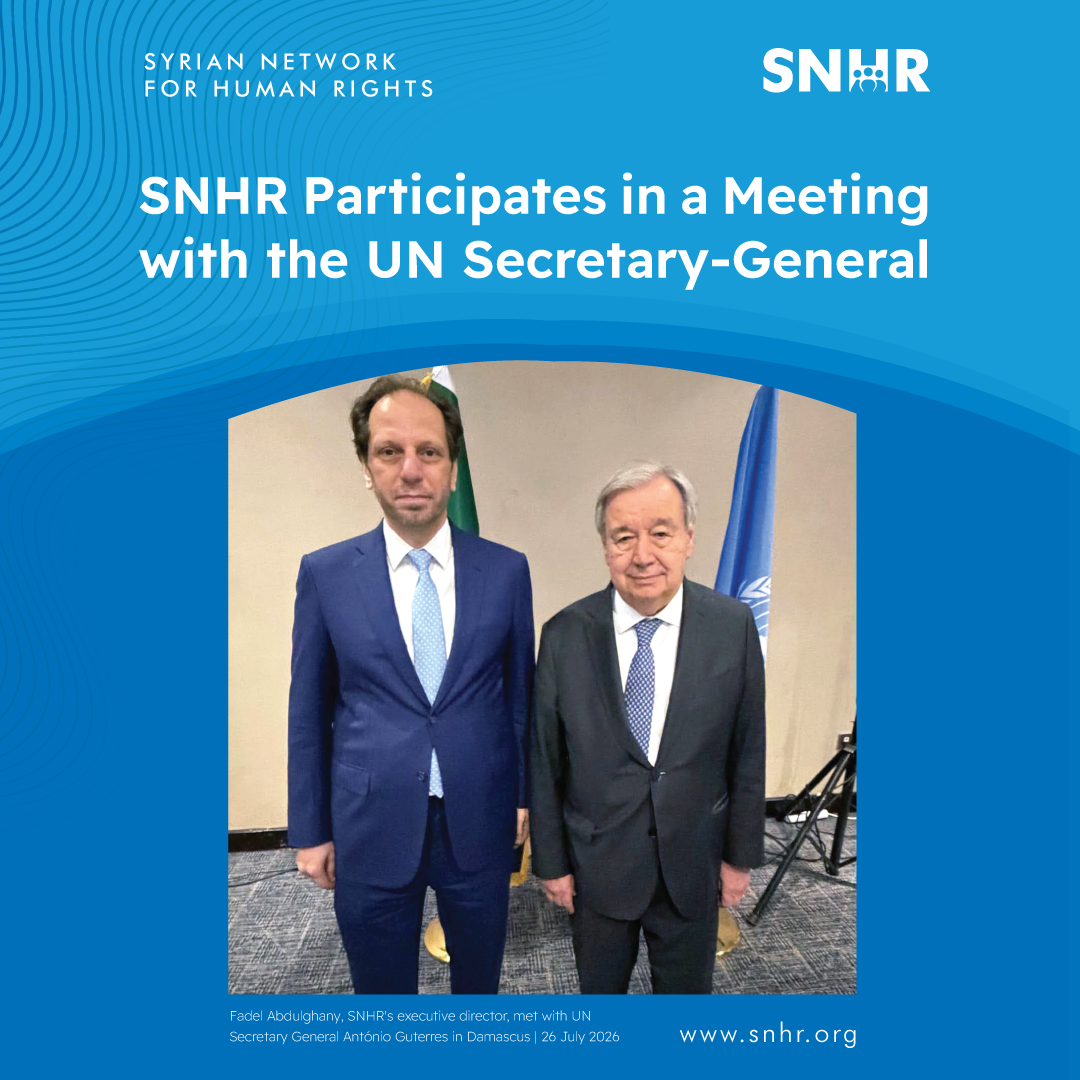
Damascus – The Syrian Network for Human Rights (SNHR), represented by its executive director Fadel Abdulghany, participated in a meeting held by the United Nations Secretary-General, António Guterres, with a delegation of representatives from Syrian civil society organizations to discuss the human rights situation and the priorities of the transitional phase in Syria.
During the meeting, Fadel Abdulghany delivered an intervention discussing the historic transition Syria witnessed following the fall of the Bashar al-Assad regime on December 8, 2024, the ongoing human rights and institutional challenges facing the country, and the role of the United Nations in supporting a transition based on the rule of law, the protection of civilians, and accountability for violations.
Abdulghany emphasized that the fall of the former regime brought an end to a dictatorial authority that was responsible, alongside its allies, for the vast majority of the widespread and systematic violations suffered by Syrians. At the same time, he stressed that the end of the regime does not mean the end of violations, nor does it relieve the transitional authorities of their responsibility to prevent and investigate them.
He pointed out that the continued proliferation of weapons remains a primary cause of civilian casualties, raised concern over cases of arbitrary detention, and affirmed that the threat of landmines and explosive remnants of war poses a major challenge to the Syrian government. Furthermore, he emphasized that responsibility for crimes and violations must remain individual, and that prosecuting those involved in the former regime’s crimes must not turn into revenge or collective punishment against any specific sect, region, or group.
The intervention also addressed the grave humanitarian impacts of landmines and explosive remnants of war, as well as the obstacles they pose to the safe, voluntary, and dignified return of refugees and displaced persons, and to the restoration of civilian and economic life—including the return of children to their schools and farmers to their land.
Additionally, Abdulghany cautioned against ignoring Israeli violations occurring on Syrian territory, including incursions, arrests, abductions, and attacks on civilians and civilian facilities. He emphasized that protecting Syrian sovereignty and protecting Syrian civilians are interconnected issues, and that the application of international law must be consistent and free from political considerations.
The intervention focused on five key priorities that should receive United Nations support: supporting a comprehensive national program for disarmament and the clearance of landmines and explosive remnants of war, strengthening judicial independence and reforming the security services, protecting mass graves, archives, and evidence, ensuring the participation of victims and families of the missing in transitional justice processes, and taking a clear stance on Israeli violations occurring in Syria.
The Syrian Network for Human Rights stresses the importance of the United Nations remaining open to independent Syrian civil society organizations, leveraging their expertise and data, and supporting governmental institutions to contribute to a successful transition. It also emphasizes the need to involve victims and families of the missing in shaping policies and programs related to this phase, ensuring that international community support is directed toward building institutions governed by law and capable of protecting the rights of all Syrians.
