

Languages
Available In
Introduction:
According to several defected Syrian officials, the Syrian regime doesn’t include oil revenues in the state budget, however, it were rather seized by the ruling family. Furthermore, according to B.P.’s statistical report on power in the world, the number of oil barrels that were seized by the ruling family is 385,000 barrel per day in 2010. The revenues of the oil is usually spent on personal expenses while a considerable portion is used to fund militias and “Shabiha” who work for the ruling family in order to support the dictatorial security state and carry out terrorist acts to destabilize and threat security in the area and the Syrian governorates. In case of economic and political emergencies, a small portion of the revenues were given to the state.
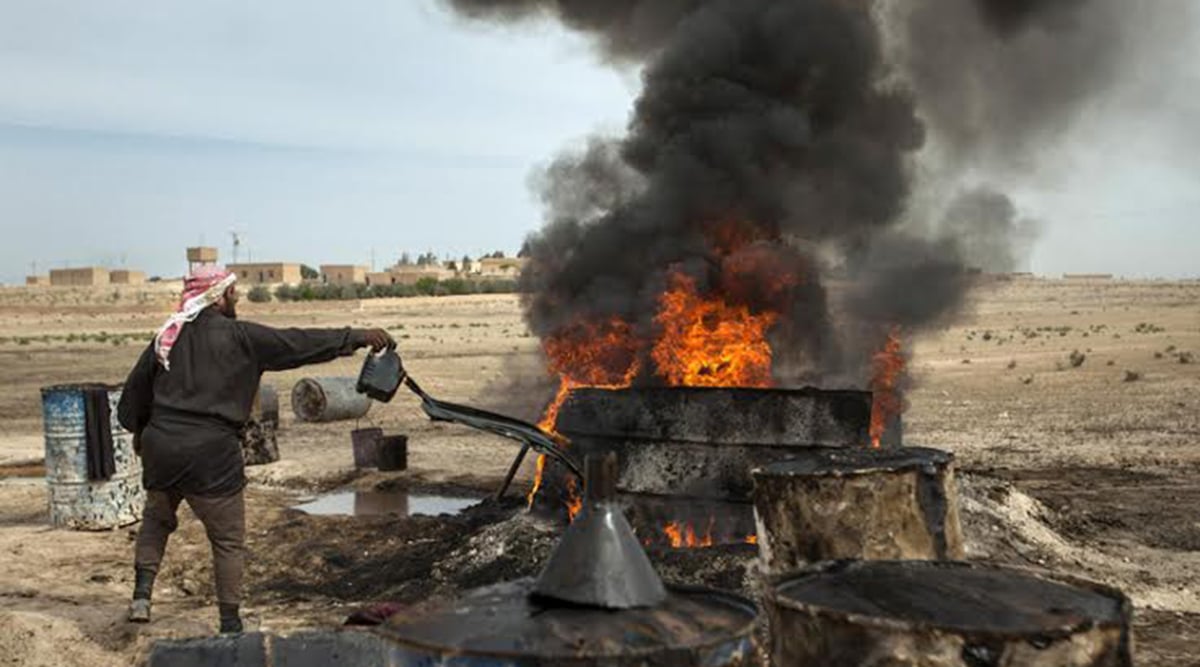
After the breakout of the Syrian revolution. The Syrian regime lost control over wide areas of Syria including the eastern area where the oil fields are. Many heated clashes and battles erupted between armed groups, tribes, and thieves over the oil wells in order to obtain the huge financial benefits. Every faction would use these oils to fund its goals. Dozens were killed and wounded in these battles
This report highlights the fact that most of the oil fields in Syria are now controlled by the Islamic State which uses it mainly to fund its military operations to take over more areas in Syria and perpetrate more crimes and terrorist acts.
IS’s territories
The Islamic State controls currently about one-third of Syria. It controls Ar-Raqqa completely, all of Der Ezzor except for the military airbase, some neighborhood in the city such as Al-Joura, Al-Ummal, and Al-Hamidiya. Also, IS controls wide areas of Al-Hassaka governorate including Ash-Shdadi, Al-Houl, and Markda in addition to many villages in northeastern Aleppo such as Al-Bab, Akhtarien, Al-Mas’oudiya, Al-Aziziya, Doybaq, Al-Ghouz, and Turkman Bareh, Akhtarien, and Ar-Ra’ie town near the Turkish border. Gegorrihphically, these areas are connected starting from Homs Badia (Sha’er Badia) in the middle of Syria to the Iraqi-Syrian borders in southeastern Al-Hassaka, Ar-Ra’ie town near the Turkish-Syrian borders, and Shamer village borders near the northeastern entry point in Aleppo.
//
