


Languages
Available In
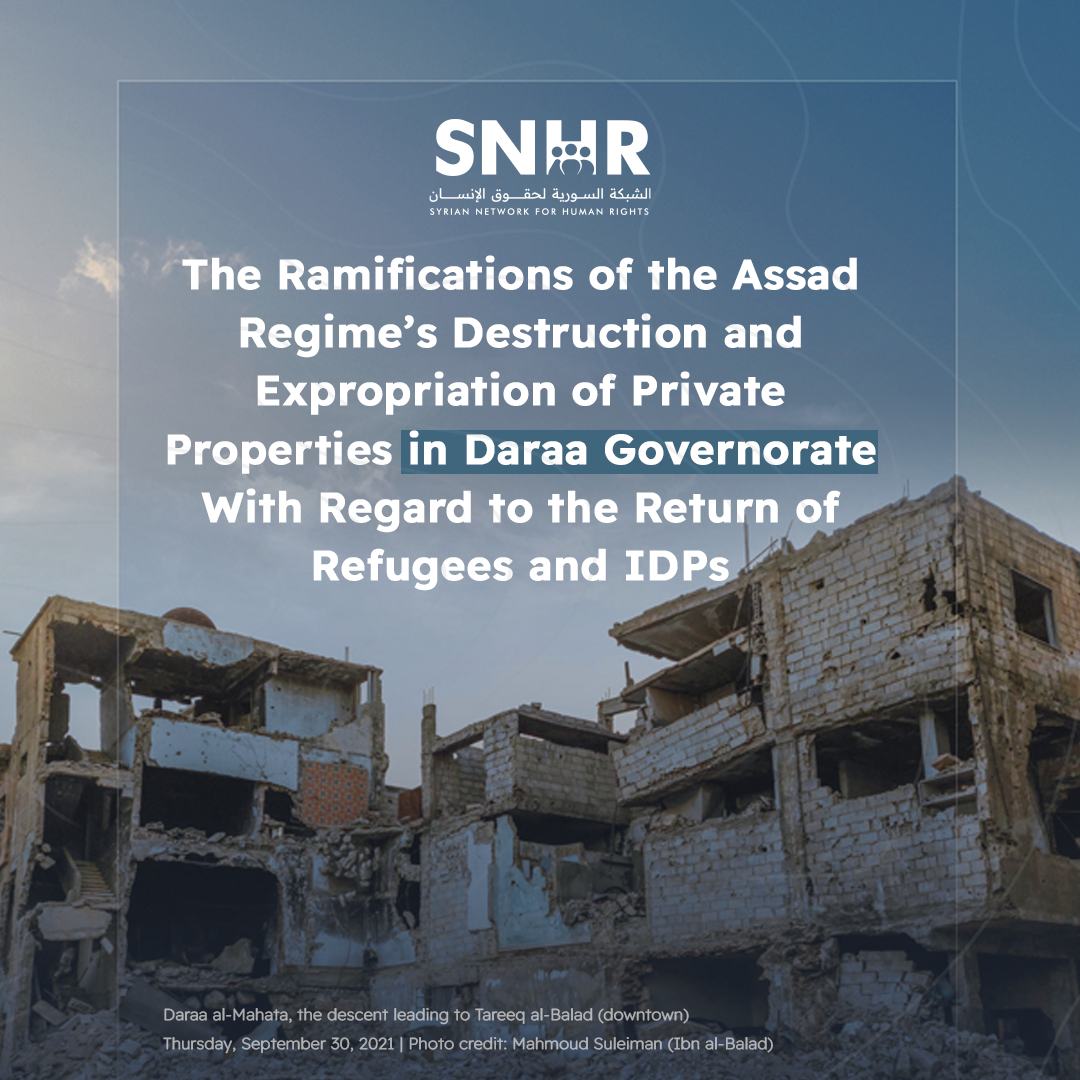
The Hague – The Syrian Network for Human Rights (SNHR) today released a report entitled ‘The Ramifications of the Assad Regime’s Destruction and Expropriation of Private Properties in Daraa governorate With Regard to the Return of Refugees and IDPs’. The report highlights the deliberate and systematic destruction policy adopted by the Assad regime to seize homes, lands, and properties through a wide array of quasi-legal laws and articles of legislation.
The report is divided into two main sections: the first consists of three chapters, while the second comprises four chapters:
- First section: This section examines the involvement of Daraa’s residents in the Syrian popular uprising and its consequences on their lives and real estate properties. It also traces the trajectory of the peaceful pro-democracy movement, the violent response by Bashar al-Assad’s regime from March 2011 onwards, and the numerous severe violations carried out by the Assad regime and its allies, shedding light on the extensive destruction inflicted upon properties and infrastructure in the governorate due to these practices.
- Second section: This section examines and analyzes selected cases from Daraa city, including the neighborhoods of the Lajien ‘Palestinian Refugees’ Camp, the Nazhin ‘IDPs’ Camp, and Tareeq al-Sadd. It also covers rural areas such as Kherbt Ghazala town and Nawa city, representing patterns of violations in rural regions. The report outlines the most significant violations committed in these areas, tracing the extensive damage done to properties and the direct impact of these attacks in forcing residents into displacement. It further explains how Bashar al-Assad’s regime exploited this situation to seize real estate properties. Additionally, the report discusses how these violations and property destruction have affected the prospects and feasibility of refugees and internally displaced persons (IDPs) returning.
As Fadel Abdulghany, SNHR Executive Director, says: “This report serves as a comprehensive document exposing one of the most dangerous systematic violations committed by the Assad regime: the seizure and destruction of property in Daraa. At SNHR, we have worked diligently to document the regime’s severe violations of property rights, starting with the enactment of unjust laws specifically designed to plunder the property of IDPs, refugees, forcibly disappeared persons, and dissidents, through to the deliberate destruction of property and infrastructure, culminating in the scorched-earth tactics aimed at uprooting the population and erasing their identity permanently.
He adds, “The report serves as a call for justice and accountability. It confirms that the destruction and displacement faced by Syrians in Daraa was not the result of random occurnces, but part of a coordinated policy aimed at altering the region’s demographic structure.
He concludes, “We hope this report will help to highlight the systematic violations against the Syrian people and serve as a step toward achieving justice for the victims and in holding accountable those responsible for this humanitarian disaster. Such crimes are not subject to the Statute of Limitation. What is presented in this report is a clear call for the international community to hold the Assad regime and its allies accountable for the practice of seizure and destruction, and to work on restoring the victims’ rights and ensuring the achievement of transitional justice, which is essential for sustainable peace in Syria.”
Methodology
The report was produced using an investigative and analytical approach by compiling live accounts, interactive maps, documentary images, and video footage with the objective of providing accurate and reliable findings, particularly in monitoring real-time developments on the ground. It also presents a small-scale survey featuring interviews and accounts from hundreds of victims from various parts of Daraa Governorate whose properties there were subjected to violations by Bashar al-Assad’s regime and pro-Assad militias. Regarding the analytical maps derived from satellite imagery, the report complies with the technical standards used by the United Nations Satellite Centre (UNOSAT) of the United Nations Institute for Training and Research (UNITAR) to assess the level of destruction and damage to buildings and urban facilities.
Targeted groups in property seizures
The report notes a significant expansion of the Assad regime’s real estate property seizures over the six years from 2018 to 2024, which relied on using a series of illegitimately issued laws and decrees dating back to 2011. In these actions, the Assad regime exploited the turbulent conditions of the internal armed conflict, as well as using its own absolute control over both legislative and executive powers in the state. The report stresses that while these oppressive laws targeted the Syrian population in general, they primarily focused on three specific groups:
- Forcibly displaced persons (refugees and IDPs): estimated to number 12.8 million Syrians as of November 2024 according to the Office of the UN High Commissioner for Refugees (UNHCR);
- Forcibly disappeared persons: at least 113,218 Syrians have been categorized as forcibly disappeared persons as of August 2024; and
- Deceased civilians and military personnel: The estimated number of civilian and military deaths reached around 500,000 Syrians, with the majority not officially registered in civil records. The report emphasized that most individuals in these categories were opponents of Bashar al-Assad’s regime and had been directly targeted since the beginning of the popular uprising in March 2011.
Key statistics on violations in Daraa Governorate
The report stresses there is a direct link between numerous grave violations against civilians and abuses of property rights. These violations forced residents into displacement, facilitating the regime’s property seizures through enacted laws. The report documents at least 22,443 civilian deaths, including 3,869 children and 2,140 women, by the parties to the conflict and controlling forces in Dara governorate between March 2011 and July 2024. The report also reveals that at least 8,706 of the people arrested/detained since the start of the conflict up until July 2024, including 224 children and 194 women, remain arbitrarily arrested and/or forcibly disappeared. In addition, the report documents no fewer than 2,500 deaths due to torture in the same period. The report underlines that the overwhelming majority of these violations were perpetrated by Assad regime forces.
Weapons used in Daraa
The report documents that the Assad regime dropped at least 11,153 barrel bombs on various areas in Daraa governorate between July 2012 and August 2018, resulting in no fewer than 1,177 civilian deaths, including of 272 children and 193 women. The report also documents three chemical weapon attacks carried out in the region by Assad regime forces in Daraa between January 23, 2012, and July 2024. All three of the chemical weapons attacks were carried out by Assad regime forces.
Case studies
The report divided the cases studied in the second section into separate subsections. The first subsection focuses on Daraa Camp (comprising both the Lajien and Nazhin Camps), in addition to Tareeq al-Sadd area. The second concerns the town of Kherbt Ghazala, while the third subsection is dedicated to Nawa city. Across these three subsections, the report highlights the most significant violations witnessed in these areas, meticulously tracking the systematic confiscation of Syrian citizens’ real estate properties. It also documents the extent of physical destruction inflicted upon these locations. Furthermore, the report provides a comparison between the scale of destruction as observed through satellite imagery and the actual situation on the ground, offering a clear and comprehensive picture to the reader regarding the extent of looting and property seizures, as well as the true magnitude of destruction that affected numerous cities, towns, and neighborhoods across Daraa governorate.
the issue of refugee and IDP return
In the fourth subsection of the second section, the report examines the impact of attacks and property destruction in Daraa governorate on the return of refugees and IDPs. It provides a detailed review of the significant obstacles that hindered their return to their original areas. The report emphasized that these obstacles were not limited to the large-scale destruction of properties and infrastructure but also included a deliberate system of security, legal, and administrative challenges imposed by Bashar al-Assad’s regime to obstruct the return of the displaced and exploit their absence to seize their properties.
Key findings of the report
Through cartographic analysis, the report explains, SNHR has concluded that the artillery and aerial bombardments carried out by Bashar al-Assad’s regime and its allies against several cities, neighborhoods, and rural areas in Daraa governorate were exceptionally excessive. The report affirmed that this level of targeting was not purely driven by military objectives but was aimed at inflicting the maximum possible destruction on civilians’ real estate properties to facilitate their seizure. SNHR determined that the primary goal of this policy was to force residents into displacement initially and to ensure that they would not be able to return, allowing the Assad regime to later exploit these properties during the reconstruction phase. The report emphasizes that this objective was the driving force behind all preceding stages, regardless of the massive material losses suffered by the Syrian population or the deliberate impoverishment resulting from the confiscation of their properties and lands.
Key recommendations of the report
To the international community and the UN
- Establish a specialist international body to document crimes related to property seizures, composed of legal experts and technology specialists, tasked with collecting and analyzing all the relevant evidence, particularly the documents, and decrees issued by Bashar al-Assad’s regime in this regard.
- Issue clear national and international resolutions totally rejecting the recognition of any laws or decrees enacted by Bashar al-Assad’s regime during the conflict, particularly those targeting the confiscation of refugee and IDP properties.
- Support programs and projects that utilize artificial intelligence techniques in the analysis of satellite imagery to provide an accurate and detailed assessment of the destruction and violations committed against real estate properties in Syria, and make this data available to bodies responsible for implementing transitional justice.
To international human rights organizations
- Conduct comprehensive documentation of all violations related to real estate properties in Syria, with a particular focus on those committed during the conflict, especially those targeting civilian properties and vital infrastructure.
- Prepare comprehensive legal files on property rights violations carried out by Bashar al-Assad’s regime, which can be used as evidence in international courts or within any legal framework or transitional justice mechanism in the future.
To the UNHCR
- Establish an advanced technological platform that enables refugees and IDPs to register their complaints regarding property rights, with the aim of formally documenting and following up on these cases with relevant international entities.
- Collaborate with international institutions to design special programs for compensating and rehabilitating real estate properties in affected areas, ensuring special attention is given to women and the most vulnerable and worst affected groups.
- Consistently emphasize, in all international forums, that the return of refugees and IDPs must be voluntary, safe, and dignified, with guarantees that they will regain their rights and properties.
