


Under al-Shaar, the Syrian Ministry of Interior Was Responsible for Nearly Quarter of A Million Violations Which Necessitates Accountability
Available in:
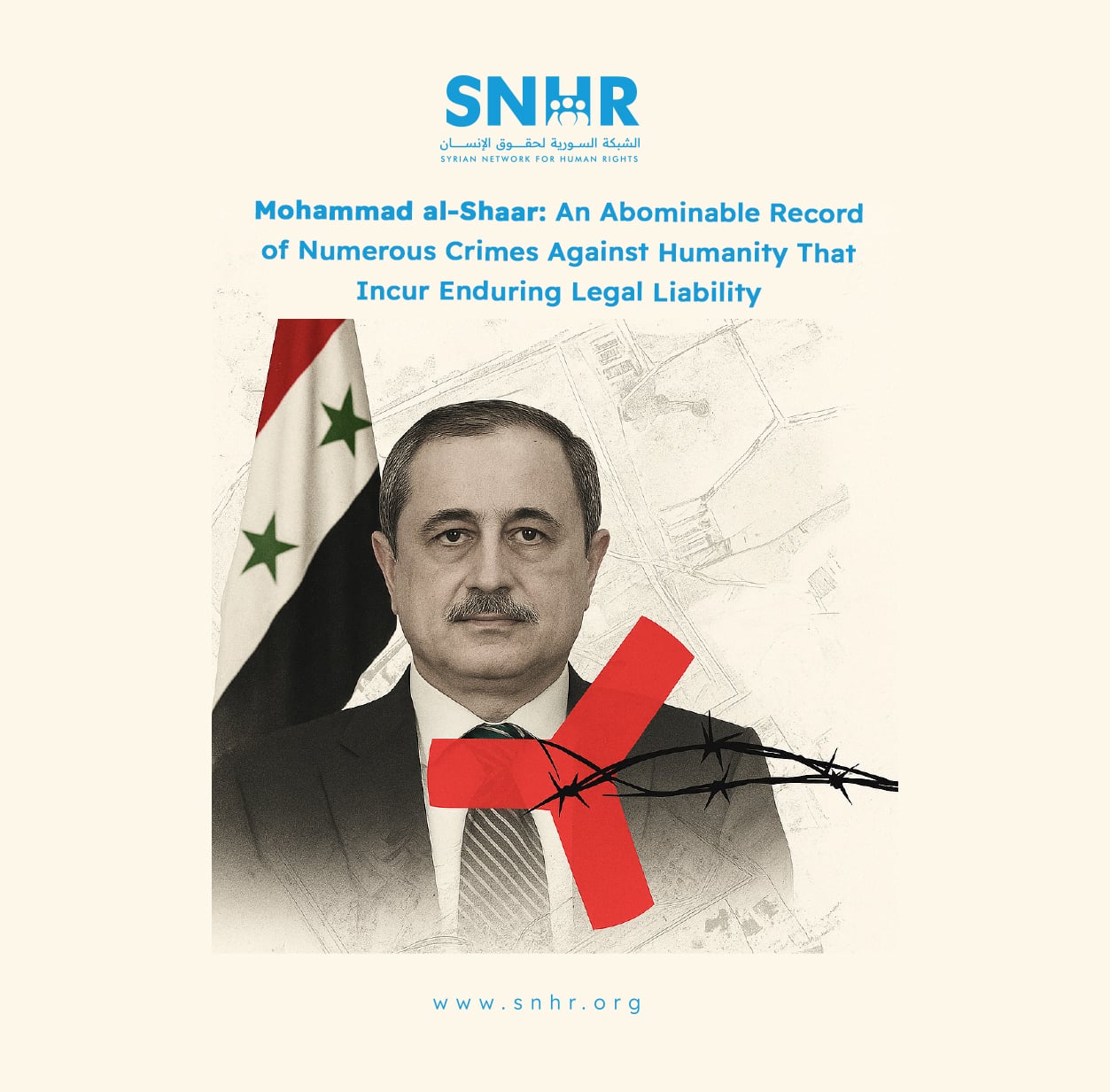
The Hague – The Syrian Network for Human Rights issued today a report on the black record of the Interior Minister under the deposed regime of Bashar al-Assad, the report indicated that Mohammed al-Shaar possesses a dark record of crimes against humanity and legal responsibility that does not expire with the passage of time. The report added that the Interior Ministry under al-Shaar was responsible for nearly a quarter of a million violations, which warrants unequivocal accountability.
The report stated that Major General Mohammed al-Shaar is a top figure in the ousted Assad regime and is responsible for crimes against humanity against Syrians. It added that the Syrian Network for Human Rights’ database documents that al-Shaar, as Minister of Interior, was a direct supervisor of systematic repression policies, including extrajudicial killings, arbitrary arrests, enforced disappearances, torture, and the killing of detainees during uprisings in civilian prisons, in addition to complicity in unlawful executions. Under his leadership, the Ministry of Interior also participated in numerous forced displacement operations targeting areas besieged by Assad regime forces for years.
Under his leadership, the Ministry of Interior played a key role in implementing the decisions of exceptional courts, such as the Military Field Court and the Terrorism Court. These decisions resulted in the confiscation of opposition members’ property, the issuance of travel bans, and the manipulation of civil registry records of the forcibly disappeared. Furthermore, the ministry was implicated in suppressing rebellions within civilian prisons using live ammunition, depriving detainees held there of their most basic rights, and obstructing thousands of forcibly displaced persons from obtaining official documents and extorting money from them.
According to the Syrian Network for Human Rights’ database, the total number of documented violations linked to the Ministry of Interior’s agencies reached 256,364, detailed according to their type and nature, during Major General Mohammed al-Shaar’s tenure as head of the ministry. These statistics do not include the tens of thousands of victims of forced displacement, in whose displacement the ministry played various roles, nor the thousands who were denied their basic rights to obtain their official documents, in addition to the thousands of detainees who faced harsh conditions in civilian prisons run by the Ministry of Interior.
The report chronicles the security, military, and political career of Major General Mohammed al-Shaar, who has held numerous prominent positions, including security chief in the Lebanese city of Tripoli, head of the Military Security Branch in Tartus, head of investigations and later head of the Military Security Branch in Hama, head of the Military Security Branch in Aleppo, head of the 227th District Branch of the Military Intelligence Division in 2006, and head of the Military Police Administration in Syria.
The report stated that the Minister of Interior bears direct and indirect legal responsibility for the serious violations committed by the ministry’s agencies during his tenure, in accordance with international humanitarian law and international human rights law. Direct responsibility arises when the Minister of Interior issued explicit orders, approved violations, or knew of their occurrence but failed to take any measures to stop them or hold those responsible accountable. Given the scale of the violations recorded, indirect responsibility under international law, whereby civilian and military leaders bear responsibility for crimes committed by their subordinates if they failed to take the necessary measures to prevent them or hold the perpetrators accountable.
Based on the evidence and facts documented in the Syrian Network for Human Rights’ database, the Minister of Interior bears direct legal responsibility for the violations committed by agencies affiliated with his ministry. The scale of these violations and their continuation over eight years, with no action taken to stop them, confirms that the minister was either directly involved or negligent in performing his duties.
Under the Rome Statute of the International Criminal Court, the Minister of Interior may be charged with crimes against humanity and war crimes, making him liable to prosecution before national and international courts.
SNHR’s legal accountability is outlined as follows:
“In no case can perpetrators of grave violations be forgiven or pardoned by the Assad regime’s first-rank leaders, no matter how much they try to justify their actions or escape responsibility. These crimes, which include extrajudicial killings, torture, enforced disappearances, and forced displacement, are not individual cases, but are part of a systematic policy aimed at crushing dissent and terrorizing society as a whole. Crimes against humanity and war crimes have no statute of limitations, and no political settlement or considerations of interest can grant impunity to those whose hands are stained with the blood of innocent people. Genuine justice requires that they be held accountable in accordance with the law, and that victims and their families be redressed to ensure that these atrocities are not repeated in the future.”
According to the Syrian Network for Human Rights database, during the tenure of Major General Mohammed al-Shaar, the Ministry of Interior committed gross human rights violations, including nine systematic patterns practiced on a wide scale, including:
SNHR documented the killing of 10,452 civilians, including 803 children and 737 women, at the hands of the Ministry of Interior’s police and political security forces during their crackdown on demonstrations in various Syrian governorates, targeting them with live ammunition, between April 14, 2011, and November 2018.
SNHR documented the deaths of at least 32 people under torture in Criminal Security branches between April 14, 2011, and November 2018. It also documented the disappearance of at least 326 people, including 12 children and 9 women, who remain forcibly disappeared in these branches during the same period.
SNHR documented the deaths of at least 83 people, including three children, under torture inside the Political Security branches between April 14, 2011, and November 2018. It also documented the disappearance of at least 1,459 people, including 23 children and 14 women, who remain forcibly disappeared inside the Political Security branches of the Bashar al-Assad regime during the same period.
SNHR documented at least 1,608 arrests, including 18 children and 198 women, as well as 73 individuals who had previously settled their security status, while they were at immigration and passport offices in several Syrian governorates to process their paperwork.
SNHR documented the deaths of at least 110 detainees in civilian prisons, including 17 as a result of police shooting, and 93 others as a result of torture, medical neglect, and malnutrition.
SNHR also documented the deaths of at least 93 detainees inside central prisons across Syria’s governorates between April 14, 2011, and November 2018. These deaths were the result of systematic torture and deliberate medical neglect, including the refusal to provide detainees with healthcare or respond to their critical health conditions, and malnutrition, which caused their health to deteriorate and led to their deaths.
According to the Syrian Network for Human Rights’ database, the Ministry of Interior was complicit in the execution of 843 defecting police officers and personnel between March 2011 and October 2018.
The Ministry of Interior played a major role in implementing judicial rulings issued by military and exceptional courts. During Mohammad Al-Shaar’s tenure, the ministry implemented at least 11,267 property confiscation procedures. The ministry was the executive tool for seizing property and stripping Syrians of their assets, based on trials that lacked fair standards. 115,836 travel bans were used to prevent citizens from leaving the country and to immediately arrest those who participated in popular protests, restricting the freedom of movement of tens of thousands of people based on security warrants not based on legal evidence, but rather on confessions extracted under torture or based on unreliable security suspicions. 112,000 search warrants were issued by the Political Security Directorate, reinforcing the security crackdown and persecution.
The Syrian Network for Human Rights documented at least 1,661 forcibly disappeared persons officially registered as deceased, including 50 children and 21 women, in addition to 16 medical personnel and 10 media personnel, between the beginning of 2018 and the fall of the regime on December 8, 2024.
In addition to depriving tens of thousands of forcibly displaced persons of official documents and extorting them financially, the Ministry of Interior actively participated in numerous forced displacement operations targeting areas besieged by Assad regime forces, contributing to the implementation of large-scale displacement operations.
The report stated that these violations expose the pivotal role played by Ministry of Interior under Mohammad al-Shaar in implementing policies of systematic repression and crimes against humanity. Its responsibility was not only limited to direct violations but extended to empowering and sustaining the system of repression through legal, administrative and security tools. Under Syria’s international obligations, the state is obligated to respect and protect human rights in accordance with the international conventions it has ratified, such as the International Convention on Civil and Political Rights (ICCPR) and the UN Convention against Torture. The commission of these violations by the Ministry of Interior reflects a failure to meet these obligations.
The report was concluded by recommendations to the current transitional government in Syria take the following measures to ensure justice and accountability for crimes and violations committed by the Ministry of Interior during Major General Mohammad Al-Shaar’s tenure
- Hold Major General Mohammad Al-Shaar accountable
- Take all necessary legal measures to hold Mohammad al-Shaar accountable for crimes and violations committed by the Ministry of Interior under him, including extrajudicial killings, torture, enforced disappearances, arbitrary executions, and seizure of property, in accordance with international standards of justice and accountability.
- Reject any attempts to grant him legal impunity or political settlements that would lead to his evasion of justice.
- Ensure that Mohammad al-Shaar does not escape justice in accordance with international human rights law and international humanitarian law.
- Conduct a thorough investigation into the role of the Ministry of Interior
- Launch a comprehensive investigation into the Ministry of Interior’s role in systematic repression, including its security services, particularly the Criminal Security and Political Security.
- Investigate all security and administrative officials involved in violations related to the Ministry.
- Protect victims’ rights, and ensure redress and reparation for the victims
- Ensure justice for victims by providing them with fair compensation, as well as legal guarantees that violations will not be repeated.
- Take measures to assist survivors of arbitrary detention and torture, including psychosocial and legal support.
- Reform the Ministry of Interior and its agencies
- Dismantle and restructure the Ministry of Interior, and exclude all individuals implicated in serious crimes and violations.
- Ensure that the Ministry is subject to independent oversight mechanisms to prevent the recurrence violations in the future.
- Cancel all arbitrary measures issued by the Ministry of Interior
- Cancel property seizure orders, lift travel bans and security prosecutions that have been used as repressive tools against dissidents, and ensure fair compensation for the victims of these arbitrary practices.
- Restore the civil rights of citizens who were deprived of them as a result of the practices of the Ministry of Interior under Mohammad al-Shaar.
- Intensify international efforts
- Strengthen cooperation with international organizations concerned with human rights, such as the UN and the EU, to ensure the implementation of international sanctions against Mohammad al-Shaar and prevent him from escaping justice.
- Support human rights organizations and civil society
- Provide technical and logistical support to human rights bodies working to document crimes and prepare legal files against those involved in violations.
- Activate the role of civil society in monitoring any judicial procedures to ensure their integrity and non-politicization.
- Strengthen evidence-gathering and documentation efforts to support opportunities for prosecution before national and international courts.
- Establish a national transitional justice mechanism
- Establish an independent national body to document the crimes of the former regime and hold those responsible accountable, as part of a transitional justice process that ensures truth, justice for victims, and prevention of impunity.
