


Available in:
Damascus – June 26, 2025
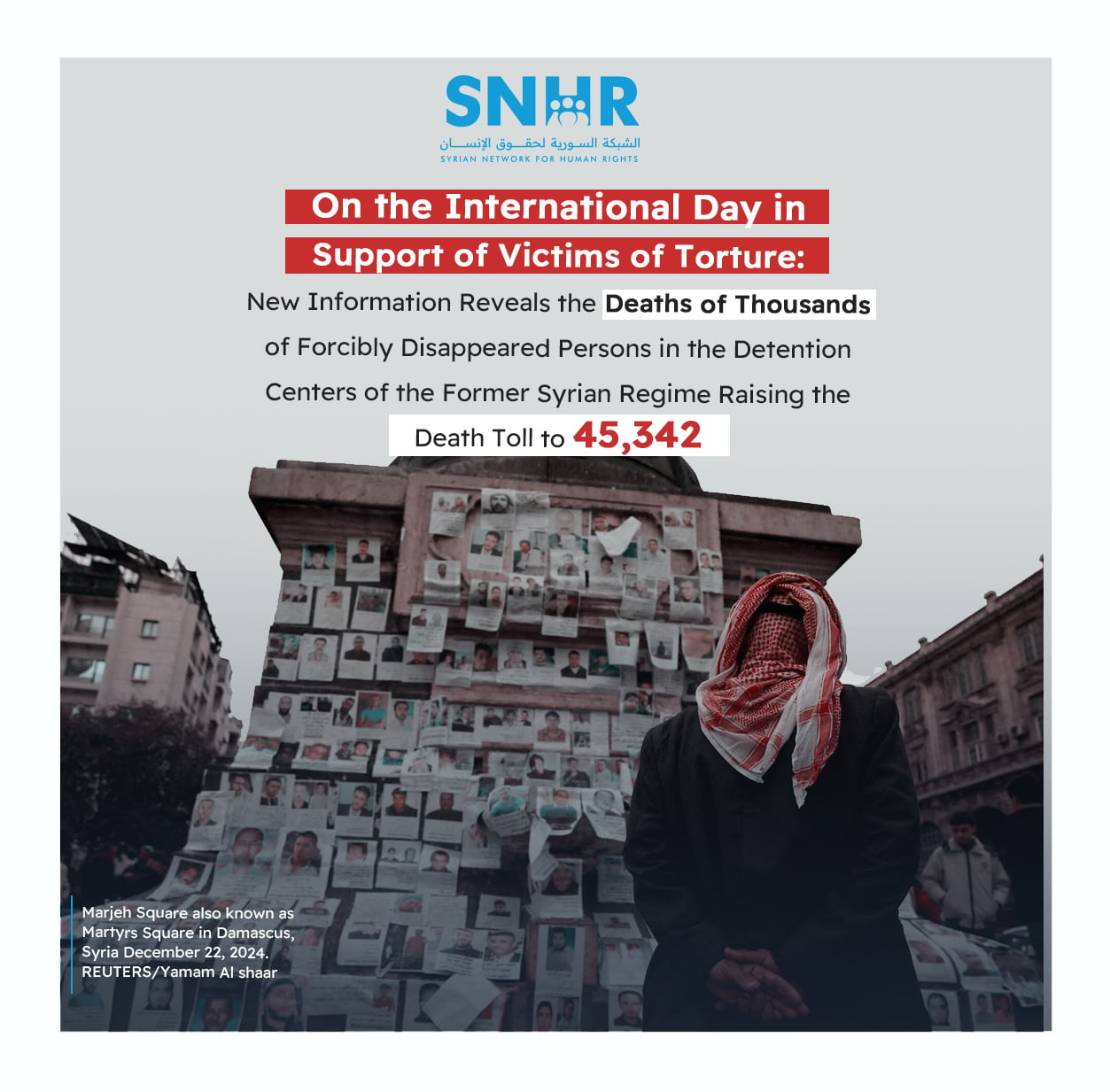
The Syrian Network for Human Rights released its annual report on the occasion of the International Day in Support of Victims of Torture, highlighting one of the most horrific systematic crimes to which Syrians have been subjected since March 2011. The 2025 report comes at a pivotal moment following the fall of the Bashar al-Assad regime on December 8, 2024, and the subsequent revelation of new information through official documents and records, as well as contact with thousands of families, which revealed to us the deaths of large numbers of forcibly disappeared persons in regime detention centers. This has led to a significant increase in the documented number of victims who died under torture or in inhumane detention conditions, according to the Syrian Network for Human Rights database.
Over the course of fourteen years, the network has documented the torture and abuses suffered by detainees in official and unofficial detention centers run by the Bashar al-Assad regime. It has built a massive database based on the testimonies of thousands of survivors and relatives of victims, supported by visual and documentary evidence. This database serves as a primary reference in numerous international investigations and mechanisms.
Data on victims who died under torture since March 2011, distributed according to the Syrian Network for Human Rights database
The report indicated that the year 2025 witnessed a significant increase in the number of documented victims of torture in Syria, primarily due to the availability of thousands of data from testimonies, documents, and evidence that revealed the deaths of tens of thousands of forcibly disappeared persons in previous periods. Their deaths were confirmed through official documents, data from civil registry offices, reports from detention centers, and testimonies from survivors inside those centers, following the collapse of the security system that had systematically withheld this information.
According to the network’s documentation, at least 29,959 people were recorded killed as a result of torture in 2025, bringing the total number of victims from March 2011 to June 2025 to 45,342, including 225 children and 116 women.
Most of these deaths date back to the period between 2011 and 2014, which marked the peak of the campaign of arrests and enforced disappearances. The network’s data also shows that at least 181,244 individuals, including 5,332 children and 9,201 women, remain detained or forcibly disappeared in detention centers run by various entities inside Syria between March 2011 and June 2025. Of these, at least 177,021 individuals, including 4,536 children and 8,984 women, are classified as forcibly disappeared. Statistics confirm that the vast majority of those arrested were detained for their participation in the popular movement and were arbitrarily detained without any fair legal or judicial procedures.
Bashar al-Assad’s regime is responsible for more than 99% of deaths due to torture
The data revealed that more than 99% of deaths under torture (45,032 out of 45,342) occurred within detention centers run by the former regime, which used torture as a systematic tool of repression within an official policy encompassing the four main security agencies: Air Force Intelligence, Military Security, State Security, and Political Security, in addition to civilian and military prisons and unofficial detention centers.
SNHR documented the use of at least 72 torture methods, ranging from beatings, electric shocks, waterboarding, stress positions, solitary confinement, deprivation of food and healthcare, and sexual violence. These methods affected all groups, including children, women, the elderly, and people with disabilities.
According to the report’s analysis of the distribution of torture victims across Syrian governorates, Daraa, Rif Dimashq, Hama, and Homs topped the list. The report also indicated that regional affiliation was often a factor in the practice of torture, with regime personnel torturing victims based on their affiliation with opposition-held areas as part of collective revenge operations.
Documentation through “Caesar” photos
Through leaked photos from military hospitals, known as the “Caesar photos,” the network was able to identify 1,017 victims, the majority of whom were arrested in 2012 and 2013. The data showed that the largest number of victims was documented in Branch 227 (the Area Branch), which recorded 382 victims, followed by Branch 215 (the Raid and Assault Brigade) with 300 victims. Both were among the most prominent centers of deadly torture under the Assad regime.
Accountability and justice as a gateway to ending impunity and preventing the recurrence of torture in Syria
The report emphasized that the fall of Bashar al-Assad’s regime and the beginning of the transitional phase place a historic responsibility on the new authorities, along with Syrian society as a whole, to dismantle this heavy legacy and address it seriously and institutionally. This requires adopting a comprehensive plan to address the issue of torture, based on the following:
- Opening independent and serious national investigations into torture crimes committed since 2011 and before.
- Establishing judicial independence and empowering the judiciary to prosecute perpetrators of these crimes at all levels, without exception or impunity.
- Enhancing cooperation with international mechanisms, such as the International, Impartial, and Independent Mechanism (IIIM), and national courts with universal jurisdiction.
- Truth-telling and institutional transparency:
- Publicizing the results of investigations into incidents of torture and enforced disappearance.
- Facilitating access by victims’ families to information related to the fate of their loved ones, enabling them to claim their legal rights.
- Redress and Justice for Victims:
- Officially recognize victims’ rights and consider them victims of grave violations.
- Launching psychological, health, and social support programs for torture survivors.
- Providing fair material and moral compensation to victims and their families, including symbolic reforms and appropriate exemptions.
- Institutional Reform and Ensuring Non-Recurrence:
- Dismantling security agencies implicated in torture crimes and restructuring them in accordance with human rights and the rule of law principles.
- Purifying institutions of individuals implicated in serious violations and barring them from holding public office in the future.
- Legislation:
- Amending national laws to comply with the Convention against Torture and criminalizing all forms of torture without statute of limitations or legal exemptions.
- Transitional Justice as an Integrated Process:
- Integrating the torture file into a comprehensive national transitional justice strategy, including accountability, reparations, truth-telling, and institutional reform.
- Involving civil society and victims in the formulation and implementation of this strategy to ensure genuine representation of the interests of those affected.
Report Conclusions:
- The torture practices committed in detention centers of the former Bashar al-Assad regime, including death by torture, constitute a crime against humanity under Article 7 of the Rome Statute, given their widespread and systematic nature and the targeting of civilians as part of state policy.
- The continued use of torture in some detention centers of other parties to the conflict reflects a failure to respect international human rights law and holds those responsible accountable.
- Statistics show that more than 99% of deaths under torture occurred within detention centers run by the Bashar al-Assad regime, highlighting the institutional nature of this crime and calling for urgent action at the national and international levels.
Recommendations
First: The Transitional Government:
- Officially recognize the crimes of torture and abuse in detention centers as part of the gross human rights violations suffered by Syrians and take clear steps to address them within the transitional justice process.
- Conduct a comprehensive inventory of official and unofficial detention centers used by the former Bashar al-Assad regime and investigate the nature of the violations committed within them, including interviewing former employees and witnesses.
- Protect evidence and records related to detainees and torture victims, and ensure they are not tampered with or destroyed, given their legal and human rights importance for any subsequent investigations.
- Review and suspend all legislation and administrative orders that legislate or provide legal protection for perpetrators of torture, and work to enact laws consistent with the Convention against Torture.
- Preventing the conclusion of any political or judicial settlements that perpetuate impunity or legitimize past violations.
- Ensure the cooperation of transitional institutions with relevant UN mechanisms, particularly the International Commission of Inquiry and the International Impartial Mechanism (IIIM) and provide them with necessary documents and evidence upon request.
- Launching a comprehensive national reparations program for victims and their families, including material and moral compensation, psychological and social support, and symbolic recognition of victims’ status in the public sphere.
- Include the torture issue in educational curricula and the public narrative of the new state, as part of national reconciliation, preventing the recurrence of violations, and promoting a culture of human rights.
- Ensure that those directly or indirectly involved in torture crimes are not permitted to hold any security or administrative positions and implement strict institutional vetting procedures as part of the reform process.
Second: The Syrian Judiciary and Concerned Legal Institutions:
- First, we must work to ensure the independence of the judiciary, then open judicial investigations into torture-related crimes in accordance with international standards and prosecute those responsible at all levels without statute of limitations or exceptions.
- Develop the tools of the national judiciary to enable it to prosecute crimes against humanity, including crimes related to torture and enforced disappearance, and establish specialized units for these cases.
- Strengthening cooperation with local and international human rights organizations that possess databases and documented testimonies of victims and survivors, to be used as evidence in accountability processes.
Third: The International Community and UN Entities:
- Continue supporting documentation and accountability efforts related to torture crimes in Syria and provide technical and logistical assistance to independent Syrian bodies working in this field.
- Expand the jurisdiction of international and national courts with universal jurisdiction to prosecute those involved in torture crimes in Syria, including those residing outside the country.
- Supporting psychosocial rehabilitation programs for victims, especially those who have been subjected to severe forms of torture and sexual abuse, and providing specialized, long-term services.
