

Russia Killed 6,993 Civilians, Including 2,061 Children and 984
Available in:
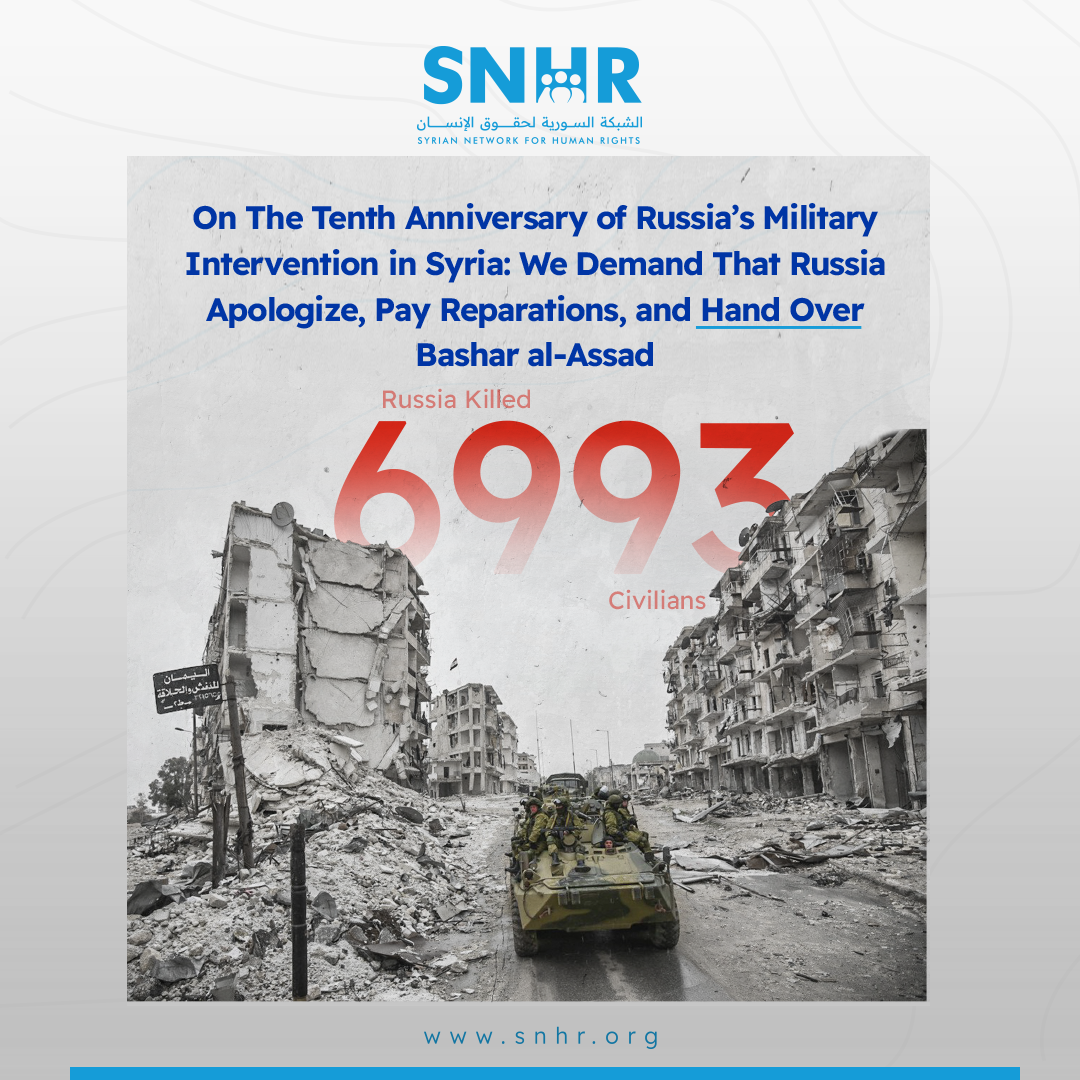
Damascus – The Syrian Network for Human Rights (SNHR) today issued a report marking the tenth anniversary of the Russian military intervention in Syria. The report called on Russia to issue an official apology, pay compensation to the victims, and extradite Bashar al-Assad, who fled to Russia after the fall of his regime in December 2024. The network documented the deaths of 6,993 civilians, including 2,061 children and 984 women.
The report noted that the tenth anniversary of the Russian intervention falls after the fall of Bashar al-Assad’s regime in December 2024, which halted Russian attacks but did not end their devastating effects of violations, displacement, and widespread destruction. Over the course of nine years, the Syrian Network for Human Rights has documented these violations in annual reports, asserting that the Russian intervention since September 2015 marked a dangerous turning point in the conflict, as it completely sided with the regime against demands for freedom and justice, supported it politically and militarily, and committed grave violations, including bombing, forced displacement, destruction, and the use of cluster munitions against civilians.
The report stated that Russia provided comprehensive political, military, and economic support to the Assad regime. It obstructed international accountability by using its veto power 18 times, 14 of which occurred after its military intervention. It voted against the Syrian people in 21 Human Rights Council sessions, opposing any condemnation of the regime, and enlisted allied states to protect it. Its military intervention also contributed to the regime regaining control over strategic areas such as Aleppo, Ghouta, Daraa, and Idlib, changing the map of the conflict. Moscow supported the regime logistically and technically, covering up its violations, including the use of chemical weapons, and using its media and diplomatic arms in the Geneva, Astana, and Sochi processes to ensure the regime’s survival at the expense of Syrians’ aspirations.
Fadel Abdulghany, director of the Syrian Network for Human Rights, says:
“Ten years after the announcement of the Russian military intervention in Syria, which resulted in the deaths of approximately seven thousand civilians, 44% of whom were women and children, the use of internationally prohibited weapons, and the systematic targeting of medical and educational facilities, we cannot turn the page on these crimes or ignore Russia’s continued harboring of the criminal Bashar al-Assad. Moscow has erected, politically and diplomatically, a fence that has prevented accountability by obstructing Security Council resolutions, while our human rights documentation confirms that these violations amount to war crimes and crimes against humanity. Therefore, any talk of new relations with Russia must be preceded by an official admission of responsibility and a clear apology, the handing over of Bashar al-Assad to justice, and the launch of a compensation and reparations program for victims, with guarantees of non-repetition and support for reconstruction based on a transitional justice approach that places victims’ rights at the center.”
Documented Russian Violations (September 30, 2015 – December 8, 2024)
The report listed the most prominent violations committed by Russian forces since their military intervention in Syria on September 30, 2015, until the fall of the Assad regime on December 8, 2024. The Syrian Network for Human Rights documented the deaths of 6,993 civilians, including 2,061 children and 984 women (adult females). The report confirmed that the high percentage of children and women among the victims indicates that Russian attacks have largely targeted populated areas, raising strong indications of the possibility of deliberately targeting civilians or causing disproportionate damage in violation of international humanitarian law. According to the network’s database, Aleppo governorate recorded the highest number of civilian casualties by governorate, followed by Idlib and Deir Ez-Zor.
SNHR also documented at least 363 massacres committed by Russian forces during the same period, demonstrating widespread reliance on indiscriminate or disproportionate attacks and confirming that Russian intervention was a key factor in escalating civilian suffering and committing violations that amount to war crimes.
SNHR documented the killing of at least 70 medical personnel, including 12 women (adult females), in addition to the killing of at least 24 media personnel at the hands of Russian forces during the same period.
Additionally, SNHR recorded at least 1,262 attacks on vital civilian facilities, including 224 schools, 217 medical facilities, and 61 markets, carried out by Russian forces since their intervention until the fall of Bashar al-Assad’s regime. Idlib province topped the list of provinces in terms of the number of attacks, followed by Aleppo and Hama, reflecting a systematic pattern of targeting civilian facilities.
Since late September 2015, the Syrian Network for Human Rights has documented Russian violations through a comprehensive database that tracks attacks and their resulting casualties and destruction, including massacres, the targeting of vital facilities, and the use of cluster munitions. Most notable among these was the Idlib massacre and the destruction of a power station in October 2014. The network also monitored Russia’s political role in obstructing Security Council resolutions, voting against condemning the Assad regime, manipulating aid mechanisms, and conducting media disinformation campaigns. Despite the systematic attacks and distortions it has been subjected to, the network has continued to issue accurate reports that have contributed to documenting violations that amount to war crimes and crimes against humanity.
Recommendations for local and international actors
- Holding those responsible for Russian violations accountable: The international community and Syrian human rights organizations must pursue legal investigations into violations committed by Russian forces, including military and political leaders, to ensure accountability for all those implicated in crimes against humanity and war crimes.
- Enhancing transparency and preserving evidence: It is essential to continue collecting and preserving evidence and testimonies from former conflict zones according to legal standards, in preparation for their presentation to competent international or national judicial bodies.
- Supporting the rights of victims and compensating them: Establishing fair compensation programs for civilian victims, including material and moral compensation and rebuilding vital facilities and basic services, ensuring the restoration of the basic rights of the affected population.
- Protecting civilians and vital facilities in the future: Establishing national and international mechanisms to prevent the recurrence of attacks on civilians and vital facilities, and strengthening laws and procedures that guarantee the protection of the civilian population in Syria from any external or internal military intervention.
- Supporting political processes and transitional justice: Strengthening transitional justice processes in Syria, including trials and reconciliation mechanisms, to ensure that past violations are addressed in a manner that protects the rights of all and promotes the rule of law.
- Framing relations with Russia within the framework of justice requirements: The Network calls on the Syrian government to regulate any future relations or cooperation with Russia within the framework of a commitment to accountability for past violations. This includes demanding that Russia assumes its legal responsibilities towards affected civilians, obligating it to compensate and contribute to the reconstruction of what was destroyed during its military intervention in Syria, and ensuring that similar violations against civilians or vital facilities are not repeated.
