


Available in:
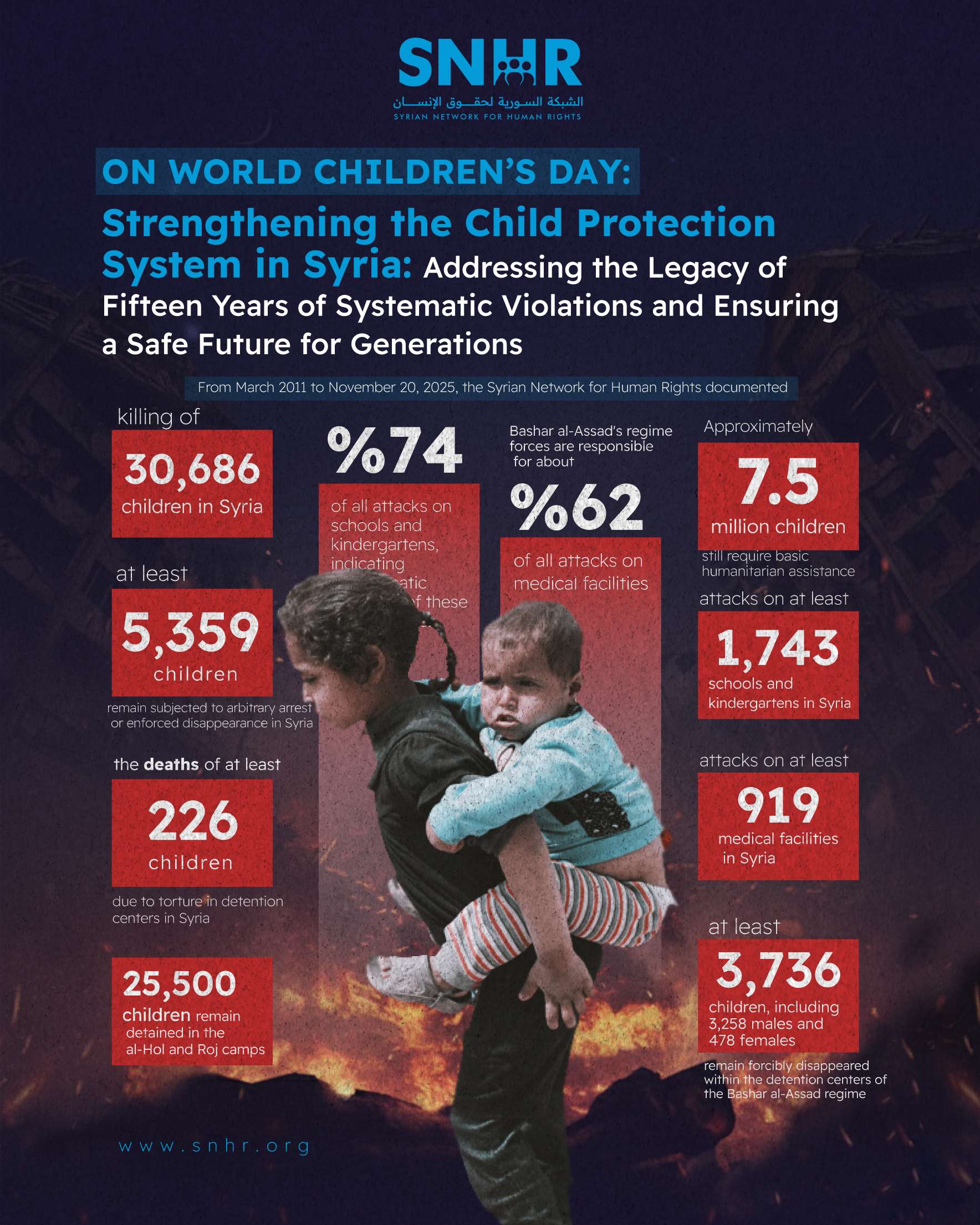
Damascus – The Syrian Network for Human Rights issued its fourteenth annual report on the International Day of the Child, titled Strengthening the Child Protection System in Syria: Addressing the Legacy of Fifteen Years of Systematic Violations and Ensuring a Safe Future for Generations. The report reviewed the widespread violations that children in Syria have been subjected to over 14 years, including killing, torture, forced recruitment, denial of education and health care, as well as the destruction of schools and medical facilities, and the continued danger of mines and unexploded ordnance.
The report explained that children in Syria during the transitional phase following the fall of the Assad regime continue to face profound structural challenges, most notably the deterioration of the education sector, the lack of basic services, and the need for humanitarian assistance for 7.5 million children. Despite a decrease in violence, the effects of psychological trauma, poverty, parental loss, and weak social protection systems remain significant obstacles preventing children from accessing their fundamental rights. The network’s annual report emphasizes the ongoing impact of the legacy of armed conflict on children’s present and future, and the necessity of strengthening recovery and protection mechanisms.
The report indicated that the Syrian Network for Human Rights documented the killing of 30,686 children between March 2011 and November 20, 2025, with the former regime of Bashar al-Assad responsible for 76% of these deaths, equivalent to 23,138 children. The year 2013 was the deadliest, with Aleppo province having the highest number of child victims, followed by Idlib, then Rif Dimashq and Deir Ez-Zour.
The Network’s databases also show that 5,359 children remain detained or forcibly disappeared, including 3,736 children detained or disappeared by the former Assad regime, making it responsible for 70% of all cases. The highest number of arrests and disappearances was recorded in 2014, with Deir Ez-Zour governorate having the highest number of cases, followed by Damascus, then Raqqa and Rif Dimashq.
The report added that the network documented the killing of 226 children under torture from March 2011 to November 20, 2015, including 216 at the hands of the former regime of Bashar al-Assad, making the regime responsible for 96% of all cases of children killed under torture during the years of conflict. 2012 was the worst year, followed by 2013, 2015, and 2014. The highest number of child victims of torture was recorded in Hama Governorate, followed by Homs, then Rif Dimashq and Idlib.
The report indicated that the network’s databases show that 1,743 schools and kindergartens were attacked between March 2011 and November 20, 2025, including 1,287 attacks (74%) perpetrated by the former regime of Bashar al-Assad. The systematic targeting of educational infrastructure deprived hundreds of thousands of children of their right to education and exacerbated the ongoing impact of the conflict on the educational process. The network also documented 919 attacks on medical facilities during the same period, 566 of which (62%) were carried out by regime forces. This reflects a direct targeting of the health sector and further deteriorates the ability to provide care for children under dire humanitarian conditions.
The report also addressed the most prominent and ongoing risks and violations faced by children in Syria. Following the fall of the regime, patterns of child killings continued due to clashes between armed groups, cross-border shelling, Israeli attacks, and injuries from celebratory gunfire. The network documented the deaths of 51 children in coastal events, 20 children in Suwaida, and 18 children killed by celebratory gunfire up to November 20, 2025. Landmines and unexploded ordnance remain among the most serious threats during the transitional phase, having killed at least 107 children and seriously injured others since December 2024. These remnants are scattered throughout residential and agricultural areas, hindering the return of families and leaving children in a constant state of fear, due to inadequate clearance efforts and a lack of awareness programs.
The report indicated that the arbitrary detention of children continues, particularly in areas controlled by the Syrian Democratic Forces, where detained children are prevented from contacting their families and are subjected to cruel treatment. Approximately 25,500 children remain detained in the al-Hol and Roj camps under harsh conditions that constitute unlawful deprivation of liberty, while sporadic kidnappings for ransom have been reported in the governorates of Latakia, Tartus, and Suwayda.
The report added that the Syrian Democratic Forces continue to recruit children through methods including abduction and direct coercion, including drawing them from the streets and schools. The Syrian Network for Human Rights affirms that these practices constitute a violation of the Convention on the Rights of the Child and international humanitarian law, as they expose children to violence, deprive them of education, and forcibly involve them in armed conflict.
The report indicates that data from the Syrian Network for Human Rights shows that the former regime of Bashar al-Assad pursued a systematic policy of arresting and forcibly disappearing children since 2011. Security forces also transferred a number of children to care institutions such as SOS Children’s Villages without any official documentation, thus erasing their identities and manipulating their legal status. The Network calls for comprehensive investigations into these practices and the restoration of the identities and rights of the children, many of whom remain missing, considering this issue a fundamental part of the transitional justice process following the fall of the regime.
Since 2011, the Syrian Network for Human Rights (SNHR) has been documenting grave violations against children, including killing, arbitrary arrest, torture, and enforced disappearance, with the aim of providing accurate data to support child protection and accountability for perpetrators. The SNHR collaborates with several UN mechanisms, including the Monitoring Mechanism (MMM), the International Commission of Inquiry, UNICEF, and the UN Working Group on Enforced or Involuntary Disappearances, to provide recommendations within the framework of transitional justice and to strengthen psychosocial rehabilitation and education programs. It also continues its efforts to uncover the fate of children transferred from detention centers and to amplify their voices internationally, ensuring that children’s rights are central to any national program during the post-regime transition.
SNHR’s report on International Children’s Day reveals that violations committed against children since 2011 are widespread and systematic, including killing, torture, enforced disappearance, and forced recruitment, amounting to crimes against humanity. The report also affirms that the former regime of Bashar al-Assad bears the greatest responsibility for these violations, particularly extrajudicial killings, torture, attacks against civilians, and enforced disappearances. The report emphasizes that the enforced disappearance of thousands of children remains a legally recognized crime and is not subject to any statute of limitations. The former regime and those involved in these practices are obligated to disclose their fate, as transferring children to care institutions without official documentation constitutes identity manipulation and a fundamental violation of lineage and basic rights.
The report noted that even after the fall of Bashar al-Assad’s regime in December 2014, some parties, most notably the Syrian Democratic Forces (SDF), continued to engage in recruitment, arbitrary detention, and other violations against children. The remnants of weapons, including landmines and unexploded ordnance, also pose a persistent threat to children’s lives and constitute a breach of the obligation to protect civilians under international humanitarian law. Furthermore, the detention of more than 25,000 children in al-Hol and Roj camps without individual reviews violates the Convention on the Rights of the Child and constitutes an unlawful deprivation of liberty. The report indicates that these grave violations have had profound, intergenerational consequences, including the loss of parents, the collapse of education, psychological trauma, and a continuing threat to the future of Syrian society as a whole.
In conclusion, the report emphasized that protecting children during the transitional phase is a crucial test of the new Syrian state’s and the international community’s commitment to human rights and justice principles. No political process can be complete without truth-seeking, reparations, and guarantees that the violations that devastated the lives of entire generations of Syrian children will not be repeated. The report concluded with the following recommendations:
First: To the National Commission for Missing Persons
- Launch a unified national database of missing persons, encompassing all age groups, subject to independent verification standards and integrated with civil registries.
- Initiate formal investigations into the transfer of children from detention centers to care homes and orphanages, ensuring that families are informed of the investigation results and have the right to request a review.
- Develop a national search and recovery plan that includes mechanisms for accessing former detention facilities, hospitals, morgues, and sites believed to contain mass graves.
- Establish regular institutional coordination with international organizations concerned with missing persons in the areas of DNA analysis, evidence management, and database development.
- Launch a direct communication program with families of missing persons, including hearings, regular updates, and family involvement in policy development.
- Establish a national unit for the protection of witnesses and whistleblowers to ensure a safe environment for anyone who may have information about the fate of missing persons, including children.
- Publish quarterly reports on the progress of search operations, the exhumation of mass graves, the collection of samples, and communication with families.
Second: To the National Transitional Justice Commission
- Integrate the files of missing persons and children into the transitional justice system, recognizing them as fundamental pillars for truth-seeking and reparation.
- Draft a comprehensive legislative framework addressing various crimes, including enforced disappearance, child recruitment, unlawful transfer, and denial of identity.
- Launch a national reparations program encompassing psychosocial support, recovery programs, and symbolic and material compensation, while considering the specific needs of children.
- Preserve national memory through a comprehensive archive documenting the testimonies of child and adult victims, ensuring that evidence is not destroyed or lost.
- Coordinate with courts and public prosecution offices to ensure that investigations into missing persons and children support and strengthen accountability processes until the transitional justice judicial framework is fully established.
- Guarantee legal accountability for individuals who have committed violations against children, with safeguards for a fair trial that prioritizes the best interests of the child.
- Safely involve adolescent children and their families in the transitional process through hearings and by protecting their privacy.
Third: Restoring Legal Identity and Lineage
- Launching a national program to identify children transferred from prisons to care homes or those who have lost contact with their families, and ensuring their official registration in civil records.
- Reviewing the records of care homes and associations in cooperation with them, correcting any discrepancies, and issuing official documents that reflect the child’s true identity.
- Facilitating family reunification and reconnection whenever possible, through simplified legal procedures.
Fourth: Protecting Children from Post-Conflict Dangers
- Intensify mine and explosive remnants of war (ERW) clearance programs in areas frequented by children, based on accurate hazard maps and professional standards.
- Establish local community protection units focused on raising awareness among children and their families about the dangers of explosives, reporting mechanisms, and prevention.
Fifth: Rehabilitation and Reintegration
- Launch long-term psychosocial support programs for affected children, including former recruits, detainees, and those without families.
- Invest in specialized national centers that provide treatment, counseling, and behavioral and cognitive rehabilitation.
- Support formal and non-formal education through remedial education programs and alternative curricula that enable children to catch up on lost school years.
Sixth: Supporting Children’s Rights in Legislation and Institutions
- Review national legislation for the transitional period to ensure the protection of children from detention, recruitment, separation from their families, and enforced disappearance.
- Train judges, lawyers, social workers, and protection sector personnel on international standards related to children’s rights.
- Launch a national child protection framework that defines the responsibilities of governmental and non-governmental institutions in prevention, support, and response.
Seventh: To the Syrian Transitional Government
- Provide the legal and institutional environment for the work of the two national bodies for missing persons and transitional justice, and support cooperation between them.
- Allocate an independent budget for programs to search for and locate missing persons, rehabilitate children, and restore their identities.
- Enhance transparency and public communication by publishing periodic statements on the progress of investigations, especially in cases involving children.
- Launch national awareness campaigns on children’s rights, the importance of reporting missing persons, and how to seek assistance.
- Support international cooperation aimed at transferring technical expertise without compromising national sovereignty.
Eighth: To the International Foundation on Missing Persons
- Provide specialized technical support in managing missing persons data, DNA analysis, and mass grave work.
- Build national capacities to ensure the sustainability of search and investigation processes after the end of international support.
- Support the tracking of displaced or missing children through biometric matching technologies and biometric databases.
Ninth: To the International Community
- Support national institutions’ search, detection, and family reunification programs for children.
- Encourage technical cooperation with relevant national bodies and support protection and recovery programs.
- Fund education, protection, and reparations programs to ensure the continuity of vital services for children.
