


At Least 17,438 Cases of Arbitrary Arrest and 2,463 Cases of Death due to Torture Have Been Attributed to Branch 300 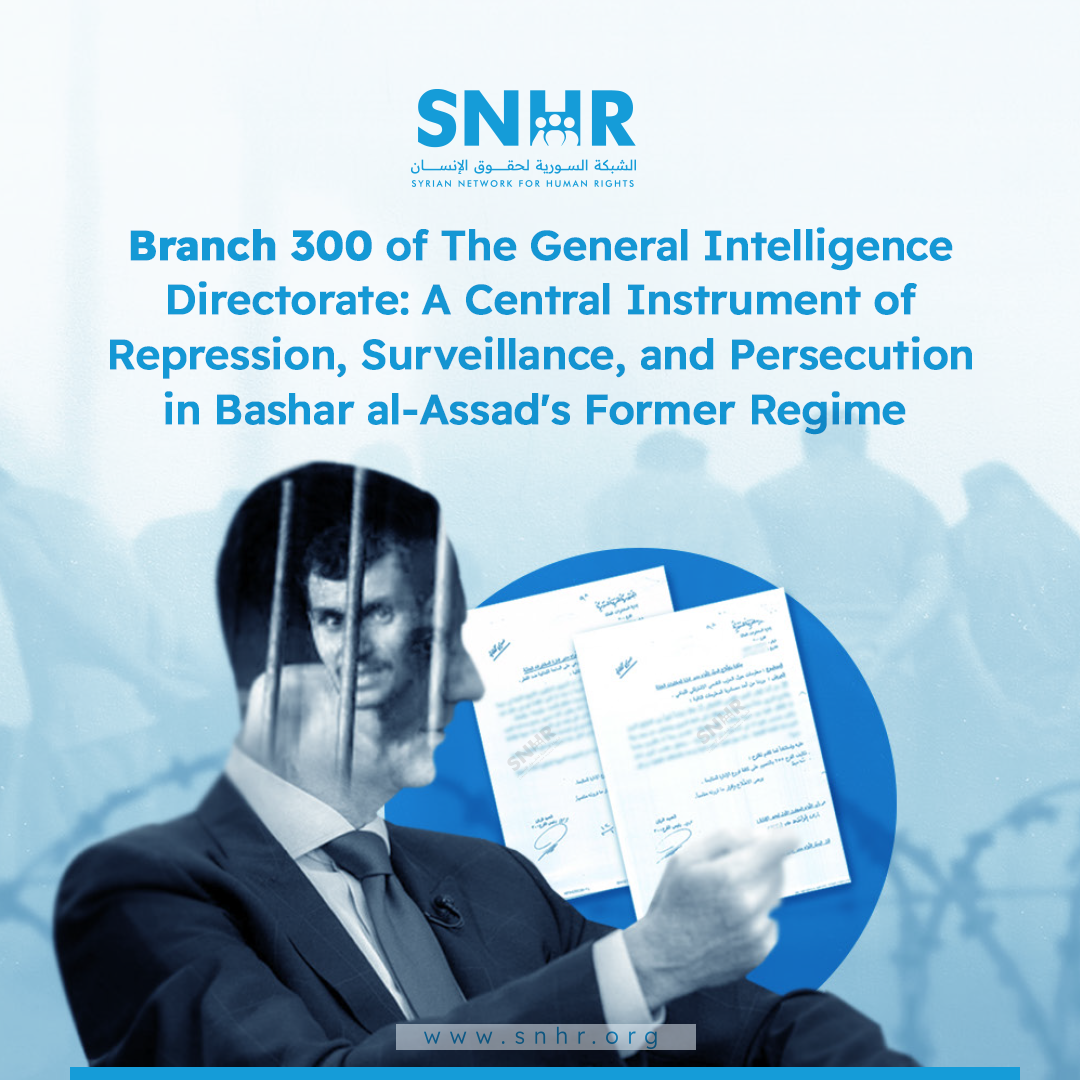
Available in:
Damascus – The Syrian Network for Human Rights issued a report entitled “Branch 300 of the General Intelligence Directorate: A Central Tool for Repression, Surveillance and Persecution in the Former Bashar al-Assad Regime,” in which it presented an in-depth analytical reading of the nature of this branch of the General Intelligence Directorate, as a pivotal link in the security apparatus that practiced systematic repression against civilians during the era of the former regime.
The report relied on security documents and correspondence, as well as testimonies from survivors and victims’ families, analyzing these sources according to international documentation standards and the principles of international humanitarian law and human rights. This report is part of the Syrian Network for Human Rights’ efforts to document the practices of lesser-known security branches, complementing previous reports on branches such as Branch 215, with the aim of exposing the systematic violations of the former security regime.
The general background of the security services in Syria
The report reviewed the structural framework of the security services in Syria, which consists of four main intelligence agencies with dozens of branches in all governorates, and which are directly subordinate to the National Security Bureau in Damascus, which reports to the President of the Republic, thus giving it broad influence that exceeds the legislative, executive and judicial authorities.
Despite their different names and specializations, they all share the goal of protecting the regime, monitoring society, and controlling political, media, and economic activity. These include:
- General Intelligence
- Military Intelligence
- Air Force Intelligence
- Political Security
The most prominent systematic violations committed by the security services after 2011
The report explained that since 2011, the security services in Syria have committed widespread and systematic violations affecting various segments of society. The most prominent patterns of violations are as follows:
- Arbitrary Arrest and Enforced Disappearance
According to the Syrian Network for Human Rights, at least 160,123 people, including 3,736 children and 8,014 women, remain forcibly disappeared from March 2011 to October 2015 in detention centers belonging to the former regime. The Damascus countryside governorate had the highest number of victims of enforced disappearance, followed by Aleppo, then Damascus, and then Hama.
- Systematic Torture
The report revealed that Syrian security forces practiced systematic torture in detention centers, including electric shocks, beatings, painful suspension, sleep deprivation, food and water deprivation, and sexual assault and threats thereof.
According to the Syrian Network for Human Rights database, at least 45,032 people were killed as a result of torture in detention centers run by the former regime between March 2011 and October 2015, including 216 children and 95 women. The report indicates that the governorates of Daraa and Rif Dimashq topped the list of governorates with the highest number of deaths due to torture, followed by the governorates of Hama and Damascus.
- Excessive use of force and extrajudicial killings: Security forces fired on peaceful protesters and funeral processions under central orders, resulting in the deaths of thousands of civilians.
- Policies of intimidation and surveillance: The security services imposed pervasive surveillance through networks of informants, conducted nighttime raids on homes, and targeted medical personnel and paramedics.
Counter-Espionage Branch (Branch 300): Identity and Role in the Security Apparatus
The report explained that Branch 300 reports directly to the General Intelligence Directorate (State Security), which was officially established by Legislative Decree No. 14 of 1969. Although the Directorate is officially classified as a civilian agency, most of its leadership consists of military officers seconded from the Ministries of Defense and Interior. The Directorate comprises central and regional branches spread throughout all governorates, the most prominent of which are:
- Information Branch (255): Gathers information from various sectors and issues decisions such as travel bans.
- Investigation Branch (285): Handles investigations of detainees referred from other branches.
- Counterterrorism Branch (295): Carries out raids and assassinations under the banner of “counterterrorism.”
- Counterespionage Branch (300): Monitors foreigners and those suspected of dealing with foreign entities.
- Internal Branch (251): Focuses on intelligence within the country and monitors governmental and political institutions.
- External Branch (279): Manages intelligence stations abroad and oversees expatriate affairs.
- Technical Branch (280): Responsible for wiretapping and technical surveillance.
- Economic Branch (260): Investigates financial and economic cases.
- Training Branch (290): Responsible for qualifying and training agency personnel.
Origins and Specialization in the Context of Security Repression
The report indicates that Branch 300 (the Counter-Espionage Branch) was likely established in the late 1970s or early 1980s to enhance the regime’s ability to monitor political and social activity linked to foreign entities. The branch focused in practice on tracking Syrians with foreign connections, pursuing dissidents, and using accusations of espionage as a pretext for arbitrary arrest and torture.
- Supervision: Operates under the direction of the department director, who reports to the National Security Bureau, thus linking it to the regime’s top leadership.
- Level: A central branch superior to regional branches, possessing broad powers at the national level.
- Main Departments: Central Investigation, External Monitoring, Analysis and Correspondence, Arrest and Investigation/Interrogation.
- Command: Typically headed by an officer with the rank of Brigadier General or Major General, in coordination with other branches such as Branch 251 (Internal), Branch 285 (Central Investigation), and Branch 279 (External).
- Geographic Location: The headquarters is located in Damascus, in the Kafr Souseh security district, near the State Security headquarters.
- Physical Structure: The ground floor contains individual and group cells, and interrogation and torture rooms. The upper floor houses the offices of officers and investigators, as well as the archives and communications departments.
- Secrecy and institutional isolation: Branch 300 is characterized by mystery and high secrecy, as it is rarely mentioned in official media or United Nations reports, and the information available often depends on the testimonies of detainees or former employees before 2011. Its building is also characterized by complete closure, high walls, and the absence of official signs.
The Actual Role of Branch 300 in the Repression System
According to the report, Branch 300 played a central role in the security apparatus of repression after 2011. Its most prominent tasks included:
- Monitoring foreigners, expatriates, and institutions with foreign ties:
- Monitoring diplomats, employees of international organizations, and expatriates.
- Monitoring the entry and movements of foreigners within the country.
- Monitoring governmental and private institutions with foreign connections.
- Pursuing the activities of political parties and figures with foreign ties, including monitoring meetings of the Lebanese Communist Party and Syrian opposition figures in Beirut.
- Pursuing external media and human rights activity
- Monitoring Syrians who deal with international, human rights and media organizations abroad, and proposing punitive measures against them.
- Gathering Information and Coordinating with Other Branches
- Coordinating with branches such as Information (255), External (279), and Internal (251) to analyze civil and political activity and transfer detainees to central investigation branches.
- Utilizing advanced technological surveillance tools, such as tracking international communications and analyzing financial transfers, to expand cross-border security monitoring.
- Submitting reports to initiate arrest, travel ban, and asset seizure measures.
- Played a pivotal role in the intelligence-security coordination network by linking internal and external branches.
Patterns of Violations Resulting from the Work of Branch 300
According to the report, Branch 300’s practices were characterized by two main elements:
- Arbitrary Arrests and Interrogations: Expanding the concept of “suspected dealings with foreign entities” to include any opposition activity or contact with foreign entities, without concrete evidence.
- Vertical Security Coordination: Transferring detainees to other detention centers after the initial investigation, and issuing direct proposals to other branches to carry out arrests or pursue specific cases.
Among the most prominent of these practices are:
- Arbitrary Arrest and Enforced Disappearance
The branch relied on widespread arrests without warrants, targeting activists, journalists, and government employees, many of whom passed through the branch before being transferred to other branches or Saydnaya Prison. It also played a role in directing other branches to carry out these arrests. The Syrian Network for Human Rights documented at least 17,438 cases of arbitrary arrest perpetrated by Branch 300, including individuals of foreign nationalities.
- Torture, cruel treatment and deaths:
According to the report, the interrogation sessions focused on foreign funding and relations with the media and human rights organizations, and were often accompanied by physical torture practices to force detainees to sign pre-prepared confessions. SNHR documented at least 2,463 cases of torture caused by Branch 300, including people of foreign nationalities.
- Additional Violations:
- Denial of Healthcare: Some detainees were left to suffer from bleeding or infections without treatment.
- Denial of a Fair Trial: Most detainees were not brought before a judge, and some were referred to military or terrorism courts after months, while others were released after days or weeks.
- Financial Extortion: Large sums of money were demanded from detainees’ families in exchange for information or promises of release.
- Monitoring Communications Without a Judicial Warrant: The branch monitored telephone calls and international communications.
Legal and Command Responsibility of Branch 300
Branch 300 reports directly to the General Intelligence Directorate, which has been led since 2011 by only three officers: Major General Zuhair Hamad (2011–2012), Major General Muhammad Dib Zaitoun (2013–2019), and Major General Hussam Muhammad Luqa (2020–2024). The documents included in the report also indicate that the branch is administratively subordinate to the Director of the General Intelligence Directorate and is subject to the National Security Bureau and the Presidency.
Legal Conclusions
- Systematic nature of violations: The violations committed in Branch 300 were not individual in nature, but rather came within the framework of the regime’s systematic policy aimed at suppressing political opposition.
- Command responsibility: Branch leaders and General Intelligence Directorate leaders bear direct responsibility for violations, whether through issuing orders, condoning them, or participating in planning and execution, according to the principle of chain of command criminal responsibility.
- Exceeding legal authority: The branch carried out extrajudicial detentions and investigations, violating international covenants on civil, political, economic, and social rights.
- Central role in the network of repression: The branch formed 300 core units within an interconnected network of security branches.
- The crime of enforced disappearance continues: The statute of limitations does not apply to these crimes as long as the fate of the victim remains unknown.
- The invalidity of superior orders: Orders issued by superiors do not justify grave violations, and coercion is considered only as a mitigating circumstance.
- The inadmissibility of evidence obtained under torture: Any confessions or information obtained by the branch through torture are inadmissible in court.
- No amnesty or reconciliation without accountability: Political settlements do not negate the right of victims to prosecution or redress.
- The right to truth and the preservation of archives: Victims and their families have the right to know the truth, and the authorities have a duty to preserve records and prevent their destruction, including the archives of security branches.
Recommendations
These recommendations stem from the need to strengthen accountability and oversight during the transitional phase, ensure the protection of victims and witnesses, and restructure security agencies to guarantee that violations are not repeated. They also aim to support transitional justice processes by documenting violations, holding perpetrators accountable, and developing clear and transparent oversight mechanisms for the new security apparatus, thereby reinforcing the principles of the rule of law and respect for human rights.
A. To the Syrian authorities and the executive branch:
a.Judicial Accountability:
- Documenting all violations committed by Branch 300 and linking them to specific leadership responsibilities to enable prosecution at both the national and international levels.
- Bringing former officers, directors, and subordinates involved in violations to justice in accordance with national laws and international legal standards, including crimes of torture, enforced disappearance, and arbitrary detention.
b.Enhancing Transparency and Institutional Oversight:
- Restructuring security agencies to reduce the excessive concentration of power and subjecting any intelligence apparatus to rigorous judicial and oversight review.
- Documenting all files related to past arrests and making them available to national and international human rights bodies for review, to ensure that violations are not repeated.
c. Legal Protection for Victims and Witnesses:
- Providing comprehensive protection programs for survivors and witnesses, including confidentiality and logistical support throughout the investigation and prosecution processes, and preventing any form of reprisal.
- Providing psychological and legal support to victims to ensure their rehabilitation and support restorative justice.
d. Strengthening Transitional Justice:
- Including violations attributed to Branch 300 within transitional justice programs, including official investigations and independent fact-finding commissions.
- Utilizing this documentation as an educational and historical tool to illustrate the effects of systematic repression on civil society and ensure that those responsible do not escape accountability in the future.
e. Developing oversight mechanisms for new security agencies:
- Ensuring that any new intelligence agency adheres to the principles of the rule of law and is subject to effective parliamentary and judicial oversight to prevent a recurrence of past abuses.
- Adopting clear standards for civilian oversight of security operations and defining the powers of officers to prevent security agencies from becoming instruments of repression.
B. To the Legislative Authority
a. Enact a law explicitly criminalizing enforced disappearance and torture, and eliminating any conflict with exceptional legislation or broad definitions of security or terrorism.
b. Establish a permanent parliamentary committee to oversee intelligence services, with the power to summon and question officials and the right to access classified documents, and to submit periodic public reports.
c. Enact a law to protect witnesses and whistleblowers, and another to protect personal data and public archives.
C. To the Judiciary and the Public Prosecution
a. Establish specialized departments or prosecution offices for serious crimes, with protocols for the chain of command for preserving evidence, and an absolute prohibition on the use of confessions obtained under torture.
b. Issue procedural guidelines for investigating historical violations in accordance with the Istanbul Protocol, the Minnesota Protocol, and open-source digital methodologies.
c. Implement immediate appearance orders and conduct periodic judicial reviews of all previous and current arrest and detention orders.
D. To the media and academic institutions:
a. Develop editorial policies for multi-source verification in cases of detention and disappearance, avoiding stigmatization and disseminating sensitive information to families.
E. To the United Nations and international mechanisms:
a. Strengthen the resources and mandates of existing mechanisms for documentation, analysis, and judicial support, and expand psychosocial and legal support programs for victims.
b. Fund for forensic programs and national capacity-building in the search for missing persons.
F. To donors and funding institutions:
a. Multi-year funding for information and evidence management systems, the establishment of national forensic laboratories, and witness protection programs.
b. Support community awareness programs on basic rights and legal procedures.
