


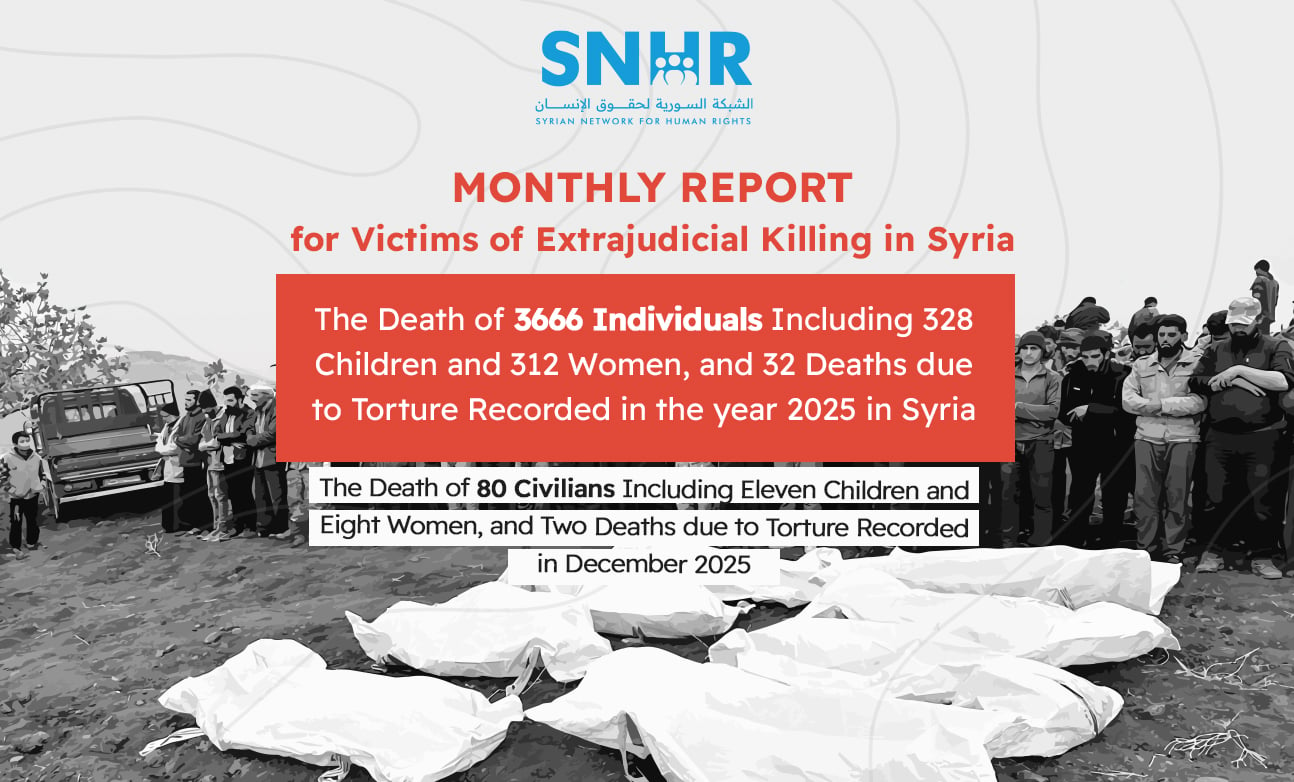
The Death of 80 Civilians Including Eleven Children and Eight Women, and Two Deaths due to Torture Recorded in December 2025
Available in:
Damascus – The Syrian Network for Human Rights (SNHR) reported today that 80 civilians were killed in Syria in December 2025, including 11 children, 8 women, and 2 victims of torture. The SNHR also documented the killing of 3,666 individuals in 2025, including 328 children, 312 women, and 32 victims of torture.
The 20-page long report monitored the toll of victims in December 2025 and the year 2025, in addition to the victims who died as a result of torture, the toll of massacres committed by the parties to the conflict and the controlling forces, the toll of media personnel, medical personnel and civil defense personnel, and the toll of attacks on vital civilian centers. The report also addressed the tasks carried out by the Syrian Network for Human Rights in the field of documenting extrajudicial killings.
The report was based on continuous monitoring of incidents and sources, as well as a wide network of relationships comprising dozens of diverse sources, along with the analysis of images and video clips.
This report includes victims whose deaths the team was able to document during the past month and the year 2025. Some of the documented deaths may have occurred months or years earlier; therefore, the date of documentation and the estimated date of the incident are included. This also takes into account the radical shift in power and control following the fall of the Assad regime on December 8, 2024.
The report indicated that despite the fall of the Assad regime, we are still documenting the killing of citizens by Assad’s forces in various ways, either due to militias loyal to him, or due to the explosion of war remnants and cluster munitions from previous bombing, or the death of citizens who were injured during previous bombing by Assad’s forces and died later.
The report indicated that of the 3,666 individuals documented killed in 2025, 73 civilians, including 8 children, 6 women, and 16 who died under torture, were killed by Syrian government forces. Two massacres were also perpetrated by Assad regime forces. Additionally, 14 civilians, including 9 children, 1 woman, 1 member of the Civil Defense, and 1 person who died under torture, were killed by Assad regime forces. The Syrian Democratic Forces (SDF) killed 73 civilians, including 15 children, 14 women, and 12 who died under torture. The Syrian National Army (SNA) killed 5 civilians, including 2 children, 1 woman, and 1 person who died under torture. International Coalition forces killed 2 civilians, one of whom was a child. The report also documented the killing of 1217 individuals, including 51 children, 63 women, and 32 medical personnel, and 53 massacres by armed groups participating in military operations in the coastal region (March). Finally, it documented the killing of 446 people, including 9 children, 21 women, and 1 medical personnel, and 4 massacres by non-state armed groups affiliated with the Assad regime. The report documented the killing of 62 civilians, including 3 children and 3 women, by Israeli forces. It also recorded the killing of 35 civilians, including 14 children, 5 women, and 3 medical personnel, and one massacre, by Turkish forces. The report documented the killing of 374 civilians, including 39 children, 79 women, 4 media personnel, and 10 medical personnel, as well as 11 massacres and 2 deaths due to torture, by armed groups involved in the escalation and military operations in the Suwayda Governorate in July. The report also recorded the killing of 1,365 people, including 177 children and 119 women, by unidentified parties.
The report indicated that Latakia Governorate topped the list of governorates with approximately 17.59% of the total number of victims, followed by As-Suwayda Governorate with approximately 12.14%, then Hama Governorate with 10.86%, and Tartus Governorate with approximately 10.26% of the total victims recorded in the Syrian governorates.
The report stated that the Syrian Network for Human Rights documented the killing of 80 civilians, including 11 children and 8 women (adult female), and 2 people due to torture in December 2025. Among them was 1 woman killed by Syrian government forces, and 1 member of the Civil Defense killed by Bashar al-Assad regime forces due to cluster munition explosion. The report also recorded the killing of 10 civilians, including 3 women, by the Syrian Democratic Forces. The report also recorded the killing of 1 child by the International Coalition forces, and documented the killing of 14 civilians, including 3 children and 1 woman, by Israeli forces, and the killing of 2 people under torture by local non-state armed groups led by Hikmat al-Hijri. In addition, 51 civilians were killed, including 7 children and 3 women, and 1 massacre was committed by parties that we were unable to identify.
The report indicated that the governorates of Rif Dimashq and Hama topped the ranking with a percentage of approximately 18%, followed by the governorates of Aleppo and Suwayda with a percentage of 11%.
The report indicated that at least 65 attacks on vital civilian centers occurred in 2025, including 11 attacks on educational facilities (schools), 8 on medical facilities, and 9 on places of worship (mosques and churches).
According to the report, the Syrian Network for Human Rights recorded at least two attacks on vital civilian centers in December, one of which targeted a place of worship.
The report concluded with a number of conclusions and recommendations:
Conclusions
- Attacks on civilians and civilian objects: The evidence collected by SNHR indicates that most of the attacks documented in this report were deliberately directed against civilians, including the destruction of civilian facilities.
- Landmines: A large proportion of the Syrians killed in February died as a result of landmine explosions, with none of the perpetrator forces involved in the Syrian conflict, past or present, issuing maps revealing the locations where landmines have been planted. This indicates a chilling total indifference by all parties to the lives of civilians, particularly children.
- Indiscriminate bombing by SDF: The indiscriminate and disproportionate attacks carried out by the SDF are clearly violations of international humanitarian law, with the crimes of indiscriminate killing amounting to war crimes.
- Remote bombings: The use of remote bombings to target densely populated areas reflects a criminal mindset intent on deliberately inflicting the greatest possible number of deaths, which is a clear contravention of international human rights law and a flagrant violation of the Geneva IV Convention on Civilians of 1949, Articles 27, 31, and 32.
- Turkish forces have failed to respect the principle of proportionality, as prescribed in international law, in their attacks on SDF sites, which resulted in civilian casualties. Meanwhile, the SDF has violated international humanitarian law by stationing its personnel in civilian areas.
- Despite the efforts made during the transitional phase, there remain clear gaps in the protection of civilians, particularly in areas of tension and military operations. These shortcomings, if they persist, would violate legal obligations under international humanitarian law and international human rights law and require enhanced preventive measures and effective responses, particularly to protect women and children.
- Continued lack of security oversight even after the regime change
Despite the downfall of the Assad regime, killings and armed attacks continue. This indicates that the transitional phase has yet to establish security and stability, underlining the imperative need for reforming and restructuring the security apparatus into a human rights-based, effective entity.
- Ongoing patterns of violations linked to the post-conflict reality
July 2025 witnessed patterns of killings related to the misuse of weapons and drowning incidents resulting from migration. These reflect post-conflict challenges that require a different type of response, one that goes beyond documentation of violations to include prevention and community education.
Recommendations
These recommendations represent a practical roadmap for addressing the consequences of extrajudicial killings in Syria. They contribute to advancing the path of transitional justice, building institutions that respect human dignity and rights, and preventing the recurrence of violations.
Transitional Syrian government
- Cooperate with international mechanisms
- Issue official invitations to independent UN and international mechanisms, including:
- International, Impartial and Independent Mechanism (IIIM)
- Independent International Commission of Inquiry on the Syrian Arab Republic
- International Commission on Missing Persons (ICMP).
- International Red Cross, Human Rights Watch (HRW), and Amnesty International.
- Enable these organizations to have unrestricted access to detention centers and crime scenes.
- Protect evidence and crime locations
- Take urgent measures to safeguard evidence, including documenting mass graves and detention facilities and preventing any tampering or trespassing.
- Register and clearly mark important sites to ensure they can serve as legal evidence in the future.
- Promote justice and accountability
- Collect evidence on violations, including official records and crime sites.
- Ratify the Rome Statute of the International Criminal Court (ICC) and grant the court retroactive jurisdiction.
- Adopt comprehensive transitional justice policies, including holding perpetrators accountable, compensating victims, and ensuring transparency and credibility.
- Protect civilians and cultural sites
- Ensure the safety of civilians and minorities and protect their fundamental rights to live securely.
- Prioritize the removal of mines and remnants of war, allocate the necessary funding, and raise awareness of related risks.
- Protect cultural and heritage sites from looting or destruction.
- Governance reform
- Build an inclusive governance structure representing all components of Syrian society, including women and minorities, as well as civil society organizations.
- Document and safeguard abandoned properties to ensure that their rightful owners receive compensation in the future.
- Improve essential services and ensure they’re accessible to all citizens, including those with disabilities.
- Prevent further violations
- Ensure respect for fundamental rights and freedoms for all without discrimination.
- Reform the judiciary and security apparatus in accordance with international human rights standards.
- Support affected populations and rehabilitation
- Provide psychological and social support to families of missing persons and conflict victims.
- Develop comprehensive programs for the rehabilitation of survivors and released detainees.
UN Security Council and the international community
- Refer crimes to the ICC
- Refer the Syrian dossier to the ICC or establish a special tribunal to prosecute those involved in war crimes and crimes against humanity.
- Pressure international actors, including the Russian government, to hand over individuals responsible for crimes, including Bashar Assad and his family, to international courts.
- Freeze and confiscate the former regime’s funds
- Work on freezing the financial assets of the former Assad regime and its affiliates and allocate them to support transitional justice efforts and humanitarian aid, as well as for the victims and their families.
- Enhance humanitarian efforts
- Urge UN agencies to intensify the delivery of humanitarian aid, including food and medicine, in affected areas and internally displaced persons (IDP) camps.
- Ensure humanitarian aid reaches northeastern Syria, in coordination with local authorities, to meet the needs of IDPs and facilities detaining individuals accused of formerly belonging to or being affiliated with ISIS.
- Guarantee that aid provided to the current or future government promotes respect for human rights and creates conditions for free and fair elections.
- Remove mines and war remnants
- Allocate funding from the UN fund to support landmine removal efforts in affected areas to reduce long-term risks and ensure a safe environment for civilians.
- Support the missing persons issue and national reconciliation
- Provide resources to strengthen the efforts of the ICMP, including training local staff and using advanced technologies to identify missing persons.
- Support initiatives contributing to national reconciliation and offer psychological and social support to families of missing persons.
- Lift sanctions to ensure they don’t adversely affect humanitarian operations
- Review economic sanctions imposed on Syria to ensure they do not adversely affect humanitarian operations while maintaining sanctions targeting designated terrorist groups.
- Ensure protection of Syrian refugees
- Urge host countries to refrain from forcibly deporting refugees or pressuring them to return.
- Work to create conditions within Syria for the safe, voluntary, and dignified return of refugees in accordance with international standards, prioritizing infrastructure improvement and security stability.
Office of the UN High Commissioner for Human Rights (UNHCR)
- Submit reports to the UN Human Rights Council and the UN on documented violations in this and previous reports, highlighting that killing is still going on in Syria.
Independent International Commission of Inquiry on the Syrian Arab Republic (COI)
- Open comprehensive investigations into the violations mentioned in this and previous reports. SNHR is willing to collaborate in such endeavors and share more evidence.
- Work to identify individuals responsible for war crimes and publish their names to expose them internationally and halt political and economic dealings with them.
International, Impartial and Independent Mechanism (IIIM)
- Collect further evidence of the crimes documented in this report and share expertise with Syrian organizations working on documentation and data collection.
Syrian Democratic Forces (SDF)
- Establish an internal committee to investigate violations committed by the SDF, hold those responsible accountable, and compensate the victims.
- Refrain from positioning military forces in civilian areas, which poses a threat to their lives.
- Provide maps indicating the locations of landmines planted by SDF personnel in civilian areas.
Armed opposition factions/Syrian National Army (SNA)
- Protect civilians in all areas under their control.
- Launch investigations into human rights violations, hold perpetrators accountable, and disclose the investigation results to the local community.
- Provide maps indicating the locations of landmines planted by the factions in civilian areas.
Turkish forces
Launch investigations into the incidents documented in this report, compensate the victims, and respect the principles of international law, particularly the principles of distinction and proportionality.
Humanitarian organizations
- Develop urgent plans to provide decent shelter for IDPs, particularly widows and orphans.
- Intensify efforts to remove landmines alongside relief operations.
- Equip vital facilities, such as medical facilities and schools, with ambulances marked with clear, recognizable signs visible from long distances.
