


 Available in:
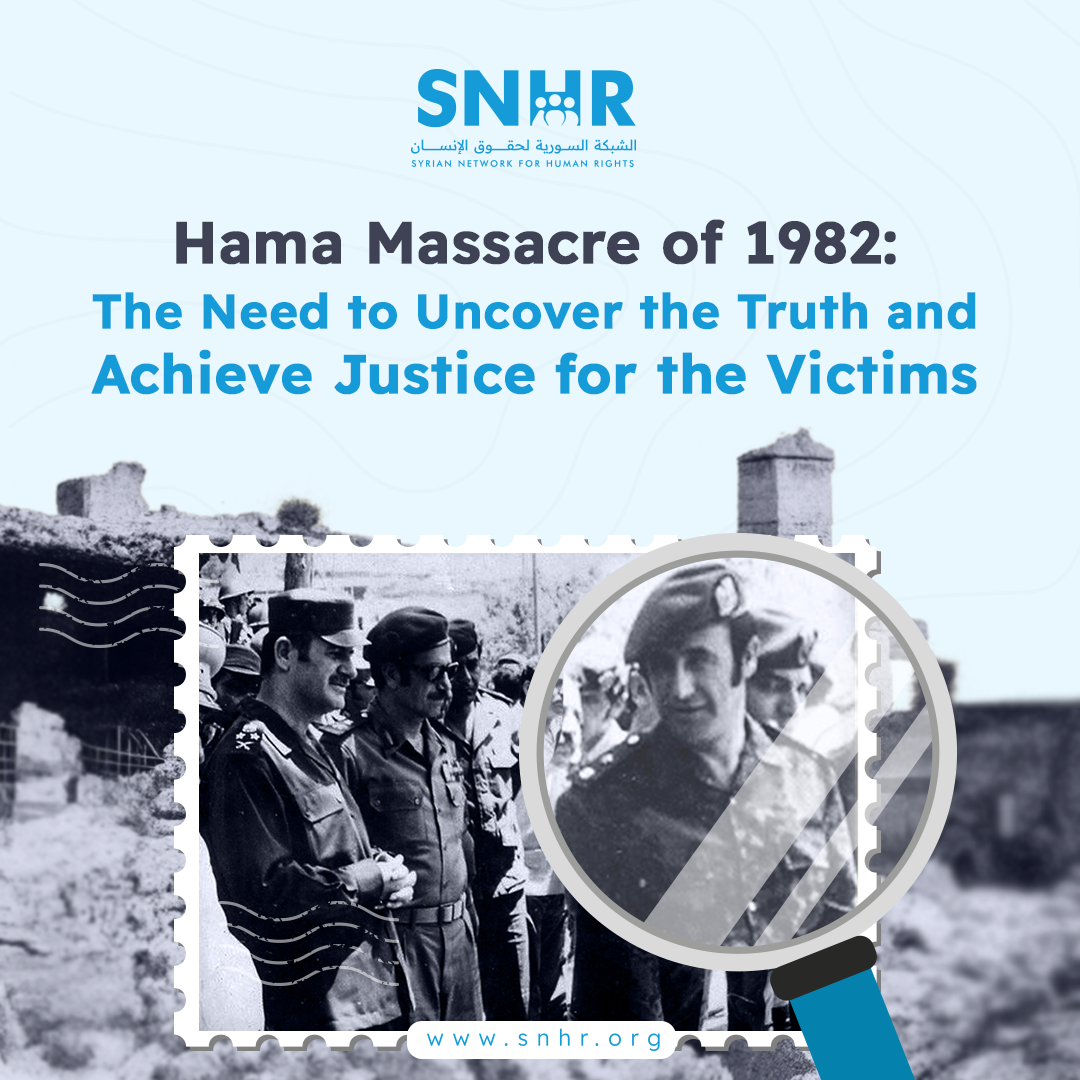
Damascus – The Syrian Network for Human Rights issued a report today marking the 44th anniversary of the Hama massacre, calling for the truth to be revealed and justice to be served for its victims. The report explained that with the fall of the Assad regime on December 8, 2014, a new era began, one supposedly based on justice and the rule of law. However, consolidating stability requires confronting the legacy of violations and holding the perpetrators accountable. The 1982 Hama massacre stands out as one of the most horrific symbols of repression in modern Syrian history. For forty-three years, the regime prohibited any investigation, accountability, or disclosure of the fate of the disappeared, and even suppressed any commemoration. With the new era, opening this file is a crucial step on the path to justice for the victims, survivors, and families of the disappeared.
The report detailed the massacre, noting that in February 1982, regime forces under Hafez al-Assad launched a month-long offensive on the city of Hama, involving the Defense Brigades, Special Forces, and intelligence services. A complete siege was imposed on the city, basic services were cut off, and the attack was characterized by indiscriminate shelling, summary executions, widespread arrests, and torture. Historical neighborhoods were destroyed, and property was confiscated, some of which is believed to have been built on sites suspected to contain mass graves. An estimated 30,000 to 40,000 civilians were killed, and another 17,000 disappeared. The report classifies these acts as crimes against humanity, which are not subject to any statute of limitations.
The report indicated that the Assad regime adopted a policy of denial regarding the Hama massacre, labeling it as “events against terrorists,” which contributed to erasing the victims’ suffering and dehumanizing them, while promoting its image as the protector of what it called “the secular order.” It also transformed Hama into a message of deterrence based on unrestrained violence, thus entrenching fear and submission on a broad societal scale. The report added that the international response was absent; effective documentation and accountability were lacking, and decisive Security Council resolutions were not issued. This reinforced the regime’s belief in impunity and contributed to the continuation of widespread violations thereafter.
The report also revealed that the massacre led to widespread destruction of Hama’s urban fabric. Entire neighborhoods were demolished and rebuilt according to a plan imposed by the regime, with structures erected on land suspected of containing mass graves. On a humanitarian level, the report explained that the tragedy affected most families through killings and enforced disappearances, leaving behind decades of uncertainty and intergenerational trauma. Despite official censorship, the memory of the massacre was preserved through oral tradition, literature, and the arts, forming a foundation for clinging to the truth and striving for reconciliation based on recognition and justice.
The report noted that after the fall of the regime, public discussion of the massacre became possible, and the 2025 anniversary saw its first official commemoration. Families began to inquire about the fate of their missing sons through official channels. The report considered this historic moment a crucial test for the government: confronting the legacy of Hama to understand the structure of repression that governed Syria for decades, paving the way for genuine reconciliation, and building a state based on the rule of law. Impunity paved the way for subsequent violations, and breaking the silence today is essential for dignity and healing, and for establishing the right to truth, recognition, and justice for the victims.
The report concluded by emphasizing that the 1982 Hama massacre represents a litmus test for the new Syria’s commitment to justice and human rights. After decades of waiting, the victims, survivors, and families of the disappeared deserve truth, recognition, accountability, and guarantees of non-recurrence. The Syrian Network for Human Rights expressed its readiness to support the path to justice, calling on the government, the international community, and civil society to seize this historic moment, as Syria’s future is linked to confronting its past, and the time for justice has come.
Recommendations
To the Syrian Government:
- Issue an official statement recognizing the Hama massacre as a crime against humanity, condemning the atrocities committed, and affirming the commitment to truth, accountability, and reparations.
- Declare February 2nd a National Day of Remembrance for these crimes.
- Establish an independent national commission of inquiry comprised of judges, legal experts, human rights representatives, and representatives of the victims’ families, empowered to document the crimes, identify those responsible, and make recommendations regarding prosecution and compensation.
- Establish a local agency comprised of city residents to search for approximately 17,000 forcibly disappeared persons, granting it access to security archives, identifying mass graves, conducting forensic investigations and identifying remains, and returning remains to their families with dignity.
- Secure, preserve, and make available to investigators the archives of the former regime, and systematically review documents related to military operations, detention, and the fate of disappeared persons.
- Reform the legal framework to enable the prosecution of perpetrators of crimes against humanity, abolish immunity provisions protecting former security personnel, and guarantee fair trial standards.
- Implement a comprehensive reparations program that includes the restoration or compensation of property, financial compensation for victims’ families, and psychosocial support services.
- Erect a permanent memorial in Hama, developed in consultation with survivors and victims’ families, and include the massacre in school curricula to ensure future generations understand this chapter of Syrian history.
- Undertake institutional reforms to prevent the recurrence of such atrocities, including the establishment of an independent oversight body for security forces, a ban on the use of military force against civilians, and the integration of human rights education into training curricula within the security sector.
To the international community:
- The United Nations should formally acknowledge its failure to document or respond to the massacre, issue official documents condemning the crimes and recognizing the suffering of the victims, and the Human Rights Council should support Syrian national accountability efforts through technical assistance and capacity building.
- States should fulfill their obligations to investigate crimes against humanity and prosecute perpetrators through universal jurisdiction where applicable, cooperate with Syrian authorities by exchanging evidence and extraditing suspects, and support judicial capacity building.
- Facilitating the return of frozen assets belonging to former regime officials held by the countries that hold them, allowing these assets to be allocated to victim compensation programs.
- Ensuring the continuation of international civil society efforts to document and provide technical support for transitional justice processes, and to persist in pushing for accountability.
To Syrian civil society:
- Continue systematic documentation, including collecting testimonies, identifying victims, and gathering evidence for legal proceedings.
- Provide direct support to survivors and victims’ families, including assistance with administrative and legal procedures, psychosocial services, and information on missing relatives.
- Ensure that advocacy efforts reflect the needs and priorities of those most directly affected within transitional justice processes.
- Support cultural and educational initiatives to commemorate the massacre, encourage literary and artistic works addressing this history, and document oral histories before they are lost.
Conclusion
The 1982 Hama massacre represents a true test of the new Syria’s commitment to justice, human rights, and the rule of law. The victims waited more than four decades for their suffering to be acknowledged and for justice to be served. Many did not live to see this day. Those who remain—the survivors and their families who have never ceased waiting for news of their loved ones—deserve a state that commemorates their suffering by guaranteeing truth and accountability and ensuring that such atrocities are never repeated.
The Syrian Network for Human Rights declares its readiness to support all efforts aimed at achieving justice for the victims of the Hama massacre. We call upon the current Syrian government, the international community, and Syrian civil society to seize this historic opportunity. Syria’s future depends on its willingness to confront its past; the time for justice has come.
