


Syria’s First Year of Transition
Available in:
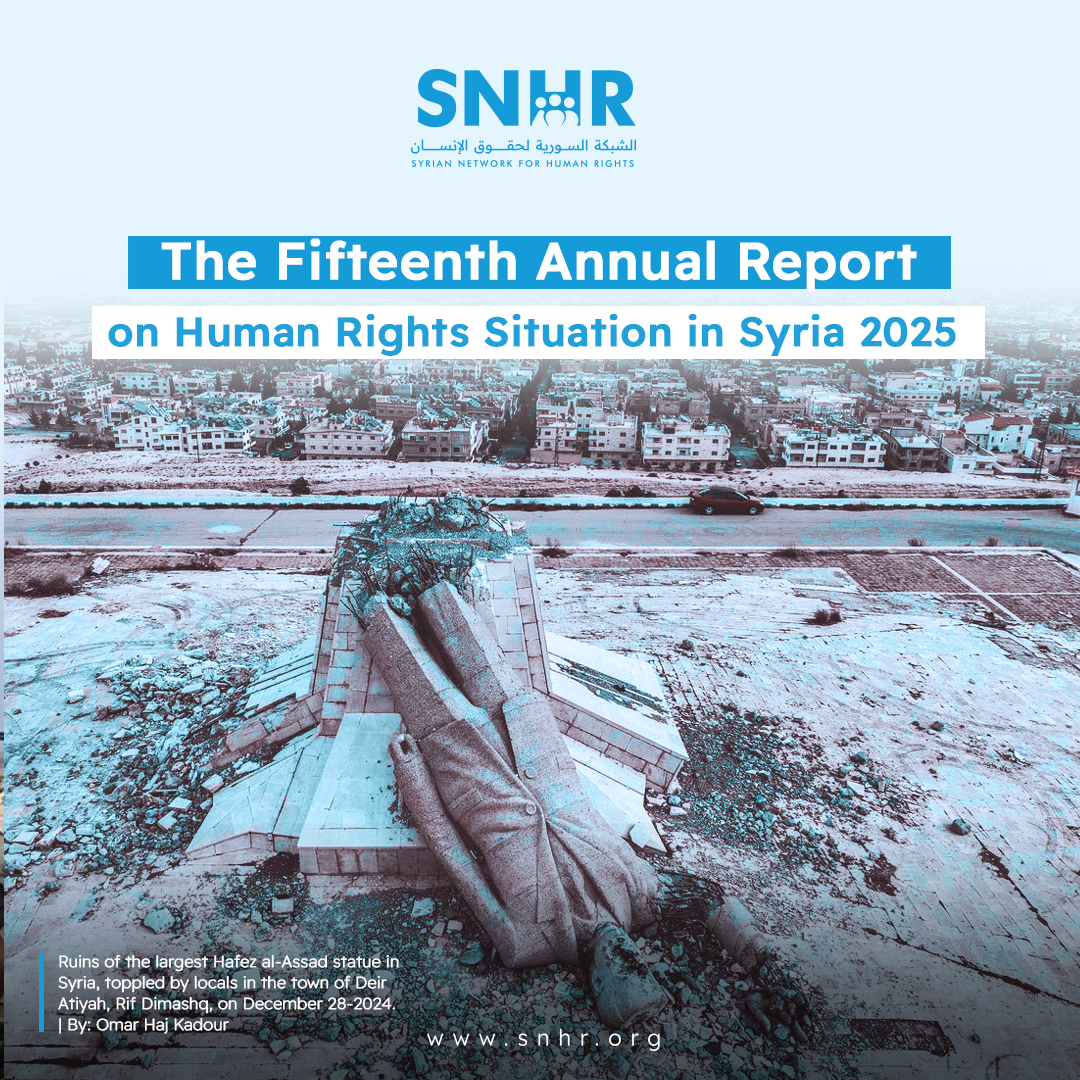
Damascus – The Syrian Network for Human Rights (SNHR) has released its fifteenth annual report on the human rights situation in Syria, coinciding with the first anniversary of the transitional phase. The report examines the human rights situation in Syria during 2025, the first full year after the fall of Bashar al-Assad’s regime on December 8, 2024. It notes that this year was characterized by the interplay between hopes for political transition and the risks of security, social, and institutional fragility. While this moment opened a window for rebuilding the state on the foundations of the rule of law and respect for human rights, events have shown that political transition alone is insufficient to halt violations without genuine institutional reform, effective accountability, and the protection of civilians. The country has also witnessed rapid political and security transformations accompanied by violations of the right to life, liberty, and security of civilians, bringing back to the forefront the issues of transitional justice, the missing, mass graves, and the reform of state institutions. The report also notes that the cessation of support for some of the Syrian Network for Human Rights’ programs during 2025 impacted its documentation capacity, meaning the figures presented represent the minimum number of documented violations. The report provides an analysis of the most prominent patterns of violations and political and human rights developments, along with legal frameworks and recommendations to support the protection of civilians and enhance accountability.
Fadel Abdulghany says:
“This report shows that the first year of the transitional phase in Syria brought important opportunities to reform state institutions and enhance respect for human rights, but at the same time it revealed major challenges that still require serious and systematic attention. Protecting civilians, revealing the fate of the missing, holding those responsible for violations accountable, and preserving public freedoms are the foundational conditions for any legitimate and sustainable stability in Syria.”
This report is based on the methodology adopted by the Syrian Network for Human Rights for monitoring, documentation, and analysis. It draws upon the documentation and research work completed during 2025 and the Network’s database, which contains information verified according to rigorous standards. The documentation process relied on direct testimonies, field monitoring, reliable local sources, open sources, visual materials, and reports received through the Network’s official channels. All information underwent a multi-level verification process to ensure the highest levels of accuracy and reliability. The report focused its analysis on data related to extrajudicial killings, arbitrary arrests, enforced disappearances, and attacks on civilian infrastructure and vital facilities, aiming to identify the most prominent patterns that characterized the human rights situation in Syria during 2025. It also took into account the political and security transformations following the fall of Bashar al-Assad’s regime, and the resulting changes in the actors and patterns of violations. The report emphasizes that the figures presented represent a minimum of documented violations, given the challenges faced in monitoring and documentation processes throughout the year.
The report details the most prominent violations documented by the Syrian Network for Human Rights in Syria during 2025, based on its databases and specialized reports. Regarding extrajudicial killings, the Network documented the deaths of 3,666 civilians during 2025, including 328 children and 312 women, in addition to 32 individuals who died as a result of torture at the hands of the main actors in Syria. The Network also monitored the specific toll of victims from the most vulnerable groups, including children, women, media and medical personnel, and civil defense workers, as well as massacres and deaths resulting from torture. These figures are presented in detail in its annual report on victims, including the breakdown by responsible parties, age groups, gender, and other relevant data. Regarding arbitrary arrest and detention, the network documented at least 1,108 cases of arbitrary arrest/detention during 2025, including 73 children and 26 women. The network also monitored releases related to these cases, as recorded in its databases. This monitoring included cases of detention and prosecution targeting individuals accused of involvement in serious violations during the rule of the Bashar al-Assad regime, as well as releases from Syrian government detention centers following the conclusion of investigations or the lack of evidence of involvement. This data was presented in the network’s annual report on arbitrary arrest and detention, including breakdowns by responsible authorities, release rates, and data related to age groups and gender. Regarding attacks on vital centers and civilian infrastructure, the network recorded at least 65 incidents during 2025, including 11 targeting educational facilities, 8 targeting medical facilities, and 9 targeting places of worship. The network’s database documents these incidents according to their chronological and geographical distribution, the types of civilian infrastructure targeted, and the perpetrators.
The report highlights the most significant political developments and the reality of territorial control in Syria during 2025, following the fall of Bashar al-Assad’s regime on December 8, 2024. These developments led to changes in the power structure and the restructuring of state institutions, in addition to their impact on the map of territorial control. At the beginning of the year, large areas of the country were under the control of the Syrian government, stretching from the south, with the exception of areas that witnessed incursions, expansion operations, and bombardments by Israeli forces after the regime’s collapse. Meanwhile, the Syrian Democratic Forces continued to control parts of northeastern Syria.
This situation largely persisted until the end of the year, with the exception of the Suwayda Governorate, which fell under the de facto control of armed groups operating outside the state’s authority, led by Hikmat al-Hijri. Several Syrian regions also witnessed repeated Israeli airstrikes and limited ground incursions, resulting in civilian casualties and material damage. Meanwhile, limited activity by ISIS cells was recorded in several areas, contributing to the continued state of security instability.
The report provides an overview of the most significant human rights developments and violations in Syria during 2025, within the fragile human rights environment that accompanied the transitional phase following the fall of Bashar al-Assad’s regime. Violations persisted due to the multiplicity of actors, including Syrian government forces, the Syrian Democratic Forces, local armed groups operating outside the state’s control, elements associated with the former regime, and Israeli military operations and airstrikes within Syrian territory. This multiplicity reflects the continued complexity of the Syrian landscape, characterized by weak institutions, widespread weapons, and varying levels of territorial control.
Throughout the year, the Syrian Network for Human Rights documented numerous patterns of grave violations against civilians, including extrajudicial killings, arbitrary arrests, enforced disappearances, ill-treatment in detention centers, attacks on civilian infrastructure, and societal violence and violations against the most vulnerable groups, such as children and women. In some areas, particularly those controlled by the Syrian Democratic Forces, the recruitment of children and detention on unclear security grounds continued.
The country also witnessed serious security incidents during the year, revealing the fragility of the transitional environment. Among the most prominent were the events on the Syrian coast in March 2025, which began with attacks by groups linked to the former regime and escalated into a widespread wave of violence and violations of a retaliatory and sectarian nature. The areas of Jaramana, Ashrafieh Sahnaya, and As-Suwayda also witnessed a security escalation in April and May, including the targeting of civilians, unlawful detentions, and a rise in sectarian rhetoric. In July 2025, As-Suwayda Governorate witnessed a large-scale military escalation between government forces and armed Bedouin tribesmen and local groups led by Hikmat al-Hijri, accompanied by grave violations and a deterioration in the humanitarian situation.
Key human rights issues also came to the fore, most notably the discovery of mass graves linked to enforced disappearances, the continued threat of landmines and unexploded ordnance, as well as sporadic attacks and bombings, community violence, and organized crime. On the living conditions and services front, economic and service sectors remained volatile. While the year saw the return of some refugees and internally displaced persons, the pace of returns subsequently slowed due to persistent security vulnerabilities and deteriorating economic and service conditions.
The report stated that 2025 marked a pivotal year for the Syrian Network for Human Rights, given the rapid political and security transformations following the fall of Bashar al-Assad’s regime. The Network continued its work in documentation, analysis, and advocacy, while expanding its activities in transitional justice, legislative reform, and public policy monitoring, and strengthening its presence in international human rights and media forums. A key development was the opening of its official office in Damascus after obtaining legal authorization, enabling it to enhance its operations from within the country and solidify its position as an independent national institution defending human rights, supporting victims, and contributing to discussions concerning the transitional phase and the rebuilding of state institutions on legal and human rights foundations.
The report added that the Syrian Network for Human Rights continued to focus on transitional justice as an integrated process encompassing truth-seeking, accountability, reparations, and institutional reform, prioritizing detainees, the forcibly disappeared, and mass graves. It called for the establishment of an independent national body, ensuring the participation of victims and civil society, and strengthening the role of the media in reporting the facts and monitoring judicial proceedings. The Network also monitored the political and institutional transformations following the fall of the previous regime and presented visions for a participatory political transition based on the separation of powers and the establishment of representative institutions. It emphasized the inclusiveness of the political process for all groups and regions, the participation of women and refugees, and the exclusion of those involved in serious violations, while strengthening the independence of the legislative authority and its oversight and legislative capacities. The Network dedicated its efforts to documenting the violations and repressive policies of Bashar al-Assad’s regime, including executions, enforced disappearances, torture, and property confiscation, with a focus on the responsibility of high-ranking officials such as the former Minister of the Interior. It emphasized the need to remove those implicated from state institutions, analyze intelligence branches, and monitor the cases of missing children to ensure accountability and prevent the recurrence of violations. The network also continued to assess the laws, decrees, and official decisions of 2025, focusing on their compliance with international human rights standards and the requirements of the transitional phase. It stressed the necessity of a participatory and transparent approach to legislative reform and the involvement of civil society, considering some decrees as initial corrective steps that need to be complemented within a broader transitional justice framework.
The report also noted that 2025 saw an escalation in Israeli military operations inside Syria, including ground incursions into the south of the country (Rural Damascus, Daraa, Quneitra) and airstrikes targeting military and civilian sites. These operations contributed to complicating the security situation during the transitional phase, increasing the threat to civilian safety, and undermining local stability.
The report stated that during 2025, the Syrian Network for Human Rights actively participated in international and regional legal proceedings, providing legal documentation and support for accountability and transitional justice. It also contributed to media and academic conferences and forums, and conducted legal training activities to enhance victim protection, raise awareness of human rights, and build capacity in the Arab region.
Over the past year, the Syrian Network for Human Rights (SNHR) expanded its partnerships through agreements and memoranda of understanding with international and national entities to enhance documentation, uncover the fate of the missing, analyze the impact of attacks on civilians, and build judicial capacity. It also supported the protection of mass graves and the rights of families, as well as the promotion of national justice and understanding of international law and human rights. The SNHR continued to be a primary source in international reports by the United Nations and European and American institutions, reflecting its authoritative status and the international community’s confidence in its data and methodology for documenting violations, analyzing the Syrian context, and supporting decision-makers in assessing the situation and risks and formulating policies related to Syria.
The report indicated that 2025 witnessed the beginning of a direct role for the Syrian Network for Human Rights office in Damascus inside Syria, hosting meetings with national and international bodies to promote transitional justice, uncover the truth, document human rights, build legal files, and train personnel, reflecting the Network’s transformation into an active partner in national and international coordination for the future of human rights in Syria.
The Syrian Network for Human Rights continued to issue its periodic reports throughout the year, documenting violations and analyzing the situations of women, children, refugees, the forcibly disappeared, and victims of torture and chemical attacks, linking the documentation to the new political context, stressing the importance of justice, accountability, and reparation, and keeping the rights of the most affected groups at the forefront of national and international attention.
The report concluded that the overlap between non-international armed conflict and security instability continues, requiring all parties to adhere to international humanitarian and human rights law, including the obligation to protect civilians, prohibit indiscriminate attacks, guarantee humane treatment, and prevent torture. Furthermore, the report highlighted instances of arbitrary deprivation of life by multiple parties, constituting grave violations of the right to life and necessitating independent and impartial investigations and the accountability of those responsible individually, without discrimination or selectivity. The facts also demonstrate the continued practice of arbitrary arrest and enforced disappearance, which violates the right to liberty and security of person and undermines the rule of law, necessitating a distinction between lawful detention and detention outside judicial oversight. Torture and ill-treatment have persisted in places of detention, including resulting deaths, underscoring the need for independent monitoring of all detention centers, the criminalization of torture, and zero tolerance for any practices amounting to it. In addition, attacks on civilian infrastructure were recorded, reflecting the continued fragility of the protective environment for civilians. This necessitates that all parties refrain from targeting civilian objects and ensure the continuity of essential services such as health, education, water, and energy. The report emphasized that children, women, and vulnerable groups remain exposed to grave violations, including violence, recruitment, and denial of protection. This requires specific protection policies, rehabilitation and reintegration of victims, and prevention of re-violence. Furthermore, landmines and unexploded ordnance continue to pose a long-term threat to the right to life and physical safety, requiring effective clearance programs, community awareness campaigns, victim support, and making this issue a national priority.
The report stated that the prominence of the issue of missing persons and mass graves reflects the importance of the right to truth, disclosure of fate, preservation of evidence, identification of remains, and ensuring family participation, in accordance with international standards of independent investigation and forensic medicine.
The report emphasized that the institutional steps for 2025 offer an opportunity to build a comprehensive transitional justice process based on accountability, truth-seeking, reparations, and institutional reform, while avoiding politicization, selectivity, or the marginalization of victims to guarantee non-recurrence. While the protection of human rights faces structural challenges, including weak institutions, the proliferation of armed groups, and continued impunity, it also presents an opportunity to establish a national system that protects rights, guarantees the rule of law, ensures judicial independence, and facilitates victim participation.
The annual report on the human rights situation in Syria concluded with a number of recommendations to actors and stakeholders:
a. To the Syrian Government
The Syrian government should make the protection of human rights a central pillar in managing the transitional phase by strengthening the rule of law, ensuring that all security and military apparatuses are subject to effective and independent judicial oversight, and preventing any detention or use of force outside the legal framework. It must also expedite the activation of transitional justice and missing persons institutions based on independence, transparency, and efficiency, and enable them to access relevant records, archives, and sites.
Practical steps should also be taken to control unregulated weapons, prevent armed groups operating outside the framework of the state from continuing to perform security or military functions, protect civilian objects and essential facilities, ensure they are not used or targeted, develop comprehensive national programs for mine clearance and the removal of explosive remnants of war, and guarantee unimpeded access for humanitarian aid and essential services.
b. To the Syrian Democratic Forces
The Syrian Democratic Forces must cease all forms of arbitrary arrest or detention and ensure that any restriction of liberty is subject to independent judicial oversight and fundamental legal safeguards. They must also immediately and unconditionally end all child recruitment practices, release all child soldiers, and establish monitoring and accountability mechanisms to ensure that such recruitment does not recur.
Violations attributed to their members, including extrajudicial killings, torture, and attacks on civilians and journalists, must also be investigated independently and transparently. Freedom of the press must be respected, and civilian facilities must not be used for military purposes.
c. To local and non-state armed groups:
All local armed groups in As-Suwayda and elsewhere must immediately comply with the provisions of international humanitarian law and the rules for the protection of civilians, and refrain from extrajudicial killings, kidnappings, unlawful detentions, and any acts of reprisal, discrimination, or sectarian or regional bias. They must also cease attacks on civilian objects and respect medical, humanitarian, and media personnel.
d. To Israel
Israel must cease its military incursions and attacks into Syrian territory, respect the rules of international law, particularly those relating to the protection of civilians and civilian objects, and refrain from any use of force that is not based on legitimate legal grounds and consistent with the principles of necessity, proportionality, and distinction. Furthermore, violations resulting from these operations must be investigated, and the victims’ right to redress and compensation must be guaranteed. Israel must also withdraw from all occupied territories and compensate their inhabitants.
e. To the United Nations and its International Mechanisms
The United Nations and its mechanisms concerned with Syria should continue to provide technical and institutional support to national efforts aimed at truth and accountability, focusing on the files of missing persons, mass graves, institutional reform, and the building of judicial and investigative capacities. They should also strengthen monitoring of the human rights situation and provide the necessary expertise to ensure compliance with international standards in investigations, evidence management, and the handling of remains.
f. To the International Community and Supporting States
The international community should provide sustained support to emerging national institutions concerned with transitional justice, accountability, and judicial and security reform, and support mine clearance programs, the restoration of basic services, and the protection of the most vulnerable groups. It must also support an environment conducive to the voluntary, safe, and dignified return of refugees and internally displaced persons, exert pressure to stop violations, regardless of the perpetrators, and ensure respect for international law and the sovereignty and territorial integrity of Syria.
g. General recommendations for the transitional phase
SNHR recommends adopting a comprehensive national policy for the prevention of violations, based on reforming the security sector, strengthening the independence of the judiciary, institutionalizing oversight of the actions of the forces and agencies, publishing the results of investigations periodically and transparently, and ensuring effective remedies for victims.
It also recommends that the participation of victims, their families, and local communities be an integral element in the design of transitional justice, protection, and reform policies, and that the issues of missing persons, mass graves, landmines, and arbitrary detention be addressed as interconnected national priorities, not separate issues. Finally, establishing non-recurrence requires the adoption of professional and non-selective accountability based on individual responsibility, accompanied by genuine institutional reform that rebuilds trust between society and state institutions.
