

Available in:
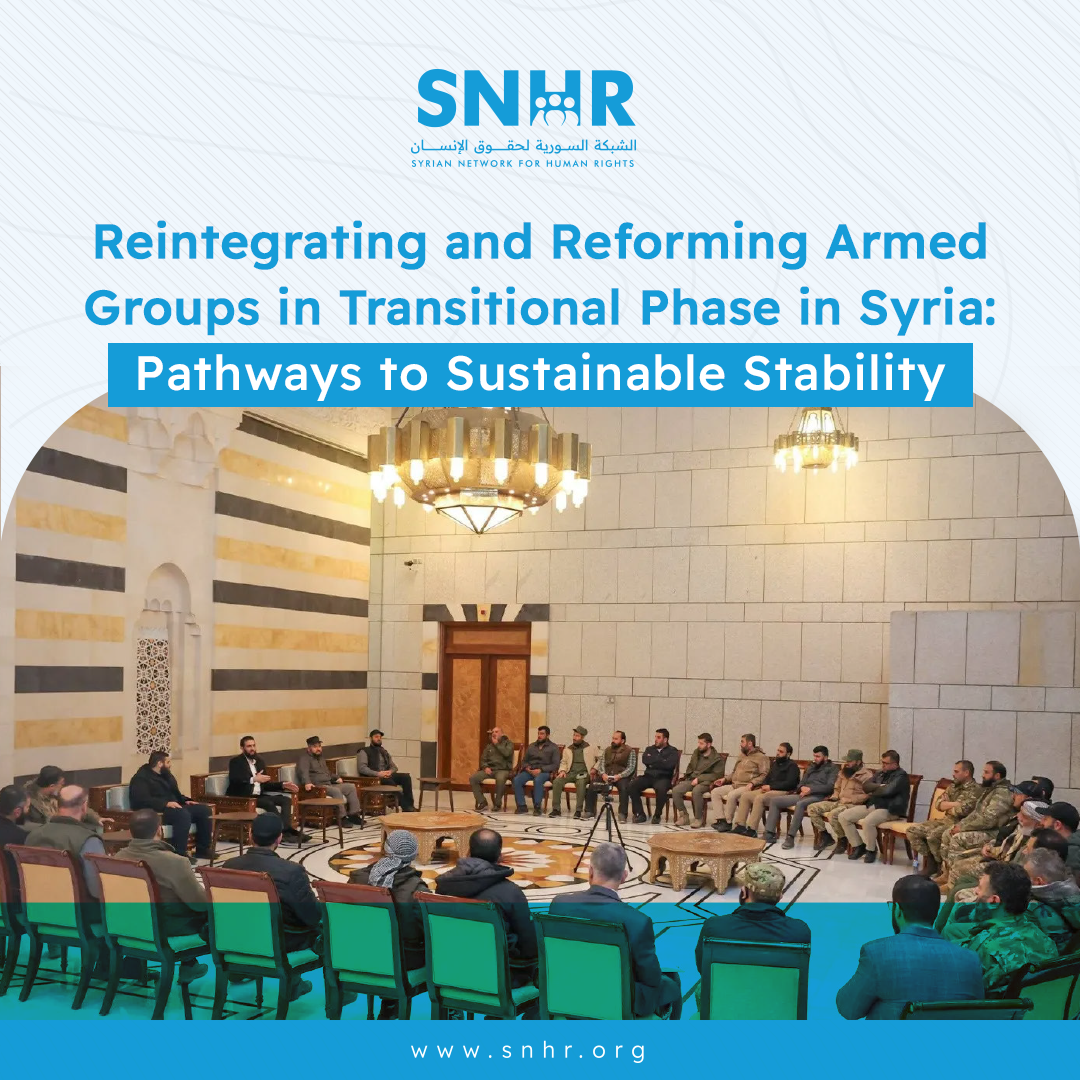
Damascus — The Syrian Network for Human Rights today issued a report titled “Reintegration and Reform of Armed Groups in Syria in the Transitional Phase: Pathways toward Sustainable Stability.”
The report addresses the legal, operational, political, and regional challenges associated with the reintegration process, and presents a roadmap and a practical framework for effectively integrating the factions within a unified national army. It emphasizes that the success of this process is a fundamental prerequisite for any sustainable political settlement.
Fadel Abdulghany, Director of the Syrian Network for Human Rights, said:
“This report demonstrates that the reintegration of combatants and the reform of the security sector will succeed only through an integrated equation: disarmament, demobilization, and reintegration; justice that ensures accountability for grave crimes without a blanket amnesty that hollows it out; and an economy that provides realistic livelihood alternatives. Transparent national ownership, with the effective participation of victims, women, and youth, is the path to building professional forces subject to civilian oversight that serve all Syrians and contribute to the stability of the region.”
First. The Core Challenges of Reintegration in the Post-Conflict Phase
According to the report, the process of reintegrating armed groups into a unified national military structure faces a number of overlapping legal, organizational, and logistical challenges, which may impede the success of the political transition if not addressed at their root. Among the most prominent of these challenges are:
1. Legal and Structural Obstacles
These obstacles include former combatants’ fears of legal prosecution, which may drive them to cling to their weapons and to preserve their areas of influence. Added to that is the risk of employing national laws for retaliatory or political purposes, which entrenches selective justice and threatens stability.
The report also pointed to the wide disparity in command structures among the armed factions, which complicates institutional unification efforts and requires cultural and organizational transformations that may be met with rejection from field commanders accustomed to autonomy. It likewise highlighted the operational and logistical challenges resulting from the diversity of sources of armament and the disparity in training levels among the different groups.
2. External Interventions
The report clarified that the intensive investments by regional and international powers in the Syrian armed groups have transformed many of these factions into tools of external agendas, which makes attempts to integrate them into a unified national structure more difficult. Regional powers view these groups as extensions of their political influence, and it is unlikely that they will relinquish their influence easily. As for international intervention, it has transformed Syria into an arena of global strategic competition, where major powers seek to achieve conflicting objectives, which complicates the process of domestic consensus on the path of integration.
3. Identity-Based and Ideological Divisions
The report affirmed that deeply rooted sectarian and ethnic divisions, alongside sharp ideological differences, represent one of the most prominent challenges on the path of reintegration. Armed groups have come to embody competing sub-identities that express divergent visions for the future of the state, including the form of governance, the role of religion, and regional alliances.
4. Crisis of Trust
The crisis of trust among the armed factions, and between them and local communities or governmental entities, is considered a fundamental challenge. Years of internal conflict, infighting, and shifting loyalties have entrenched mutual distrust, particularly in light of previous experiences of unification attempts that ended in failure.
Combatants’ fears of marginalization or targeting after disarmament also undermine their trust in any future security structures or in the political process as a whole.
5. Economic Challenges
The country is facing a severe shortage in the resources required to implement comprehensive programs for demobilization and rehabilitation. The situation is exacerbated by the absence of viable economic alternatives, as fighting has become the primary source of income for thousands of young people who lack employable civilian skills. The report warned that demobilizing these individuals without providing real employment opportunities may drive them toward crime or back into the ranks of the armed factions.
The report indicated that integration programs require substantial funding, which is difficult to secure given the fragility of state institutions and the decline in the financing capacity of international donors.
6. Social Challenges and Community Integration
According to the report, the community’s rejection of former combatants constitutes a principal obstacle to integration, as these individuals are often held responsible for suffering and violence, even if they did not commit direct violations. This stigma is accompanied by a process of social ostracism that extends to their families as well, which drives them to cling to the group as a source of protection and belonging.
Furthermore, the return of combatants to communities harmed by their actions may provoke retaliatory reactions, making the integration process fraught with risks of renewed violence, unless it is paired with serious steps toward achieving justice and community reconciliation.
Second. A Practical Framework for the Reintegration and Reform of Armed Groups
The report presented a roadmap aimed at ensuring the success of reintegration and reform operations, by adopting a comprehensive and balanced approach that takes into account the aspirations of the coming phase and is consistent with the field challenges and the constraints imposed on resources.
1. Designing a Comprehensive Process
The report recommended developing an integrated process that ensures effective engagement of all concerned parties, including representatives of the armed groups, local communities, civil society organizations, victims, women, and youth. It also stressed the importance of adopting flexible participation mechanisms that take into account political and security sensitivities, such as the formation of joint planning committees.
The report also stressed the need to adopt transparent procedures that ensure integrity and accountability throughout all stages of reintegration and reform, including the provision of effective appeal mechanisms that allow fair objection, ensuring financial and administrative transparency through the publication of budgets, activating independent oversight, and issuing periodic reports on public spending.
2. Justice and Reconciliation
The report stressed the need to address past violations through a multidimensional approach that takes into account legal and social considerations, including the following:
- Differentiated Accountability: Recognizing the disparity in levels of responsibility, with a focus on prosecuting those principally responsible for violations, in contrast to applying alternative justice mechanisms in less serious cases.
- Conditional Amnesty: Implementing conditional amnesty programs targeting specific categories, provided they are tied to conditions such as full disclosure and active participation in reconciliation efforts.
- Traditional and Customary Justice: Supporting local mechanisms for resolving minor disputes in a manner consistent with community customs.
- Reparations Programs: Providing individual and collective reparations, alongside services dedicated to victims, with community participation linked to reintegration efforts.
- Defining the Temporal Scope: Limiting the scope of accountability to the period extending from 2011 until 2024, to ensure focus and effectiveness.
To ensure the effectiveness of this track, the report proposed a set of organizing legal frameworks:
- An Integrated Legal Framework: Encompassing amnesty laws, veterans’ rights, and property restitution, with coordination among the laws to avoid contradictions.
- Transparent Executive Regulations: Specifying vetting procedures, eligibility criteria, appeals, and ensuring institutional coordination.
- Compliance with International Law: Engaging international experts to ensure the consistency of national frameworks with international standards.
- Specialized Judicial Mechanisms: Establishing judicial chambers and mobile courts to ensure that justice reaches remote areas.
- Legal Aid: Providing free legal support to former combatants and victims, to ensure they are aware of their rights and that procedures remain fair.
3. Security Sector Reform
The report underscored the need to build a unified security structure gradually, grounded in a professional military doctrine based on discipline and neutrality, while ensuring that command positions are not monopolized by any ethnic or political component.
The professional and procedural recommendations included the following:
- Comprehensive Military Training Programs: Covering tactical skills, ethical principles, the law of armed conflict, and human rights.
- Binding Codes of Conduct: Applied equally and reinforcing trust and professionalism within the security institution.
- Standard Operating Procedures: Regulating the operation of checkpoints, detention, use of force, and related practices.
- A Merit-Based Promotion System: Resting on transparent criteria and excluding political loyalties.
- International Training Partnerships: Used to enhance professionalism within specialized domains without reliance on a single external model.
- Special Ethical Training: Aimed at developing internal controls, in cooperation with religious and philosophical entities, to curb violations.
The report stressed the importance of effective parliamentary oversight over the security sector, including powers of investigation, the approval of budgets, and the confirmation of appointments, in addition to establishing independent oversight bodies to ensure transparency and accountability.
4. Economic Integration
The report recommended providing sustainable economic pathways for former combatants, through:
- Engaging them in reconstruction programs, agricultural land reclamation, and the support of small enterprises.
- Employing them in vital civilian sectors such as industry, services, private security, and civil defense.
- Providing comprehensive vocational training, supported by appropriate incentives.
It also stressed the need to provide integrated support that includes:
- Temporary financial assistance.
- Physical and psychological health care.
- Housing programs in integrated community environments that contribute to breaking isolation and to community reintegration.
5. International Support
The report stressed the importance of international support in facilitating reintegration processes, through:
- Technical Assistance: Including the exchange of expertise, the development of the security sector, the transfer of disarmament technologies, and the strengthening of national capacities, with respect for national sovereignty.
- Financing Mechanisms: Establishing trust funds under joint governance, providing direct support to Syrian institutions, and results-based financing that engages the local private sector.
- Monitoring and Evaluation: Establishing independent oversight bodies with local and international participation, drawing on advanced digital technologies to collect and analyze data while preserving privacy.
Third. Recommendations
The report presented a set of recommendations directed at various actors to support the path of reintegration and reform, the most prominent of which are:
1. To the Syrian Government
- Establishing a comprehensive national commission concerned with the reintegration file.
- Developing an integrated legal framework for reform and reintegration.
- Forming mixed operational units to enhance trust-building.
- Adopting transparent mechanisms for vetting and accountability.
- Giving the highest priority to economic reintegration.
- Establishing professional military educational institutions.
- Applying a gradual approach to geographic integration.
- Comprehensively addressing the psychological and social needs of combatants.
- Ensuring the effective participation of women in reintegration and reform processes.
- Developing effective and independent civilian oversight mechanisms.
2. To the International Community
- Coordinating diplomatic efforts to ensure the inclusiveness of political processes.
- Providing sustainable technical assistance in the technical and security domains.
- Establishing mechanisms to protect the process and ensure its continuity.
- Addressing regional security concerns in a constructive manner.
- Supporting transitional justice tracks.
- Facilitating the return of refugees and displaced persons, linking that to reintegration.
- Maintaining the arms embargo imposed on non-state groups.
- Supporting Syrian civil society independently and effectively.
3. To Civil Society Organizations
- Bridging the gap between components through sustained dialogue initiatives.
- Monitoring and documenting reintegration processes and evaluating their impact.
- Defending victims’ rights and strengthening reparation mechanisms.
- Providing direct services that contribute to reform and reintegration.
- Supporting social cohesion through comprehensive community initiatives.
- Confronting hate speech and discrimination in all its forms.
- Enhancing the participation and protection of women, alongside establishing platforms to empower youth.
- Developing local mechanisms for the peaceful resolution of disputes.
- Building local partnership networks for sustainable community participation.
4. To Donors and Development Partners
- Commitment to flexible, long-term financing that supports stability.
- Enabling Syrian ownership and strengthening Syrian institutional capacities.
- Coordinating donors’ approaches and entry points to avoid repetition and duplication.
- Investing in comprehensive economic transformation.
- Strengthening independent monitoring and evaluation systems.
- Showing flexibility in confronting setbacks, while maintaining support commitments.
