


Available in:
Fadel Abdulghany
Syria’s transitional constitutional order recognizes parliamentary immunity, however its practical substance hinges on the Rules of Procedure of the People’s Assembly, which haven’t been adopted yet. Article 25(2) of the constitutional declaration, dated 13 March 2025, provides that members of the People’s Assembly enjoy parliamentary immunity, while Article 30(f) authorizes the Assembly to lift it in accordance with its Rules of Procedure. Article 42 of Decree No. 143 of 2025, which adopted the interim electoral system, also makes entitlement to this immunity conditional on taking the constitutional oath. The delegation of the regulation of the lifting of immunity to the Rules of Procedure is in keeping with comparative constitutional practice, as this level of detail suits internal parliamentary rules more than it suits the constitutional text itself. This distribution of the regulatory function, however, makes the drafting of the Rules of Procedure the Assembly’s first constitutional task.
Immunity is built on a principle whose gist is that parliament can’t operate independently if public prosecutors, courts, or security agencies are able to remove its members, intimidate them, or silence them at critical political moments. The Venice Commission describes parliamentary immunity as institutional protection for parliament, not a personal privilege, while the Inter-Parliamentary Union ties it to parliament’s ability to represent the public and perform its functions free from harassment. So it follows that the question isn’t about the personal privilege the member obtains, but about the protection the Assembly needs in order to perform its constitutional role. This institutional conception is the reference point the forthcoming Rules of Procedure should be guided by.
Parliamentary immunity, in its traditional form, comprises two types of protection. The first is non-liability, and its effect is that the member may not be prosecuted civilly or criminally on account of the opinions he expresses or the votes he casts in the course of carrying out his parliamentary duties, including the speeches he delivers in plenary sessions, the statements he makes in committees, and the reports he prepares. The purpose of this is to guarantee freedom of debate and effective criticism of the executive authority, without exposure to judicial prosecution, claims for compensation, or administrative retaliatory measures.
As for the second type, it’s procedural immunity, which usually requires the Assembly’s prior approval before specific measures are taken, such as arrest, detention, or criminal prosecution against the member for acts unrelated to his parliamentary functions. This is unlike non-liability, which protects parliamentary opinions and votes exclusively, though its precise scope differs from one system to another. Its function is to prevent criminal proceedings from being used to silence a critic, shift the balance of votes, or intimidate an opposition bloc. Unlike parliamentary non-liability, procedural immunity may be lifted.
The constitutional declaration doesn’t settle either of these two types of protection explicitly. It doesn’t provide for absolute non-liability for parliamentary opinions and votes, nor does it specify the coercive measures that require prior authorization from the Assembly. Article 30(f) confirms that immunity may be lifted, which suggests at least a procedural dimension exists, however the text doesn’t clarify whether the protection covers arrest, prosecution, search, or interception of communications. These matters, though it’s natural for the Rules of Procedure to address them, require explicit specification, since leaving the substance of the protection to political practice or to circumstantial interpretation empties the constitutional right of its substance and leaves it exposed to selective application.
The matter grows more important given the shift in the nature of representative work, at a time where the member’s mandate isn’t confined to work inside the Assembly. His statements on television, at constituency meetings, on social media, or within party political activities may be directly connected to his legislative or oversight duties, and they may not be. Extending absolute immunity to cover all public speech would place members above defamation laws and ordinary criminal laws, while confining protection to statements actually made inside the chamber might exclude contemporary, legitimate forms of representation. The Rules of Procedure should therefore adopt a functional test based on whether the statement forms a genuine part of the exercise of legislative, representative, or oversight duties, and was made in good faith within that framework.
Related to this is an aspect concerning flagrante delicto, that is, cases in which the member is caught in the act of committing a crime. The constitutional declaration’s silence on this matter raises ambiguity as to whether the member may be arrested immediately, and as to the safeguards that should be in place when this exception is applied. The Venice Commission holds that exceptions to procedural immunity must be narrow in scope and precisely defined, and must be accompanied by immediate judicial and parliamentary review. The Rules of Procedure should adopt this standard explicitly, so that flagrante delicto doesn’t become a pretext for circumventing immunity through an arbitrary characterization of the arrest.
The absence of procedures for lifting immunity is one of the most important matters the Rules of Procedure must address. Article 30(f) confers this authority on the Assembly without specifying which party may submit a request to lift immunity, what evidence must be attached to it, whether the member has the right to be heard, what voting majority is required, or whether a rejection of the request must be reasoned. Article 30(h) refers to the decision being taken by majority, however the declaration doesn’t specify the basis on which this majority is calculated, nor the quorum required. Analytically, it’s important to distinguish between lifting immunity and the forfeiture of membership under Article 25(1), which requires a two-thirds majority; lifting immunity allows specific proceedings to go forward, whereas forfeiture of membership brings the parliamentary mandate to an end.
Any defensible procedure for lifting immunity should answer a narrowly defined question. The Assembly isn’t competent to rule on guilt, as that remains the responsibility of an independent court. Its task, rather, is to determine whether the proposed measures are a genuine application of the law or an attempt to encroach on the independence of parliament. Immunity should, as a general rule, be lifted when a competent judicial authority presents a credible factual and legal basis for taking measures concerning bribery, embezzlement, violence, or other acts unrelated to parliamentary functions, provided the measures sought are proportionate and the proceedings don’t appear to be directed or manipulated for political purposes. It should be retained when the true purpose is to punish criticism, legislative opposition, or protected speech. The Venice Commission regards this safeguard as the essence of institutional protection, since immunity must be kept from turning into a means of evading accountability, without being reduced to a formal procedure that leaves the independence of parliament unprotected.
The Rules of Procedure should reflect two further conclusions. First, the member shouldn’t have the right to waive procedural immunity unilaterally, because coercive measures may affect the Assembly as an institution, not merely the member’s private interest. Second, lifting immunity doesn’t amount to an acknowledgment of guilt, and doesn’t in itself lead to forfeiture of membership. As for whether detention suspends parliamentary participation, whether a final conviction ends membership, and which crimes give rise to incompatibility with membership, these are matters the Rules of Procedure must address explicitly.
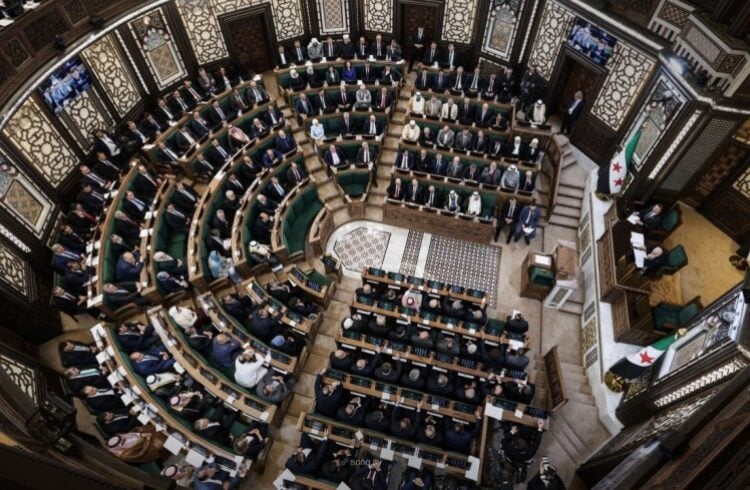
Thus, the framework of Syria’s transitional phase has recognized parliamentary immunity, and has referred the regulation of its details to the Rules of Procedure. The Assembly operates within a structure in which presidential authority carries the greater weight, as the President directly appoints seventy of its members. This composition makes the existence of robust functional immunity a matter of the utmost importance, since members must be able to hold ministers accountable, scrutinize public spending, and oppose the executive authority’s proposals, without being exposed to politically motivated prosecutions or arrests. The Rules of Procedure, which Article 29 requires to be adopted within one month of the inaugural session, should be treated as among the first rules the Assembly must adopt, and as a constitutional priority, with its provisions on immunity drafted with guidance from the comparative standards set by the Venice Commission and the Inter-Parliamentary Union. Immunity is protection for the parliamentary mandate, not an exemption from the rule of law, and the practical substance of this distinction will be determined by how the Assembly drafts its first rules.
