


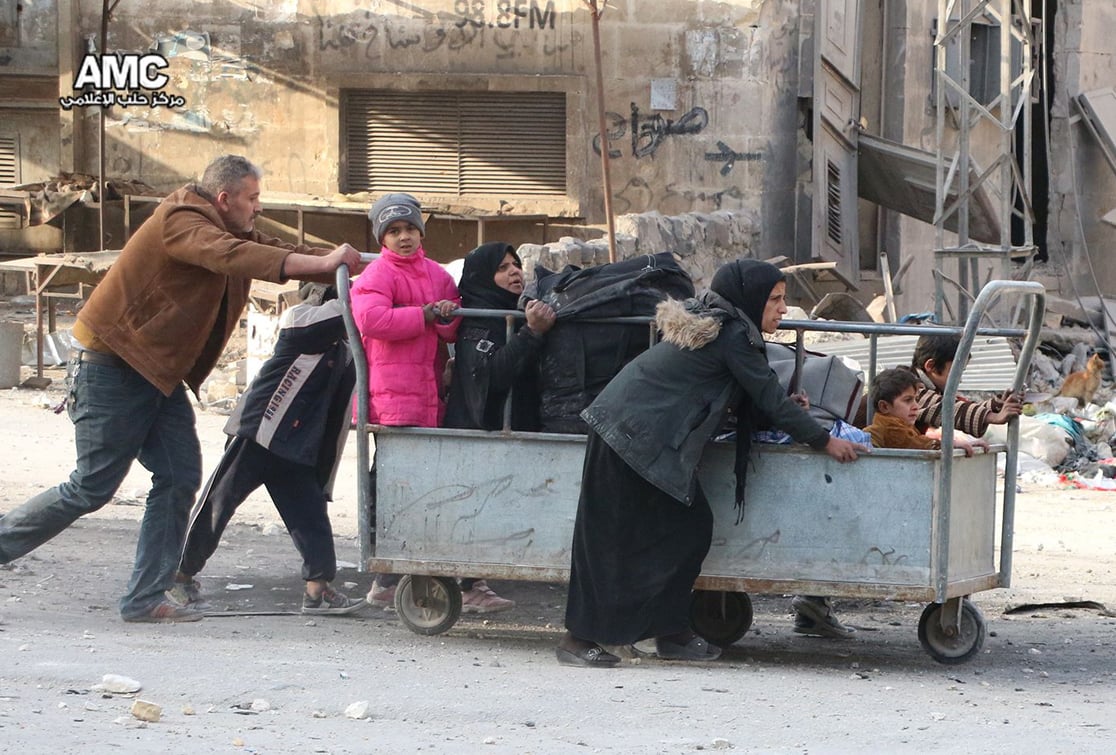
Since the second Cessation of Hostilities ceasefire ended on 19 September 2016, the bombing and destruction by the Syrian and Russian regimes haven’t stopped for one day in the eastern neighborhoods of Aleppo. Committing hundreds of violations that constitute war crimes, these airstrikes targeted residential neighborhoods, hospitals, and schools haphazardly sometimes while in other cases were deliberate. In addition, these neighborhoods have fallen again under an overwhelming and crippling siege after the Syrian regime forces, with the support of Hezbollah and Iranian and Iraqi Shiite militias on the ground, managed to take back Al Ramousa neighborhood which was a pathway used by Syrian armed opposition to access Aleppo’s eastern neighborhoods. We recorded in three extensive reports the details of the most notable violations in that period of time.
In mid-November 2016, Russian forces immensely intensified their airstrikes destroying entire neighborhoods almost completely amid a lack of any concern by the U.N. regarding the toll of causalities and wounded and the horrifying violations that are being perpetrated on a daily basis. Under this air cover, the Syrian regime forces and the Shiite militias that are fighting with the regime advanced on the ground and, consequently, took over Masaken Hananou neighborhood and then Jabal Badrou neighborhood in addition to parts of Al Haydariya and Al Sakhour neighborhoods. 35 civilians would die every day averagely. SNHR documented the killing of 676 civilians, including 165 children and 87 women, in the eastern neighborhoods of Aleppo city at the hands of Russian and Syrian forces from 19 September 2016 until 30 November 2016. The death toll is distributed by the perpetrator party as follows:
• Russian forces: 462 civilians including 128 children and 66 women.
• Government forces: 214 civilians including 37 children and 21 women.
Subsequently, eastern neighborhoods of Aleppo were split into two parts: the south and the north where most of the residents of the neighborhoods that were taken over by the regime and its allies fled to the southern part being the larger part while another portion of the residents fled to the northern part. Additionally, a third group fled to Al Sheikh Maqsoud neighborhood which is under the control of the Kurdish Democratic Union Party forces.
