

SNHR is a Principal Source in All the Reports Released by the IIT, Supporting the Team’s Crucial Mandate in Syria
Languages
Available In
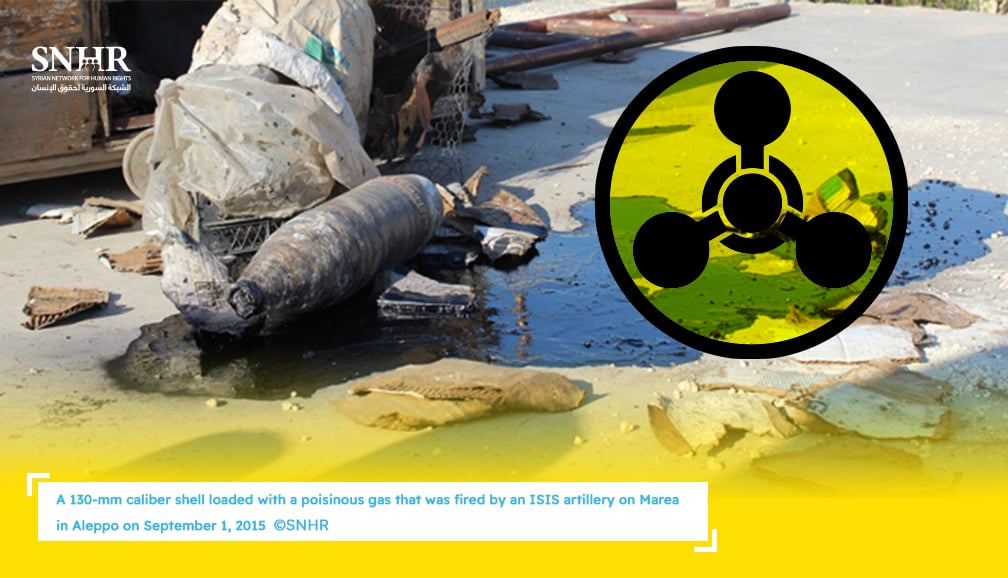
On Friday, February 23, 2024, the Organization for the Prohibition of Chemical Weapons’ (OPCW) Investigation and Identification Team (IIT) released its fourth report. In the report, the IIT, whose mandate include identifying the perpetrators of the crime of using chemical weapons, outlined the findings of its investigation into who carried out a chemical weapons attack in Marea town in Aleppo governorate on September 1, 2015. This comes after the OPCW’s Fact-Finding Mission (FFM) had established that chemical weapons were used at that time in that location.
The report confirms that ISIS used sulfur mustard in Marea on September 1, 2015, between 09:00-12:00 local time, in the course of a sustained offensive to capture the town. Sulfur mustard was deployed, using one or more guns. The remnants and munition examined from the impact locations were conventional 122-mm caliber artillery projectiles. The report adds that at least 11 individuals showed “symptoms consistent with exposure to sulfur mustard”.
The report further stresses that such attack could not have been carried out without direct orders from ISIS’s executive echelon, namely the committee working directly under the so-called caliphate of ISIS. According to the report, the IIT investigation managed to link additional structures and individuals who were involved in the use and deployment of chemical weapons by ISIS, including Diwan al-Jund (i.e., the department in charge of combatant affairs), which was affiliated with ISIS, and its committee for military development and manufacturing. More particularly, four individuals were identified as the perpetrators, while two other ISIS affiliates were identified as the main drivers of ISIS’s chemical weapons programme.
The IIT’s findings matches the degree of certainty known as ‘reasonable grounds’, which constitutes the standard of proof consistently adopted by international fact-finding and investigation bodies. IIT’s report includes data from the OPCW’s FFM, state parties, interviews conducted by the IIT, analysis of samples, computer modeling, satellite imagery, maps for the frontlines, authenticated video and photo footage, and other relevant data.
