


Around 2,000 Syrians Are Still Detained in Lebanese Prisons, Including About 190 Detained Over Their Involvement in the Syrian Uprising
Available In
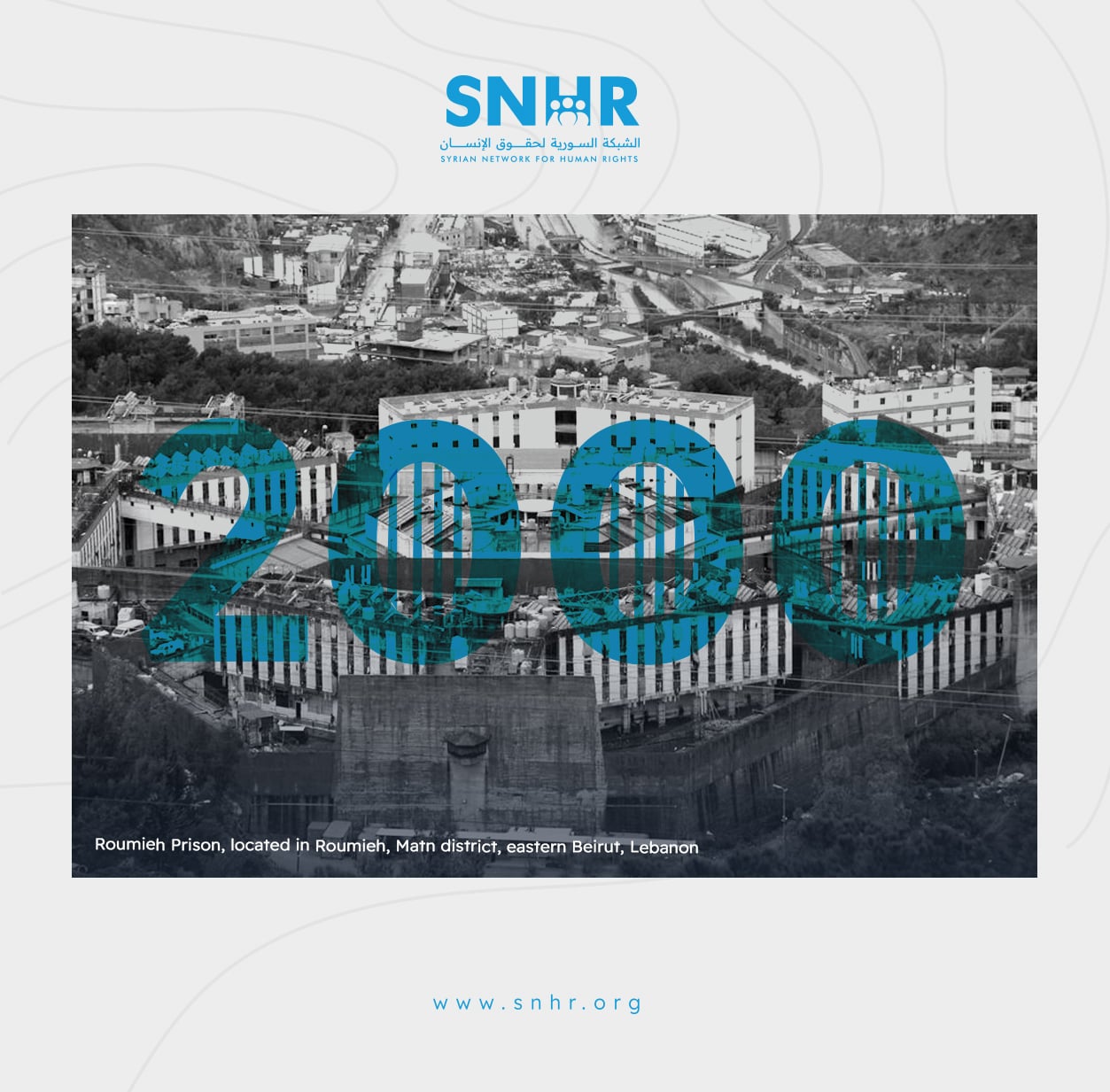
The Hague – The Syrian Network for Human Rights (SNHR) today released a statement calling in on the Syrian and Lebanese governments to take urgent action to end the suffering of Syrian detainees in Lebanon. The group estimates that that around 2,000 Syrians are still detained in Lebanese prisons, including 190 who were detained over their involvement in the Syrian uprising.
On February 11, 2025, a number of Syrian detainees in Lebanon’s Roumieh Prison announced their launch of an open-ended hunger strike to protest against their harsh detention conditions in these prisons and to demand their repatriation to Syria. This hunger strike comes in the context of worsening humanitarian conditions in Lebanese prisons, where Syrian detainees face continuous violations of their fundamental rights, having been subjected to arbitrary detention for years without any official response to their demands.
The statement reveals that SNHR obtained accounts from detainees and their families confirming that many of those on hunger strike are suffering from a severe deterioration in their health despite receiving some medical treatment inside the prison. Nevertheless, their overall health and humanitarian conditions remain dire due to the deplorable detention conditions and the lack of adequate medical care.
As the statement reveals, around 2,000 Syrian detainees are currently incarcerated in Lebanese prisons, including at least 190 who were detained for participating in the popular uprising for democracy in Syria. Among those are defectors from the former Assad regime forces and refugees. Despite being imprisoned for years, they have not yet been granted fair trials, and their fundamental rights remain unprotected due to the absence of legal safeguards.
The statement also notes that Syrian detainees, particularly in Roumieh Prison, are enduring inhumane detention conditions, including severe overcrowding, a lack of medical and food supplies, and the spread of infectious diseases, in addition to being denied contact with their families. Many have been subjected to unfair trials before Lebanese military courts or military investigative judges, based on confessions extracted through torture and threats. These coerced confessions led to them being charged with terrorism, resulting in severe prison sentences or indefinite pretrial detention.
Over the past years, the statement adds, Roumieh Prison has witnessed a series of protests and hunger strikes by Syrian detainees demanding improved detention conditions or expedited trials. However, most of these protests have been ignored by Lebanese authorities, with the detainees’ situation worsening year after year. During the COVID-19 pandemic in 2020, detainees demanded to be released due to an outbreak of the virus in the prison and the lack of medical care there, which led to an increase in infections among them. Similar protests took place in 2019 and 2022, mainly objecting to medical negligence, which resulted in the deaths of several detainees. In 2024, several detainees in Roumieh Prison attempted suicide due to the severe deterioration in their psychological state and to being overwhelmed by despair, amid the absence of any serious solutions to their plight.
The statement explains that the repatriation of Syrian detainees in Lebanon is governed by bilateral legal agreements between the two countries, most notably the 1951 Judicial Agreement, which regulates legal cooperation in extradition and the implementation of judicial rulings.
The 1951 Judicial Agreement between Lebanon and Syria sets out several conditions for transferring prisoners between the two countries, including:
- The person requested for extradition must be a national of the state making the request.
- The judicial ruling against the detainee must be final and conclusive.
- The remaining sentence must not be less than six months.
- The convicted person must consent to their transfer.
- The offense must be punishable under the laws of both countries.
- Both states must agree to carry out the transfer.
The statement, however, reveals that SNHR has documented violations of this agreement by Lebanese authorities, with Syrian detainees routinely handed over to the Assad regime during its rule upon completing their sentences or even while still in detention. Many of these prisoners subsequently disappeared or were subjected to further severe violations, including torture and extrajudicial execution.
At the beginning of 2024, Lebanese authorities held security, political, and judicial meetings with the Assad regime to review the files of Syrian detainees sentenced in Lebanon, aiming to extradite some of them to Syria as part of a plan to reduce overcrowding in Lebanese prisons. These discussions caused deep concern among the Syrian detainees there, who feared they would be subjected to torture and severe abuses after being handed over to the regime then ruling Syria.
With the fall of the Assad regime on December 8, 2024, and the Syrian transitional government’s assumption of power, the threat of deportation to a repressive regime no longer exists. Syrian detainees’ return to their homeland has now become conditional on ensuring fair trials and respect for their fundamental rights, including the prohibition of torture and arbitrary detention.
In this context, the statement stresses the need to respect the rights of Syrian detainees in Lebanese prisons and to treat them according to international standards. The current hunger strike is a legitimate form of protest against the harsh conditions they face, including overcrowding, mistreatment, and lack of medical care.
Accordingly, the Lebanese government bears responsibility for complying with international agreements related to detainees’ rights, ensuring their fundamental rights are not violated, and working towards achieving fair and sustainable resolution of their cases.
SNHR urges both the Syrian transitional government and the Lebanese authorities to take urgent, coordinated measures to end the suffering of Syrian detainees in Lebanon and to facilitate their return to Syria through the implementation of a legal framework that ensures respect for human rights. SNHR must also stress the importance of establishing clear coordination mechanisms between the two parties, bearing in mind the political and legal challenges in both countries.
The statement then outlines a number of recommendations
To the Lebanese government
- Coordinate the repatriation of detainees with the Syrian transitional government to establish a legal framework that would allow detainees to appeal repatriation decisions and ensure fair trials
- Improve the conditions of detainees in Lebanese prisons through reducing overcrowding, improving healthcare, and expediting the process of clearing their cases
- Ensure that Syrian detainees are not being discriminated against and cease trying civilians before military courts
- Provide legal options for detainees who may face risks should they be returned to Syria, and grant them temporary residence if needed
- Cooperate with international human rights groups to monitor the conditions in which detainees are held and improve their detention conditions
To the Syrian transitional government
- Supervise the process of returning detainees to Syria and ensure compliance with international standards.
- Send monitoring teams to Lebanese prisons to assess the conditions of detainees held there and improve their detention conditions.
- Provide humanitarian and legal support for detainees during their detention and fund reintegration programs targeting detainees upon their return.
To media outlets and relief groups
- Raise awareness on the issue of Syrian detainees and work to influence decision-makers.
- Provide social support for returnees, and assist them in following up on their cases.
- Encourage dialogue between civil society and the governing authorities to ensure more humane and transparent policies.
