

Languages
Available In
The Hague – The Syrian Network for Human Rights (SNHR) today released a report detailing its vision to achieve political pluralism and form a transitional justice body in Syria as part of the major political transformation Syria is going through in the wake of the downfall of the Assad regime on December 8, 2024.
The report stresses that the transitional phase marks a pivotal moment for restructuring the political system on new foundations that should ensure political pluralism and enhance public participation in decision-making while safeguarding the rights of all components of Syrian society. The success of this phase, however, remains hinged on building strong and independent institutions and establishing clear constitutional principles that guarantee legitimacy while achieving national consensus to foster stability and prevent regression into new conflicts.
The report outlines a number of key challenges that must be addressed to realize a successful political transition, chief among them are:
- Weak state institutions and administrative fragmentation
- Lack of trust among community components
- Foreign interference and interests
- Economic and social crisis
- Transition from revolutionary legitimacy to a pluralistic system
Roadmap for the transitional phase
The report details a vision for the transitional phase that hopefully can ensure justice and accountability, foster inclusiveness and human rights principles, and enhance political pluralism. This vision is grounded in the following steps:
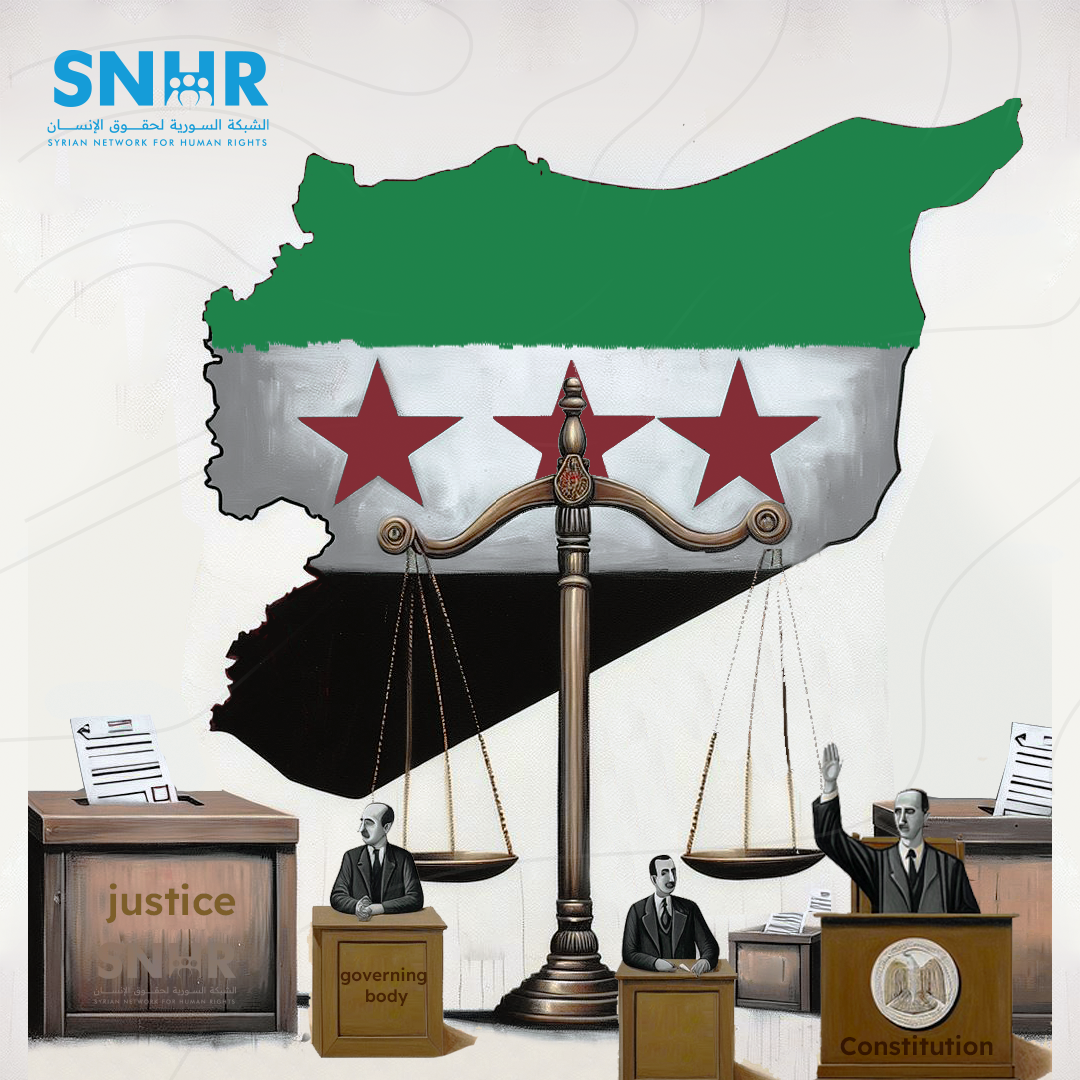
- Forming a governing body led by Ahmad al-Sharaa to ensure broader representation of various political and societal forces.
- Issuing a temporary constitutional declaration to regulate the transitional phase and define institutional powers, ensuring a clear political path.
- Establishing a transitional government responsible for rebuilding state institutions and managing the country during this interim period.
- Drafting a new constitution that reflects the aspirations of the Syrian people and guarantees fundamental rights and freedoms.
- Conducting free and fair elections that uphold the principle of peaceful power transition and allow all Syrians to democratically choose their representatives.
From revolutionary legitimacy to political pluralism
The report stresses the paramount necessity to transition from revolutionary legitimacy to political pluralism, which cannot be done without an organized approach based on restructuring the state, ensuring the effective involvement of the various national forces, and establishing strong foundations for good governance. This can be achieved through:
- Establishing participatory standards in institutions.
- Reforming state structures to ensure their independence and effectiveness.
- Building a pluralistic political system that respects the rights of all stakeholders.
- Strengthening and building on national dialogue for consensus-building.
- Consolidation pluralistic culture and political openness.
The report then outlines a proposed roadmap for political transition, through the following steps:
Forming a governing body
The formation of a transitional governing body in Syria is a fundamental and first step to ensure an organized and inclusive political transition, shifting the country from revolutionary legitimacy to institutional stability. The report underlines the importance of drawing lessons from past transition experiences in other countries, especially those that were built on fair representation, political legitimacy, and institutional competence. In the Syrian case, establishing such a body alongside the transitional leadership of President Ahmad al-Sharaa represents a critical step towards achieving stability and rebuilding the state for the following key reasons:
- Ensuring a broader representation for the various political and societal actors.
- Addressing the complex challenges of the transitional phase through clear institutional mechanisms.
- Strengthening local and international legitimacy.
- Supporting mechanisms of transitional justice and national reconciliation.
- Laying the groundwork for long-term democratic governance.
- Gaining international community support for reconstruction and consolidation stability.
Then, the report stresses that the composition of the transitional governing body must be based on strict criteria that includes competence, integrity, revolutionary legitimacy, all while ensuring a comprehensive representation for all political and societal actors. The report then proposes a number of transparency-based mechanisms to select the members of the transitional governing body, such as wide consulations among political actors and stakeholders, forming neutral committees to verify candidates’ qualifications, and ensuring balanced representation based on fair political and geographic distributions.
This governing body, the report adds, should have clear and specific powers with a balanced distribution of authority to prevent the reproduction of authoritarianism. The governing body should be also formed within a defined timetable that balances swift implementation with effective consultations. In this context, the international community can play a supportive, rather than directive, role by providing technical and logistical assistance to support a successful transitional phase.
Moreover, the report argues that a temporary constitutional declaration is a more prudent option compared to directly drafting a permanent constitution or amending the previous one. This is because a temporary declaration provides legal flexibility and allows for managing the transitional period without disrupting the political process due to contentious issues. It also enables the postponement of major constitutional debates to a later stage, giving all parties the opportunity to engage in a broad national dialogue on the future of the political system.
A constitutional declaration should clearly define the objectives of the transitional phase, including:
- Supporting national unity and ensuring political consensus.
- Recognition of the legitimacy of the transitional bodies and defining their frameworks.
- Establishing foundations for the principles of good governance, such as public sovergnity, rule of law, supporting civil peace, and resolving internal disputes.
- Achieving transitional justice and national reconciliation.
Protecting rights and fundamental freedoms
The report emphasizes the necessity of including clear provisions in the constitutional declaration to protect the fundamental rights of all citizens, including:
- Civil and political liberties, such as freedom of expression, assembly, and political organization.
- A prohibition on all forms of discrimination based on race, religion, gender, or political affiliation.
- Guaranteeing the right to legal recourse and political participation.
- Establishing a body along the lines of a ;National Transitional Justice Commission’ to oversee issues of accountability and reconciliation.
The report also underscores the importance of incorporating a clear roadmap for security sector reform and flexible mechanisms for amending the constitutional declaration to ensure its ability to respond to emerging challenges during the transitional phase.
Formation of the transitional government and drafting of the constitution
The report states that with the appointment of Mr. Ahmed al-Shara as President of the Republic during the transitional phase, the formation of the governing body, and the adoption of the constitutional declaration, a new phase begins. This phase focuses on forming a transitional government responsible for managing state affairs, implementing the provisions of the constitutional declaration, and laying the necessary foundations for Syria’s democratic transition.
According to the proposed vision, President Ahmed al-Shara will prepare a list of ministerial candidates, which will be submitted to the governing body for review. The body may approve the nominations, introduce modifications, or reject certain names if they do not meet selection criteria, which include competence, integrity, and a balance between independence and political affiliation, while ensuring the avoidance of exclusion or the militarization of governance.
The report outlines the transitional government’s powers, which include:
- Supervising the electoral process.
- Reforming the security sector.
- Managing public services.
- Developing effective economic policies.
- Preparing for elections.
- Establishing transitional justice.
Drafting the constitution and transition to a stable democratic system
After forming the transitional government, a crucial phase begins with the drafting of a permanent constitution by a founding committee. This aims to ensure a stable political transition and establish a democratic system that will govern Syria in the long term. The new constitution will replace the temporary constitutional declaration and will:
- Establish political and legal legitimacy.
- Enshrine fundamental rights and freedoms.
- Set the legal framework for elections.
- Define the foundations for the functioning of the three branches of government—executive, legislative, and judicial—while ensuring separation of powers to maintain balance and prevent authoritarianism.
The founding committee can be formed through one of the following methods:
- Direct election by the people.
- Appointment by the transitional governing body in consultation with political forces and civil society.
- A combination of appointment and election to ensure fair representation and diversity.
Regardless of the mechanism adopted, the committee must meet strict selection criteria and include:
- Legal experts specializing in constitutional affairs.
- Representatives of political parties.
- Civil society representatives.
- Representatives from the areas most affected by the conflict.
Elections and transfer of power to an elected government
The report notes that parliamentary and presidential elections serve as the final stage of the transitional process, where power is transferred to a democratically elected government, reinforcing political stability and granting legitimacy to the new system.
To ensure the integrity of the elections, they must be conducted according to the following standards:
- Achieving a high degree of transparency.
- Guaranteeing impartiality and independence in overseeing the electoral process.
- Ensuring comprehensive representation of all segments of Syrian society.
- Providing a safe and fair environment that allows all Syrians to participate without restrictions or political pressures.
Recommendations for the transitional phase
To the current government
- Implement the political transition process with clear and defined mechanisms
- Utilize this report to ensure a pluralistic transition that guarantees legitimacy.
- Develop a roadmap that includes practical steps and executive procedures within clear legal frameworks.
- Set precise timetables for implementing the political transition plan:
- Establish clear and actionable deadlines for each stage of the transition to ensure commitment and avoid political vacuum.
- Work on forming an independent oversight committee to monitor the plan’s implementation and ensure transparency and accountability.
To the international community
- Provide technical and financial support while ensuring national sovereignty
- Offer technical and financial assistance to support the building of governance institutions and strengthen their capacity in public administration, judiciary, security, and the economy.
- Fund reconstruction projects to ensure comprehensive development that benefits all Syrians, with an emphasis on not imposing political agendas.
- Support the transitional justice process.
- Enhance monitoring and advisory processes while respecting national decision-making
- Provide neutral international expertise to ensure the integrity of the electoral process and prevent manipulation of voter will.
- Provide technical and legal consultations to support the drafting of a new constitution that reflects the aspirations of all Syrians, without imposing any external political model.
- Support Syrian civil society and local institutions in building a culture of citizenship and democracy, ensuring stability and human rights protection.
- Ensure an international environment conducive to Syria’s stability
- Work on lifting economic sanctions that affect the livelihood of citizens.
- Enhance regional and international cooperation to prevent negative external interventions and ensure the protection of Syria’s territorial integrity and national decision-making.
To Syrian civil society
- Coordinate with the transitional government
- Establish communication channels between civil society and the government to ensure effective coordination in achieving political transition objectives.
- Contribute to implementing service and development projects in collaboration with local authorities to enhance citizens’ trust in the transitional process.
- Provide proposals and recommendations to the transitional government based on the needs of the community, ensuring the inclusiveness and fairness of policies.
- Actively participate in monitoring and enhancing transparency
- Increase participation in national consultations on the transition process and public policies to ensure they align with Syrians’ aspirations.
- Monitor the transitional government’s performance through independent oversight mechanisms to ensure adherence to transparency and accountability.
- Strengthen the role of independent media in covering the stages of the transition process and exposing any violations that hinder achieving pluralistic transition and stability.
- Raise awareness of citizens’ rights and fundamental freedoms
- Organize awareness campaigns to raise awareness of constitutional rights, fundamental freedoms, and the role of citizens in building a state of law and institutions.
- Train youth and women on leadership skills, political participation, and advocacy techniques to enhance their role in political life.
- Promote a culture of community accountability by organizing workshops and dialogue sessions on the importance of transparency in governance and citizens’ involvement in decision-making.
- Strengthen national reconciliation and rebuild social fabric
- Support national reconciliation initiatives by promoting dialogue among different segments of society to overcome divisions and build trust.
- Implement reintegration programs for displaced persons and returnees and provide psychological and social support to ensure sustainable peaceful coexistence.
- Document violations and provide support to victims of the conflict, especially victims of the Assad regime, to contribute to achieving transitional justice and preventing the recurrence of past violations.
- Empower civil society as a key driver in the transitional process
- Develop partnerships between local and international civil society organizations to enhance institutional capacities.
- Pressure stakeholders to ensure a legal and legislative environment that protects freedom of association, freedom of expression, and independent civil work.
- Support local development initiatives that improve living conditions, enhance stability, and create employment opportunities for communities affected by the conflict.
