

Available in:
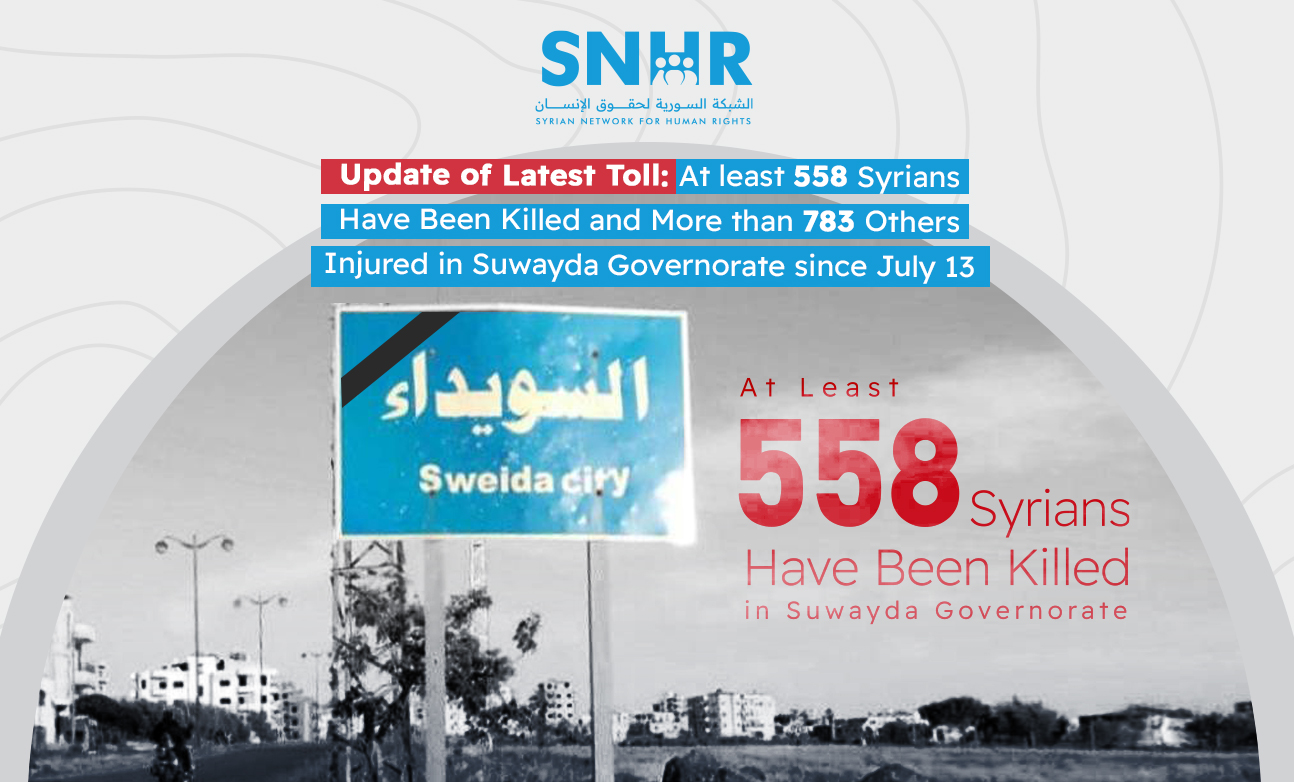
Damascus – The Syrian Network for Human Rights (SNHR) has documented the deaths of at least 558 Syrians, including 11 children and 17 women (one of them after receiving the news of her grandson’s death), as well as six medical worker – three of them are women – and two media workers, and at least 783 others have been injured with varying degrees of severity in Suwayda Governorate since July 13, 2025, and until July 21, 2025 – the date of publication of this statement – based on preliminary information available and verified by SNHR. This escalation comes in the context of violent clashes and escalating acts of violence, including extrajudicial killings, mutual shelling, as well as airstrikes carried out by Israeli occupation forces.
The preliminary toll includes civilian casualties, including children, women, and medical personnel, as well as fighters from armed Bedouin tribal groups and other local groups outside the control of the state from the Governorate, in addition to members of the internal security forces and the Ministry of Defense of the Syrian transitional government.
SNHR emphasizes that this tally is preliminary and reflects what has been verified up to the moment of publication, and that it will be updated as more information becomes available. Efforts are still underway to classify victims according to the party responsible for the violations and to distinguish between civilians and combatants.
Based on its methodology for documenting victims, which is based on international human rights law, SNHR does not document the killing of armed individuals belonging to groups outside the control of the state if they are killed during clashes, as this does not constitute a human rights violation. On the other hand, the Network will document the killing of any person after their arrest as an extrajudicial killing.
SNHR affirms that it is monitoring developments on the ground in the Governoarte of Suwayda and continues to work to verify the details of incidents and violations committed, documenting them based on direct testimonies and available evidence, as part of its ongoing efforts to identify the victims and document the legal responsibilities of the various parties involved in the ongoing developments.
Recommendations to the Syrian government
- Regulate the use of force in accordance with international legal standards, and refrain from any excessive or indiscriminate use of weapons in populated areas, as this poses a direct threat to the lives of civilians and undermines social stability.
- Ensure urgent and immediate access to humanitarian aid to affected areas, secure safe passage for relief teams, and provide medical and psychological support to the injured, especially children and women.
- Open independent and transparent investigations into all reported violations, including extrajudicial killings, abductions, arbitrary detention, and degrading treatment, in order to hold those involved accountable and strengthen community trust in justice institutions.
- Protect vital civilian centers, such as schools, hospitals, and places of worship, prevent their use for military purposes or their exposure to any attack, and work to completely neutralize them from the conflict.
- Respect for the principles of international human rights law by all parties, and affirmation of the state’s obligations in this regard.
- Support for the role of local and community institutions in conflict resolution, through the promotion of civil dialogue and mediation initiatives, and the involvement of community and religious leaders in efforts to calm tensions and prevent escalation.
- Limit inflammatory and sectarian rhetoric in the media and on social media platforms and promote a discourse of national unity and civil peace through effective regulatory measures and community awareness initiatives.
- Ensure transparency and accountability in security operations carried out by official bodies, with the need to inform the population in advance of any measures that may affect their daily lives, such as curfews or security campaigns, and provide effective grievance mechanisms.
- Encourage local and national media to play a responsible and balanced role based on documenting facts without provoking conflict and contribute to promoting a culture of human rights and civil peace.
- Provide comprehensive support to victims and their families, including psychological and social care, fair compensation, recognition of their suffering, and their inclusion in transitional justice and national reconciliation processes.
- Activate awareness and education programs in the areas of human rights, tolerance, pluralism, and citizenship, especially in areas affected by conflict, in cooperation with civil society organizations and local initiatives.
- Draw on national and international expertise in crisis management and develop rapid response mechanisms for local conflicts based on prevention, mediation, and community participation, rather than military solutions alone.
- Review the centrally managed political transition process and work to expand the base of community participation and pluralism in various state institutions.
Recommendations to other parties involved in the conflict in Suwayda Governorate
- Full commitment to respect international human rights law, and refrain from any acts of retaliation or attacks targeting civilians or civilian facilities.
- Immediate cessation of the use of weapons or incitement to violence, commitment to a comprehensive ceasefire, and efforts to exercise restraint and adopt dialogue as a means of resolving disputes.
- Cooperate with community and official efforts aimed at achieving a ceasefire and preventing the conflict from spreading, and facilitate the access of humanitarian aid and medical teams to affected areas.
- Refrain from incitement or calls for revenge, commit to neutrality towards civilians, and avoid any practices that may lead to the deterioration of civil peace.
- Respect the role of local and religious leaders and dignitaries in mediation initiatives, and refrain from any actions that hinder reconciliation efforts and community dialogue.
- Refrain from publishing or promoting any inflammatory or sectarian rhetoric through the media or social media, thereby contributing to calm and preventing escalation.
