


Available in:
Fadel Abdulghany
The 1982 Hama massacre represents one of the most horrific mass crimes in Syria’s modern history, claiming the lives of tens of thousands of civilians and leaving a deep wound in the national memory that has yet to heal.
This massacre has taken on additional significance in light of recent political developments in the country, namely the fall of the Assad regime and the formation of a new transitional government. In the wake of this fundamental shift, reopening the case of the massacre, uncovering the facts, and holding those involved accountable is a prerequisite for building a state based on the rule of law and respect for human rights.
The need to reopen the Hama massacre file cannot be understood in isolation from the principles of transitional justice, a system developed specifically to help societies emerging from internal conflicts or authoritarian regimes to overcome the legacy of oppression and move to a new phase based on truth, accountability, redress, and guarantees that violations will not be repeated.
Based on these principles, official recognition of past crimes and systematic violations becomes a crucial step in achieving national reconciliation and civil peace.
Brief political context
The Baath Party’s seizure of power in Syria in 1963 was a turning point in the country’s contemporary political history, as it dashed all hopes of establishing a pluralistic parliamentary constitutional system. and the “March 8 coup” placed the reins of power almost entirely in the hands of the Baath Party’s Military Committee.
Amid the changes that followed this period, Hafez al-Assad emerged as one of the most prominent members of this committee, then seized power for himself in 1970 in what became known as the “Corrective Movement,” tightening his grip on key institutions and consolidating control over the state and society.
During that period, the Assad regime tightened its grip on the three branches of government (executive, legislative, and judicial) through a system of laws and intensive security measures. The pillars of real political life, with its independent institutions and parties, were struck down, and trade unions and professional associations were merged into official party structures.
In this stifling climate, a “one party, one leader” model prevailed, and any outlets for political opposition or free expression disappeared.
With no effective international oversight and the repercussions of the Cold War, the Assad regime found itself with free rein to deal with those it considered opponents, paving the way for major violations such as the 1982 Hama massacre, which would not have reached such a level of systematic violence had it not been for the stability of a regime lacking any real commitment to human rights or constitutional and regulatory controls.
The Hama Massacre, February 1982
Amid political and security tensions in the late 1970s and early 1980s, violent clashes broke out in the city of Hama between Syrian regime forces and armed opposition groups (including those affiliated with or sympathetic to the Muslim Brotherhood).
The regime exploited these limited clashes to launch a large-scale security and military campaign against the entire city, beginning in early February 1982 and continuing for about a month, employing the utmost violence and brutality.
The size of the forces involved and the “systematic” nature of the attack
The Syrian regime at the time directed huge military formations towards the city of Hama, including special forces, defense brigades, and some tank brigades, in addition to security and intelligence agencies.
These forces imposed a suffocating siege on the city, cutting off water, electricity, and communication lines, turning Hama into an area isolated from the outside world. While the stated motive was to eliminate “armed pockets,” the scale of the military deployment and the methods used showed that the real goal was to punish the city and its inhabitants, given the use of methods such as artillery and air strikes, field executions, and organized looting of residential neighborhoods.
Testimonies collected by researchers and human rights activists (see the Syrian Network for Human Rights report on the 40th anniversary of the Hama massacre in February 2022) reveal that in the years that followed—despite their scarcity and the difficulty of verifying them at the time due to the media blackout – reveal a systematic approach to the attack, in which a pattern of “total destruction” was followed in neighborhoods considered to be hotbeds of armed opposition, with no real distinction between civilians and armed fighters. What was initially described as a “limited security operation” thus turned into the largest repressive campaign in Syria’s modern history.
Estimates of victims and the scale of violations
It is difficult to obtain accurate figures on the number of dead and missing due to the severe media blackout imposed by the regime on the city. However, human rights estimates and subsequent studies converge to indicate that between 30,000 and 40,000 civilians were killed during that campaign, in addition to some 17,000 people who were likely subjected to arbitrary arrest or enforced disappearance, most of whose fate remains unknown to this day. Numerous mass graves were scattered throughout the city.
Mass destruction and looting of property
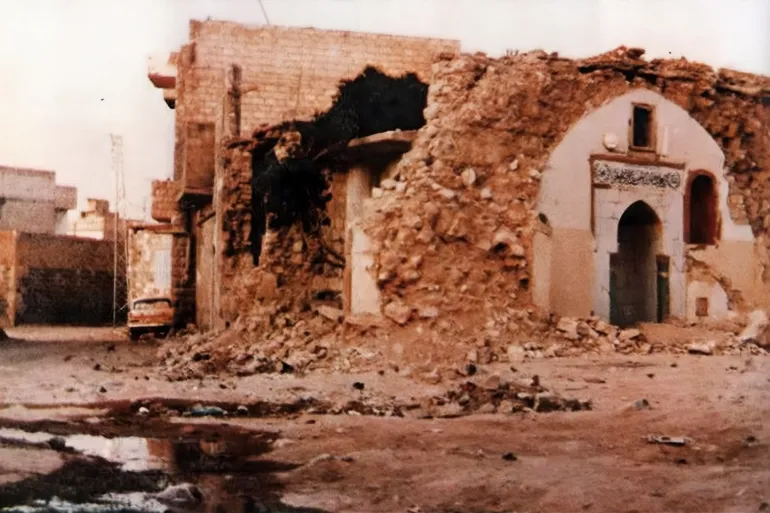
The violations were not limited to widespread killings and arrests, but also included the extensive destruction of large sections of the city’s neighborhoods, especially the historic neighborhoods in its center and old suburbs.
Artillery and air strikes intensified, razing entire buildings to the ground, including mosques, churches, and traditional markets that represented the city’s long heritage.
At the same time, there were many incidents of systematic looting, with many homes and shops stripped of their contents by soldiers or individuals wearing civilian clothing belonging to the security forces. Some markets, shops, and homes were deliberately set on fire.
This destructive military campaign had far-reaching effects on the social and economic fabric of the city. Entire families fled Hama to escape the violence, homes and shops were confiscated, and many generations experienced feelings of fear, shock, and injustice.
International and domestic disregard for the massacre
Despite the magnitude of the crimes committed in Hama in 1982, there was no official or international action that could be described as effective during that period. There was no independent UN investigation to uncover the facts, and even international human rights organizations barely addressed the issue. At the height of the massacre, Syria was subject to complex regional and international balances: the world was divided into two camps during the Cold War, which meant that many human rights violations in the Middle East went unchallenged.
Locally, the Syrian regime imposed a tight media blackout; independent newspapers were shut down early in the Baath era, and official discourse dominated the few remaining media outlets.
With the continuation of the emergency law imposed since 1963, the space for any independent political movement that could demand investigation or accountability was narrowed to the maximum. It did not stop there, but talking about the Hama massacre became taboo, exposing those who crossed the line to prosecution and arrest. Thus, survivors and victims’ families were unable to convey their suffering, and many lost faith in the possibility of justice under the absolute control of the judiciary, parliament, and media.
This neglect, both locally and internationally, contributed to the entrenchment of a culture of impunity over the following decades. The regime sent a message that it could commit grave violations against civilians without fear of any domestic or international punishment. This situation created a vacuum whose consequences continued with the escalation of similar violations, as Syrians—especially the people of Hama—were denied any opportunity for accountability or redress.
This neglect encouraged the Assad regime to commit further violations in the years and decades that followed, relying on its previous experience of impunity.
When there is no external deterrent, the ruling authority becomes increasingly bold in employing violent means whenever it deems this necessary to ensure its survival. The Hama issue has not only remained etched in the Syrian memory as an open wound, but has also become a model through which citizens and opponents alike recall how the regime can use its absolute power in the absence of international accountability.
The importance of revisiting this file today
When popular protests broke out in 2011, the memory of Hama resurfaced, both at the level of society, which evoked the past massacre as a symbol of authoritarian oppression, and at the level of the security apparatus, which once again resorted to violent repression.
In this sense, it can be said that the events of 2011 were merely a continuation of a history of repression that remained unchecked, as a result of international negligence and the absence of accountability for the Assad regime’s major crimes, from Hama to the recently documented violations.
In light of the current political changes and the fall of the Assad regime, reopening the Hama massacre file is a necessary step to bring justice to the victims and ensure that such practices are not repeated in the future.
At the international level, this correction requires effective action by the UN system and human rights organizations, either through the formation of specialized international commissions of inquiry capable of uncovering the facts, or through support for the new Syrian government in establishing legal and administrative foundations for dealing with the legacy of the massacre.
The role of the new Syrian government
The new Syrian government faces a historic responsibility to lay the foundations for transitional justice, starting with the repeal of laws that have entrenched a culture of impunity, particularly those that granted members of the security services legal immunity from prosecution.
Legislative decrees, such as Decree No. 14 of 1969, also prevented any legal action against them without official permission from the high command, which led to a sense of absolute immunity among the security and military authorities.
These laws had a negative impact on the structure of the legal system, making it almost impossible to open any serious investigation into the crimes and serious violations that occurred over the past decades. Therefore, one of the most important roles that the new government must play is to issue explicit legislation that repeals these laws and restores the independence of the judiciary, so that those involved in major crimes can be prosecuted in accordance with fair trial standards.
In addition to legislative reforms, documentation and the collection of testimonies are essential for uncovering the truth. Serious violations, such as the Hama massacre, cannot be dealt with effectively without gathering evidence and conducting transparent and independent investigations.
In this context, the formation of a national commission of inquiry is of utmost importance. It should include independent judges and legal experts, as well as representatives of the victims’ families, and be granted broad powers to access security documents, summon witnesses, and analyze evidence.
The challenges facing documentation processes, such as the passage of time and the scarcity of official documents, make the testimonies of survivors, victims’ families, and those familiar with the events an indispensable source for reconstructing the truth.
Therefore, the new government is required to provide a safe environment to protect witnesses, in addition to supporting the establishment of a national archive that preserves the testimonies of victims and available evidence to document what happened and prevent the facts from being obscured or distorted in the future.
Alongside judicial investigations and documentation, revealing the full truth about the fate of thousands of people who went missing during the Hama massacre is crucial to achieving justice and restoring the dignity of the victims’ families.
During the military campaign, approximately 17,000 people disappeared, and their families remain unaware of their fate to this day, making the search for them and the recovery of their remains an urgent requirement. This requires the formation of specialized search and investigation teams, including experts in forensic medicine and DNA identification, with the aim of locating mass graves and analyzing the remains to identify the victims.
Returning the remains of the victims to their families is an essential step in the process of officially acknowledging the crimes committed and contributes to alleviating the suffering of families who have lived in pain and uncertainty for decades.
In addition, the new government’s recognition of the Hama massacre and its inclusion in the official historical record through educational curricula and national events represents a necessary identity dimension, preventing the facts from being obscured or distorted in the future and ensuring that these events serve as a lesson for future generations.
In addition to revealing the truth, the new government must take concrete measures to compensate the victims and their families for the damage they have suffered, both materially and morally. The losses caused by the massacre were not limited to the loss of lives, but also extended to the destruction of property, looting of homes, and displacement of families, which requires the establishment of compensation programs to restore some of the rights that were taken away.
This includes providing fair financial compensation to the families of victims and survivors, as well as returning confiscated property or compensating its owners according to its market value. Reparations should also include a formal apology from the state, the erection of a memorial to commemorate the victims, and the provision of psychological and social support to survivors and families of the missing, who continue to suffer from the effects of trauma.
In terms of future guarantees to prevent the recurrence of such crimes, institutional reform is one of the key areas on which the new government must focus. Without radical reform of the security and judicial apparatus, the risk of a return to authoritarianism will remain.
This requires the establishment of independent oversight mechanisms to monitor the performance of the security apparatus, the removal of officials involved in serious violations from positions of power, and the strengthening of the independence of the judiciary so that it can hold anyone accountable for future abuses. Human rights principles should also be incorporated into educational curricula to ensure the emergence of a new generation that is more aware of the values of justice and accountability.
In addition, a legislative framework should be established that clearly criminalizes crimes against humanity, including torture, enforced disappearances, and the collective targeting of civilians, while providing legal mechanisms to prosecute those responsible for such crimes regardless of their position. Alongside these internal reforms, cooperation with international human rights organizations should be strengthened to ensure the impartiality of investigations and to benefit from global expertise.
Conclusion
The 1982 Hama massacre case represents a true test of the new Syrian government’s seriousness in fulfilling its responsibilities regarding the past and turning the page on it in a fair manner. Without launching a transparent investigation and activating specific mechanisms to hold those responsible accountable and compensate the victims, the repressive legacy of the Assad regime and its loyalists will remain present, and any national reconciliation will be impossible.
In this context, it is essential to build bridges of cooperation between the new Syrian authorities and international bodies and organizations, so that the latter can provide the former with the necessary technical and legal support and confer international legitimacy on any steps taken at the national level.
Together, these measures remain the best way to bridge the historical gap caused by the “UN failure” in the 1980s and are practical proof that Syria is now choosing to confront its past in a different way.
