

Available in:
Damascus – The Syrian Network for Human Rights issued a statement today on the occasion of the International Day for the Elimination of Violence against Women, entitled On the International Day for the Elimination of Violence against Women: Strengthening Participation of Women in the Transitional Phase in Syria to Guarantee Their Rights and Justice. The statement highlighted the widespread violations to which women and girls have been subjected in Syria since March 2011. The Network notes that it issues annual reports on November 25 that monitor patterns of violations, including extrajudicial killings, arbitrary arrest and enforced disappearance, torture, sexual violence, forced displacement, as well as discrimination and harassment, based on a reliable database that is continuously updated.
These reports aim to support transitional justice pathways, strengthen accountability mechanisms, and ensure the protection of the rights of women and girls during the transitional phase the country is going through after the fall of Bashar al-Assad’s regime on December 8, 2024. Despite the scale of the systematic violations, the network affirms that women have remained at the forefront of civil, human rights, and humanitarian efforts, through documentation, supporting victims, and leading community initiatives, in addition to bearing the burdens of displacement, loss of breadwinners, and family responsibilities.
The reports highlight the pivotal role women played during the years of struggle for political change, contrasting this with their current weak representation in decision-making positions and leadership institutions. The network emphasizes that the lack of sufficient female participation poses a major challenge to guaranteeing women’s rights and equality in the political transition and state-building process.
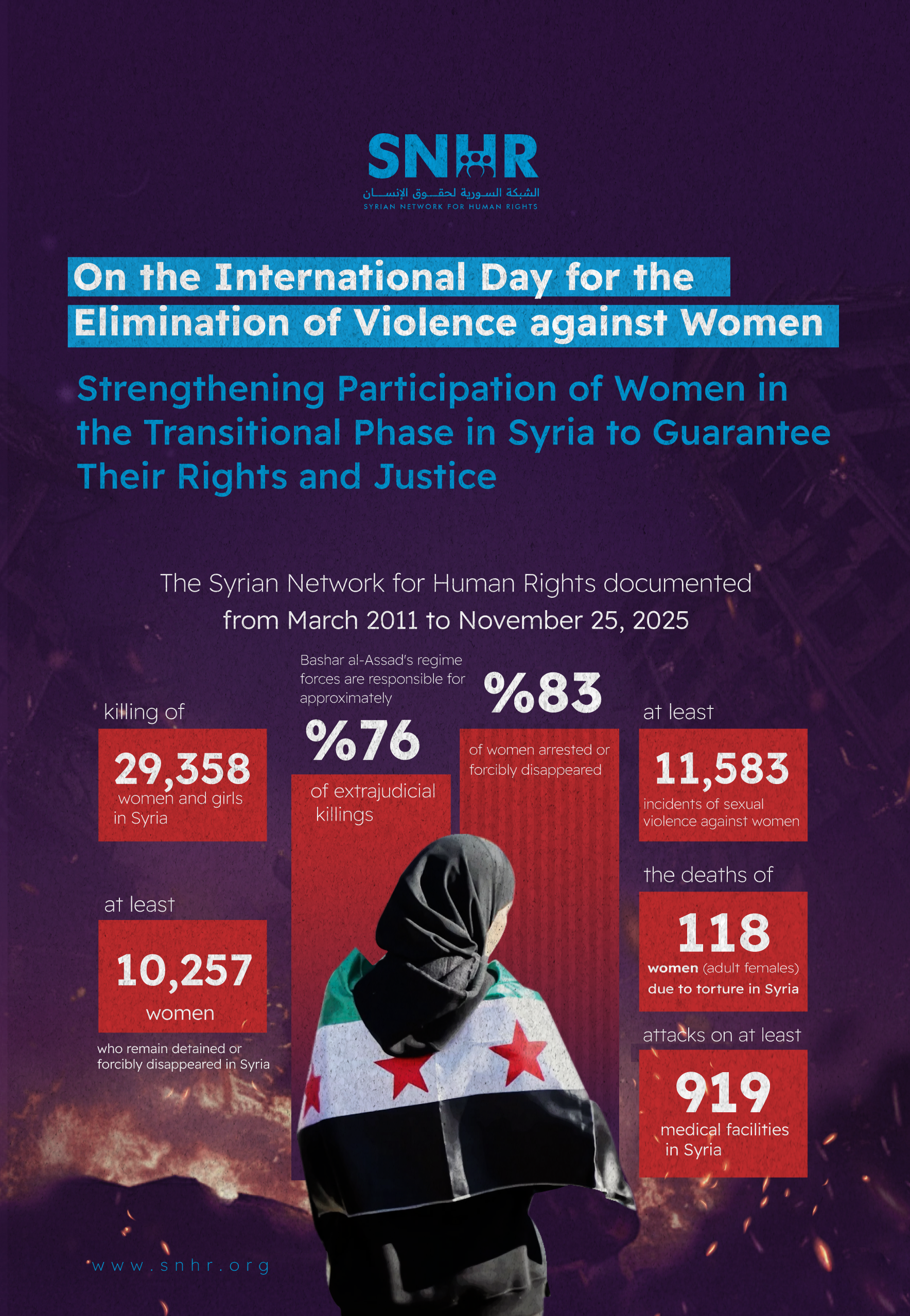
The Syrian Network for Human Rights documented the killing of 29,358 females from March 2011 to November 25, 2025, distributed as follows: 22,123 at the hands of the forces of the former Bashar al-Assad regime, and 7,235 at the hands of other parties involved in extrajudicial killings, with the regime responsible for 76% of the total victims, and 23% of the victims being female children.
The year 2013 saw the highest number of female deaths, with Aleppo, Idlib, and Rural Damascus governorates having the highest number of victims. The network also documented 10,257 women who remain detained or forcibly disappeared, including 8,501 in detention centers formerly controlled by the Bashar al-Assad regime and 1,756 in detention centers controlled by other parties to the conflict in Syria. The regime is responsible for 83% of the total. The year 2014 saw the highest rates of female arrests.
The network documented 118 deaths of women due to torture, 97 of which occurred in detention centers formerly controlled by the Bashar al-Assad regime, and 21 in detention centers controlled by other parties to the conflict in Syria. The regime was responsible for 83% of these deaths, with 2015 seeing the highest number of fatalities. The network also documented at least 11,583 incidents of sexual violence against women, 8,034 perpetrated by forces loyal to the former Bashar al-Assad regime and 3,549 by other parties to the conflict in Syria. The regime was responsible for 69% of these incidents, and the victims included thousands of underage girls.
Attacks on medical facilities reached 919, of which 566 were carried out by the forces of the former Bashar al-Assad regime and 353 by other parties to the conflict, with the regime being responsible for 62%.
The Syrian Network for Human Rights believes that the transitional phase in Syria represents a key opportunity to enhance the protection of women and girls and ensure their active participation, especially in light of the scale of violations they have been subjected to since 2011. Its vision is based on three main pillars:
First, enhance community and institutional participation by empowering women to engage in reform processes and decision-making within national committees, local bodies, and civil initiatives, and ensuring their participation in building judicial, security, and law enforcement institutions, thereby integrating a women’s protection perspective into policies and practices.
Second, strengthen legal and social protection by developing legislation that aligns with international standards to prevent and criminalize violence against women, ensuring perpetrators are held accountable, and establishing comprehensive support programs that include healthcare, psychosocial support, and economic empowerment, with a focus on protecting women from arbitrary arrest, displacement, and various violations during the transitional phase.
Third, continue human rights documentation as essential to ensure the availability of accurate data on violations against women and girls, supporting transitional justice and accountability efforts and contributing to evidence-based policymaking.
It concluded with recommendations from the Syrian Network for Human Rights to take a set of practical measures to enhance the protection and empowerment of women and girls during the transitional phase:
- Legal and Institutional Protection
- Amend and develop national laws to ensure the protection of women and girls from all forms of violence and discrimination, including laws governing arrest, detention, and investigation, anti-torture laws, and rules related to family and community discrimination.
- Establish or support specialized national bodies and local units to monitor violations against women and girls, ensure follow-up on complaints, and provide legal and psychological support to victims.
- Ensuring the strict application of penalties against perpetrators of violations, with regular follow-up on cases of violence against women and girls by the competent judicial authorities.
- Establishing local mechanisms to protect women in public spaces and conflict-affected areas, including the creation of temporary protection centers for women and girls at risk.
- Empowering Community and Political Participation:
- Enhancing women’s participation in national committees, local bodies, and civic initiatives, ensuring their direct role in shaping community and development policies and plans.
- Supporting training, capacity-building, and professional empowerment programs for women to guarantee their active participation in the civic, political, and economic sectors, including training local leaders on integrating women into decision-making processes.
- Encouraging women to assume leadership roles in community initiatives and public service institutions to ensure their needs and priorities are reflected in local and national decisions.
- Social, Psychological, and Economic Support:
- Providing psychosocial support programs for women and girls affected by violence, displacement, or loss of a breadwinner, including individual and group counseling services and referrals to specialized services when needed.
- Supporting economic and social projects that promote women’s independence and self-reliance, such as small businesses, vocational training programs, and reintegration into the labor market.
- Ensure women and girls have access to essential services, including education, healthcare, shelter, and social protection, with particular priority given to areas affected by displacement or military operations.
- Develop and implement special support programs for widows and female heads of households to ensure family stability and protect them from poverty, exploitation, and economic abuse.
- Documentation and Preservation of Human Rights Data:
- Continue to collect information and document violations systematically and regularly against women and girls, while conducting ongoing field verification to enhance the reliability and accuracy of the data.
- Establish a reliable national database of violations committed against women and girls to support local justice processes and transitional mechanisms, and to inform institutional planning for protection and support programs.
- Activate mechanisms for reporting violations at the community level, including helplines and complaint centers, while ensuring confidentiality and protecting victims and witnesses from any retaliation or pressure.
- Community Awareness and Education:
- Implementing comprehensive educational programs on the rights of women and girls in Syrian society, taking into account the cultural and social specificities of each region and targeting different age groups.
- Training local staff in schools, associations, health centers, and law enforcement institutions on how to deal with women and girls affected by violations in a way that respects their dignity and rights and provides them with the necessary psychological and legal support.
- Organizing media and community campaigns to promote the role of women in leadership and civil society, highlighting their contributions to the political transition and reconstruction process, and raising community awareness of the importance of protecting women from violence and discrimination as a fundamental condition for building a just and safe society for all its members.
