


Documentation of the Killing of 202,000 Civilians, including 45,000 who Died under Torture, in addition to 160,000 Forcibly Disappeared Persons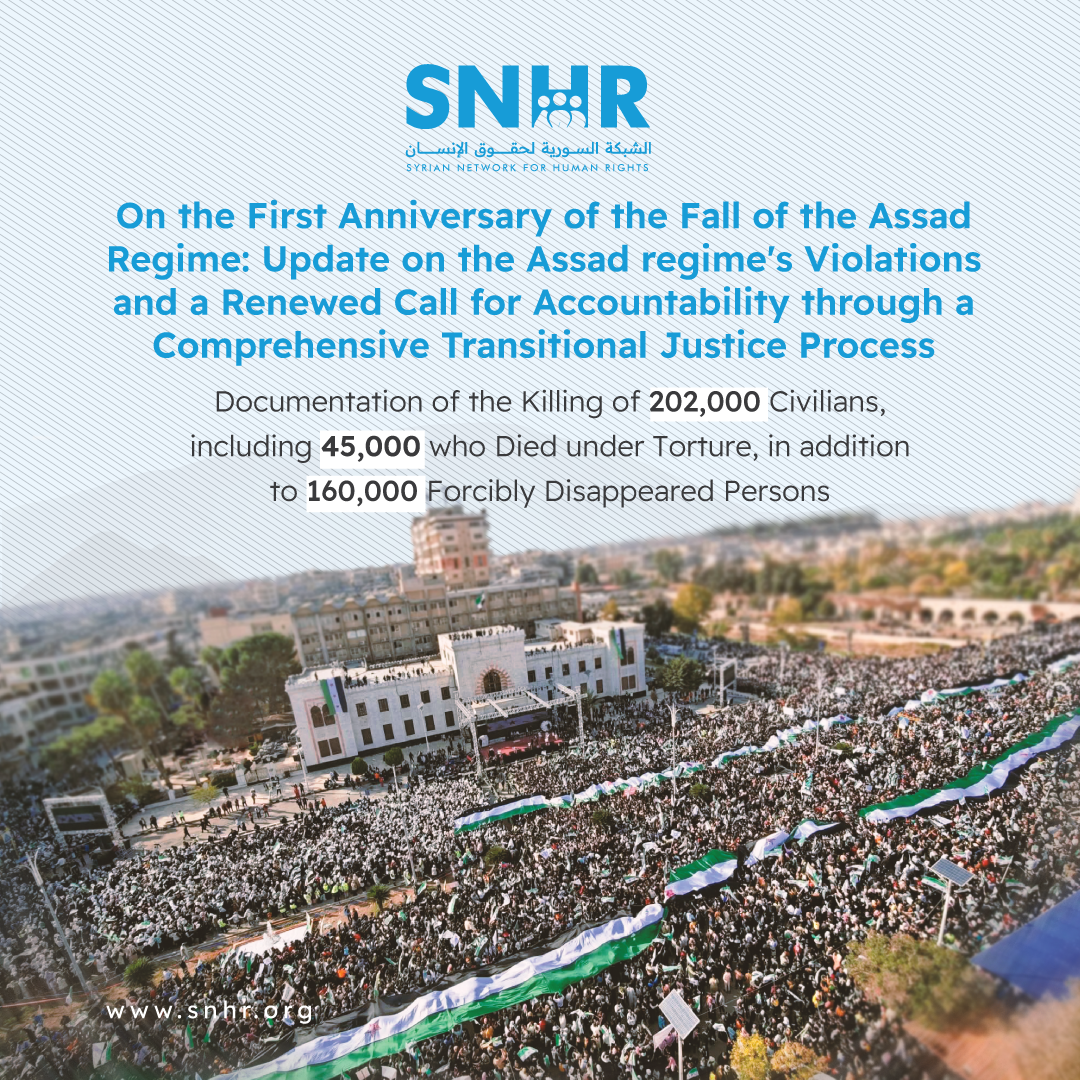
Available in:
Damascus – December 8, 2025:
Marking the first anniversary of the fall of the Assad regime, the Syrian Network for Human Rights (SNHR) has released a summary report providing a comprehensive update on the regime’s violations and renewing calls for accountability for those responsible for these crimes within a comprehensive transitional justice framework. The report emphasizes that commemorating this anniversary necessitates serious reflection on the progress of transitional justice in Syria and underscores the need for the current authorities and the international community to ensure effective accountability for the crimes committed, to reveal the fate of the forcibly disappeared, and to provide redress for victims and their families.
This occasion represents a dual moment of remembrance and accountability, a renewed reminder that any lasting stability in Syria requires uncovering the truth, ensuring that perpetrators do not escape punishment, and achieving justice for victims. The report presents an updated tally of violations committed by the Assad regime, including what could be documented during the past year, in light of access to new areas and victims, and the decline in fear following the regime’s collapse.
The Syrian Network for Human Rights documented a heavy toll of violations, including the killing of 202,021 civilians, among them 23,138 children and 12,036 women, in addition to the killing of 662 medical personnel and 559 media workers. 160,123 people remain forcibly disappeared, including 3,736 children and 8,014 women. 45,032 people were killed under torture, including 216 children and 95 women. The Network also recorded 566 attacks on medical facilities, 1,287 attacks on schools and kindergartens, and 1,042 attacks on places of worship. The report also documented the regime’s use of 81,954 barrel bombs, which killed 11,092 civilians; 217 chemical attacks that left 1,514 dead and 11,080 injured; 254 cluster munition attacks that killed 835 people; and 52 attacks using incendiary weapons. These systematic violations contributed to the internal displacement of 6.8 million people and the flight of approximately 7 million others to other countries.
The network of those implicated in the violations of Bashar al-Assad’s regime extended to include security and military agencies, a judiciary employed to serve repression, and civil institutions that facilitated enforced disappearances and the manipulation of records. It also included economic, cultural, and artistic figures who provided social and political cover for the regime. The Syrian Network for Human Rights documented nearly 16,200 individuals implicated, including 6,724 members of the official forces and 9,476 members of affiliated militias, who participated in arrests, torture, and bombings. Judges and exceptional courts played a pivotal role in legitimizing the violations, while civil servants contributed to concealing the fate of detainees and looting property. Meanwhile, businessmen, artists, and media figures helped to whitewash the regime’s image and normalize its crimes in the eyes of local and international public opinion.
The Syrian Network for Human Rights, based on continuous documentation since 2011 and more than 1,800 reports and millions of collected data points, affirms that the violations committed by Bashar al-Assad’s regime amount to crimes against humanity and war crimes. According to the 1951 Refugee Convention, perpetrators of these crimes, or those for whom there are “serious grounds to believe” they are involved, are not entitled to refugee status, as stipulated in Article 1(f), which excludes perpetrators of international crimes, serious crimes, and acts contrary to the principles of the United Nations. Despite their exclusion from refugee status, the principle of non-refoulement remains in effect, and states can grant them temporary protection while continuing to cooperate with judicial and human rights accountability efforts.
The report concludes with a set of recommendations aimed at supporting the accountability process and establishing transitional justice in Syria:
A. To the Russian Government
- Reconsider the decision to grant asylum to Bashar al-Assad: The Syrian Network for Human Rights calls on the Russian government to reconsider its decision to grant asylum to Bashar al-Assad, as this decision contradicts the obligations of states not to provide safe haven to individuals accused of war crimes and crimes against humanity, and is inconsistent with the duty to cooperate in combating impunity.
- Cooperate with international efforts to achieve justice: The Syrian Network urges the Russian authorities to fully cooperate with international and national judicial efforts aimed at achieving justice for Syrians, including considering the future surrender of Bashar al-Assad to the competent Syrian judicial authorities or to an international or hybrid court with jurisdiction, in accordance with the provisions of international law.
- Contribute to redressing the harm suffered by the Syrian people as a result of military intervention: The Syrian Network calls on Russia to acknowledge its responsibility for the human and material losses resulting from its direct military intervention alongside the Bashar al-Assad regime, and to contribute to reconstruction and reparations efforts as part of its moral and legal obligation towards the Syrian people.
B. To the United Nations and the International Community
- Exerting pressure to ensure that asylum is not used as a cover for impunity: Urging the United Nations and member states to use various diplomatic and political pressure tools to compel Russia to fulfill its legal and moral obligations and to refrain from using the concept of “humanitarian asylum” as a political cover to protect perpetrators of war crimes and crimes against humanity.
- Activating international accountability mechanisms: Calling for the activation and development of existing international mechanisms related to Syria, and supporting any international or hybrid judicial process that contributes to holding those responsible for serious violations accountable, including referral to the International Criminal Court or the establishment of a special mechanism when national justice mechanisms are not feasible.
C. To the current Syrian government:
- Commitment to the principles of transitional justice: Guarantee a fair and transparent trial for Bashar al-Assad and all those accused of committing serious violations of human rights and international humanitarian law, thereby achieving justice for victims and restoring confidence in the judicial system. And adopt a comprehensive transitional justice process that includes truth-seeking, accountability, reparations, institutional reform, and guarantees of non-recurrence.
- A comprehensive legislative strategy for justice and non-recurrence: Expedite accession to core international instruments, foremost among them the Rome Statute of the International Criminal Court, the International Convention for the Protection of All Persons from Enforced Disappearance, and relevant conventions against torture and for the protection of human rights. And criminalize core international crimes (crimes against humanity, war crimes, and genocide) in the Syrian Penal Code, as crimes that are not subject to any statute of limitations and cannot be covered by any general amnesty or political settlement. And repeal or amend laws and decrees that enshrined tyranny, confiscation of property, discrimination, and arbitrary arrest (emergency laws, terrorism courts, legislation regulating confiscations and absence, etc.).
- Deep Reform of the Judiciary and Abolition of Exceptional Courts: Establishing an independent body for professional evaluation and judicial integrity, tasked with reviewing the conduct of judges during the conflict and removing those found to have participated in or been complicit in serious violations, while guaranteeing the right to defense and due process. And rebuilding the judiciary on the foundations of independence and separation of powers, and providing effective legal safeguards to protect independent judges.
- Restructuring the Security and Military Sector (Security and Military Reform): Subjecting the work of security and military agencies to effective civilian, parliamentary, and judicial oversight. And adopting clear vetting criteria for the appointment and promotion of security and military personnel, ensuring the exclusion of those involved in torture, enforced disappearance, and extrajudicial killings from any position of authority. Also, adopting a binding code of conduct for security and military agencies, including an explicit commitment to respecting human rights and international humanitarian law, and linking accountability and promotions to adherence to these standards.
- Victim Reparation and Rehabilitation: Develop and implement comprehensive national programs to provide material and moral redress to victims and their families, including financial compensation, official recognition, and psychosocial rehabilitation. And establish specialized mechanisms and programs to support survivors of torture, enforced disappearance, sexual violence, and other serious human rights violations, giving special priority to the most vulnerable groups (women, children, and persons with disabilities).
- Reconstruction of Affected Areas Based on Rights: Adopting well-considered and transparent plans for the reconstruction of affected areas, prioritizing the needs of affected local populations and ensuring their safe, voluntary, and dignified return to their original areas. And linking reconstruction efforts to respect housing, land, and property rights, preventing the perpetuation of the consequences of unlawful confiscations or demographic change policies, and linking external funding to clear rights guarantees.
- A Clear Policy on Amnesty and Accountability: Rejecting any blanket amnesty for core international crimes and gross human rights violations. And limiting the possibility of amnesty to specific and narrow cases of politically motivated crimes that do not amount to international crimes, within a transitional justice process that guarantees the right to truth, recognition of victims, and guarantees of non-recurrence. As well as, emphasizing in constitutional and political discourse that combating impunity is a fundamental component of the new political contract in Syria, and not a tool for political bargaining.
- Preserving Archives and Evidence and Preventing Their Destruction: Enacting legislation that criminalizes the destruction or concealment of security and judicial archives and records related to serious violations, considering such actions as obstruction of justice. And establishing a specialized national unit for the preservation and archiving of evidence according to the highest standards, in coordination with international mechanisms (such as the International, Impartial and Independent Mechanism) and Syrian human rights organizations.
- Full Cooperation with International Mechanisms and Universal Jurisdiction: Declaring readiness to cooperate with international mechanisms for Syria (the Independent International Commission of Inquiry, the International, Impartial and Independent Mechanism, Special Rapporteurs, etc.), including facilitating access to witnesses, sites, and archives. And refraining from taking any actions aimed at obstructing investigations or prosecutions underway in foreign jurisdictions based on universal jurisdiction, and committing to exchanging information with these authorities when requested by law.
- Engaging Victims and Civil Society in Shaping the Justice Process: Ensuring the effective participation of victims of violations and their families, as well as independent Syrian civil society organizations, in shaping transitional justice policies, reparations laws, and institutional reform programs. And providing sustained political and financial support for psychosocial and legal support programs for victims, adopting a gender-sensitive and vulnerable-group approach.
D. To Media Institutions and the Academic Sector
-
- Preserving Memory and Preventing Denial of Crimes: Invest in producing documentary media materials (programs, films, digital platforms, and interactive digital archives) that preserve the memory of crimes and violations and counter narratives of denial, justification, or equating the perpetrator with the victim.
- Strengthening Scientific Research and Specialized Studies: Encourage universities and research centers to conduct in-depth studies on transitional justice in Syria, patterns of violence, and the reform of security and judicial institutions. This will inform decision-making with evidence-based policies and enrich the national and international public debate
